Introduction
Federal Way offers a robust network of pediatric services that includes primary‑care clinics such as Pediatrics Northwest–Mary Bridge Children’s, specialty centers like Seattle Children’s South Clinic, and dedicated cardiology programs at Seattle Children’s Heart Center and local pediatric cardiologists. Families can access well‑child exams, same‑day sick visits, developmental screening, asthma and allergy care, and advanced heart‑health diagnostics (echocardiograms, fetal echo, rhythm monitoring) without traveling far from home. Across these practices, building trust and compassion is emphasized as a cornerstone of effective care. CDC and AAP guidelines highlight that consistent, empathetic communication, culturally‑sensitive interactions, and clear follow‑up (e.g., MyChart portals, interpreter services) foster secure parent‑provider relationships, improve adherence to preventive recommendations, and reduce anxiety during visits. By prioritizing family‑centered, transparent care, Federal Way pediatric providers create a supportive environment where children thrive and families feel confident in the health decisions they make.
Specialized Cardiology and Urgent Care Services
Specialized Cardiology & Urgent Care Services
| Service | Provider | Hours (Urgent Care) | Contact | Notes |
|---|---|---|---|---|
| Fetal & Pediatric Echocardiograms | Seattle Children’s Heart Center (Satellite) | – | 253‑838‑5878 | Coordinated treatment for congenital defects |
| Electrocardiograms & Rhythm Monitoring | Seattle Children’s Heart Center | – | 253‑838‑5878 | Includes arrhythmia management |
| Urgent Care (Walk‑ins) | Seattle Children’s South Clinic | Mon‑Fri 4 p.m.–10:30 p.m.; Sat‑Sun 11 a.m.–8 p.m. | 253‑838‑5878 | Free parking, I‑5 access; appointments reduce wait |
| Comprehensive Outpatient Services (Ortho, Neuro, etc.) | MultiCare – Mary Bridge Children’s Outpatient Center | – | – | Close to home, collaborative care |
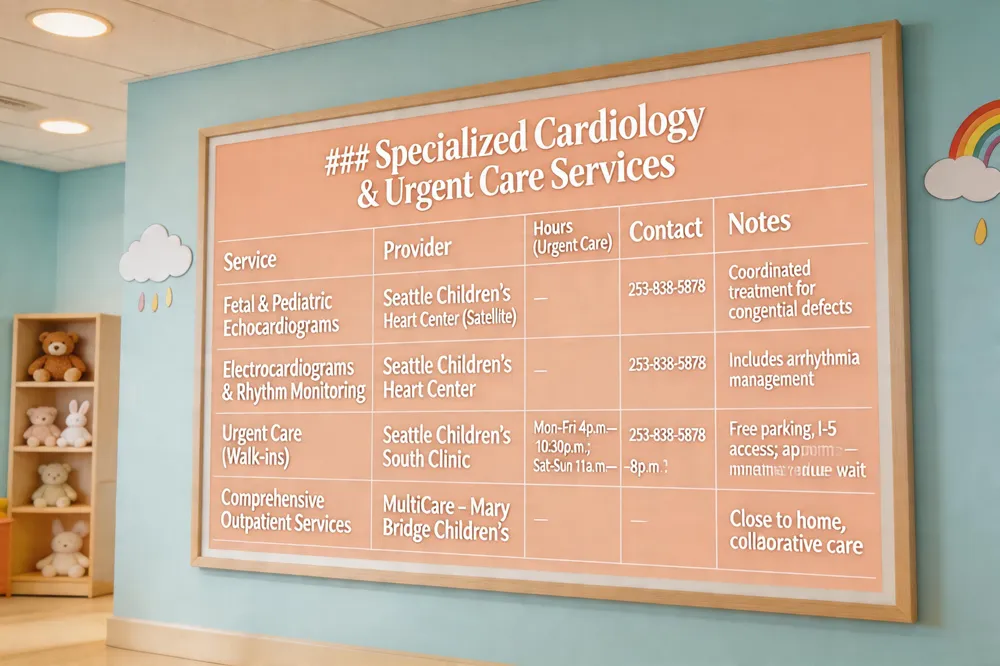 Federal Way families benefit from a full spectrum of pediatric heart care at Seattle Children’s South Clinic (34920 Enchanted Pkwy. S, WA 98003). The clinic offers fetal and pediatric echocardiograms, electrocardiograms, rhythm monitoring and coordinated treatment for congenital defects, arrhythmias and other cardiac conditions. All cardiologists belong to the Seattle Children’s Heart Center, ensuring access to surgical expertise when needed. Urgent care is available seven days a week at the same location: Monday‑Friday 4 p.m.–10:30 p.m., Saturday‑Sunday 11 a.m.–8 p.m., with free parking and easy I‑5 access. Walk‑ins are accepted, but appointments (call 253‑838‑5878) reduce wait times. The clinic is a satellite of Seattle Children’s Hospital, the region’s premier children’s hospital, and works alongside MultiCare’s Mary Bridge Children’s Outpatient Center (505 South 336th St) to provide comprehensive outpatient services, orthopedics, neurology, and more—all close to home.
Comprehensive Primary Care and Compassionate Practices
Comprehensive Primary Care & Compassionate Practices
| Service | Location | Walk‑in / Appointment | MyChart Integration | Notes |
|---|---|---|---|---|
| Well‑child Exams, Immunizations | Pediatrics Northwest – Mary Bridge Children’s (505 South 336th St, Suite 210) | Walk‑in OK | ✔ | Includes developmental screening |
| Same‑day Sick Visits | CCM Pediatrics (710 S 348th St, STE B) | Walk‑in OK | ✔ | 24/7 on‑call support |
| Chronic Disease Management (Asthma, Diabetes) | Both locations | Appointment preferred | ✔ | Individualized care plans |
| Specialty Referrals (Cardiology, Pulmonology, Sleep) | Both locations | Referral via MyChart | ✔ | Streamlined coordination |
| Compassionate Care Practices | All clinics | – | – | Empathy, cultural humility, clear communication |
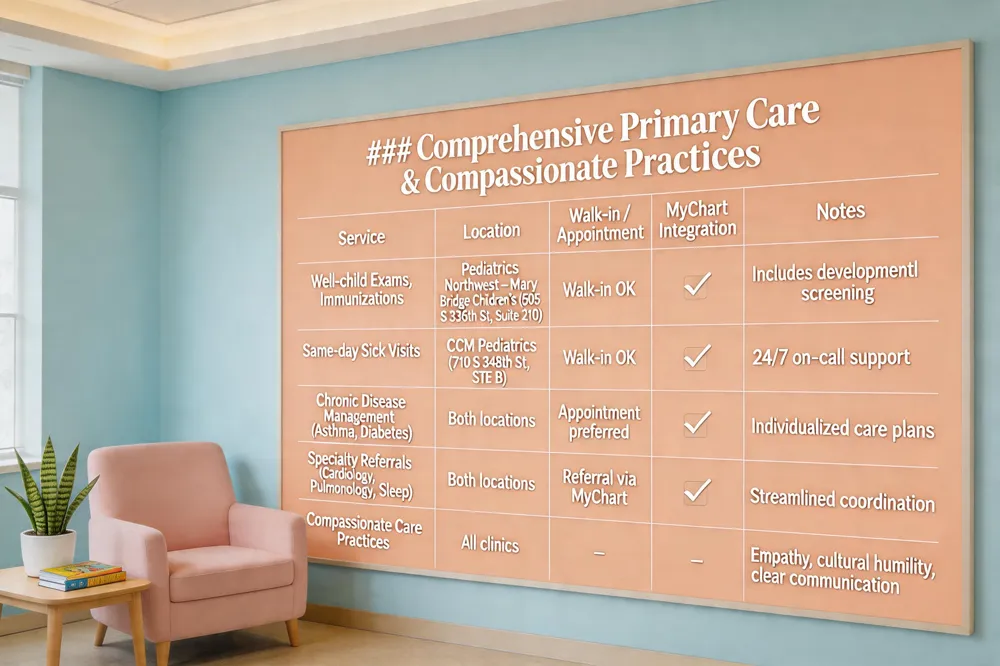 General pediatric services in Federal Way include [well‑child exams, same‑day sick visits], immunizations, chronic disease management (asthma, diabetes), developmental screening, and specialty care such as pediatric cardiology, pulmonology, and sleep medicine. Clinics like Pediatrics Northwest‑Mary Bridge Children’s (505 South 336th St, Suite 210) and CCM Pediatrics (710 S 348th St, STE B) offer walk‑in urgent care and 24/7 on‑call support, with MyChart facilitating appointments, test results, and prescription refills.
Compassionate care is the intentional recognition of a child’s suffering paired with sincere, respectful actions to relieve it. It blends empathy, cultural humility, and clear communication, allowing families to share concerns without judgment. Providers listen attentively, use age‑appropriate language, involve parents in decision‑making, and create a warm environment.
Benefits include reduced anxiety, better adherence to treatment plans, higher satisfaction, stronger trust, and shorter recovery times. Compassionate interactions also protect clinicians from burnout, enhancing overall care quality.
Pediatrics Federal Way delivers family‑centered, comprehensive care through multiple convenient locations, urgent‑care options, telehealth, and MyChart integration, fostering long‑term health for every child.
How we provide compassionate care: we start each visit by listening, use gentle tones, respect cultural preferences, explain options clearly, and involve caregivers in every decision.
What is compassionate care? It is empathy combined with concrete actions that address both emotional and physical needs, grounded in integrity, respect, and shared decision‑making.
Building Trust with Children and Families
Strategies to Build Trust with Children & Families
| Strategy | Description |
|---|---|
| Age‑appropriate language | Use words and explanations matched to the child’s developmental level |
| Maintain eye contact & warm touch | Signals safety and attentiveness |
| Honest procedural explanations | Builds predictability and reduces fear |
| Invite questions & offer choices | Empowers the child and respects autonomy |
| Follow through on promises | Demonstrates reliability |
| Respect privacy & involve parents | Shows respect for family dynamics |
| Strengths‑based approach | Focuses on abilities rather than deficits |
| Clear communication & safety | Core principles of compassionate care |
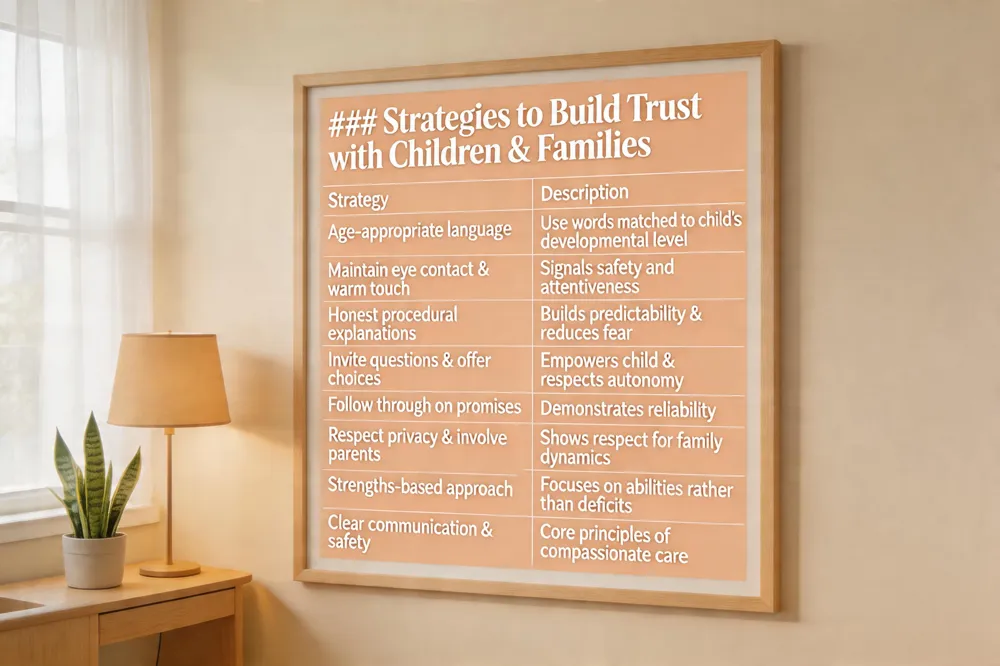 7 strategies to build trust with your child – Use age‑appropriate language, maintain eye contact, explain procedures honestly, invite questions, follow through on promises, respect privacy, involve parents as partners, thank families for sharing information, and employ a strengths‑based, non‑deficit approach to development discussions.
What strategies can you implement to gain the trust of a pediatric patient? – Speak in developmentally appropriate terms, pair calm gentle touch with warm hands, involve caregivers in the conversation, create a predictable environment with consistent routines and soothing cues, and demonstrate empathy through active listening, validation, and offering choices.
What are the five principles of compassionate care? – Safety, Dignity, Autonomy (independence), Privacy, and Clear communication.
How does compassion build trust? – Genuine concern, compassionate listening, age‑appropriate explanations, soothing tone, gentle touch, and consistent eye contact signal safety and respect, encouraging families to share vital information and fostering lasting therapeutic relationships.
Specialty Practices and Integrated Behavioral Health
Specialty Practices & Integrated Behavioral Health
| Specialty | Provider | Location | Access (MyChart / Telehealth) | Notes |
|---|---|---|---|---|
| Endocrinology, Gastroenterology, Pulmonology | Pediatrics Northwest – Mary Bridge Children’s | 505 South 336th St | ✔ (MyChart) | Multi‑specialty coordination |
| Developmental‑Behavioral Health | Integrated C&C Program | Same as above | ✔ (MyChart & Tele‑counseling) | In‑office & virtual options |
| Pediatric Cardiology (Dr. Nauman Ahmad) | Federal Way Pediatric Associates | 32124 1st Ave S, Suite #100 | ✔ (MyChart) | Fetal echo, referrals to Seattle Children’s Heart Center |
| Asthma/Allergy Care | Federal Way Pediatric Associates | Same as above | ✔ (MyChart) | Chronic disease management |
| Telehealth & 24/7 on‑call | Federal Way Pediatric Associates | Same as above | ✔ (Telehealth) | Convenient urgent care |
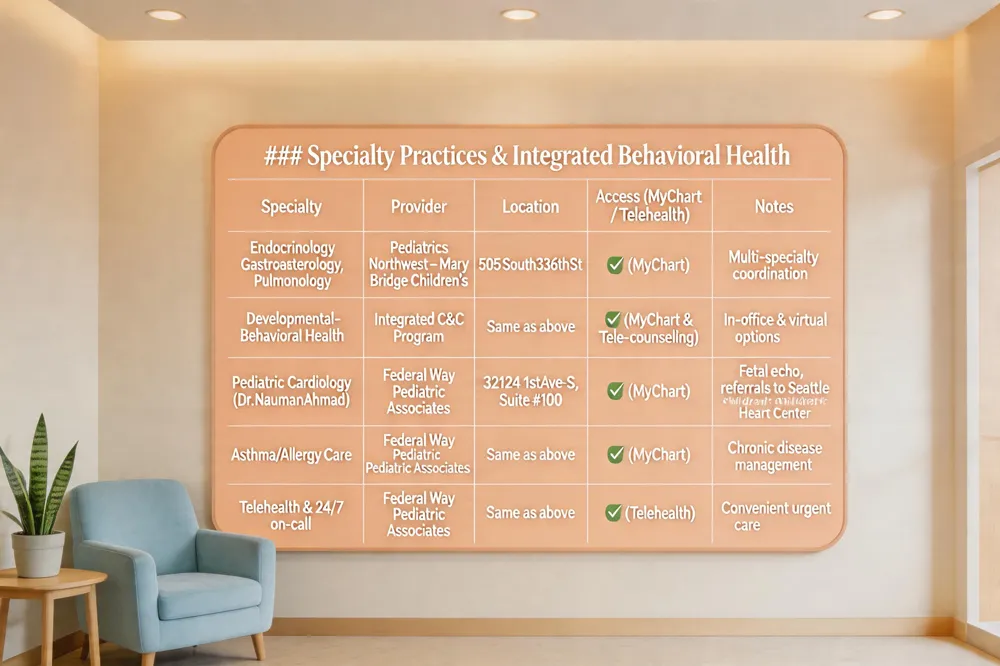 Federal Way’s pediatric community offers a full spectrum of specialty services that go beyond routine well‑child care. Pediatrics Northwest – Mary Bridge Children’s provides a multi‑specialty lineup that includes endocrinology, gastroenterology, developmental‑behavioral health, pulmonology, sleep medicine, and asthma/allergy care, all coordinated through a single MyChart portal for easy scheduling and communication. Federal Way Pediatric Associates, located at 32124 1st Ave S, Suite #100, delivers primary‑care, chronic‑disease management, walk‑in sick visits and 24/7 on‑call coverage, plus telehealth options. Its pediatric cardiology program, led by board‑certified Dr. Nauman Ahmad, offers comprehensive heart‑health evaluation, fetal echocardiograms and coordinated referrals to Seattle Children’s Heart Center. The practice’s Care & Counseling (C&C) program integrates behavioral‑health support with medical care, providing in‑office or tele‑counseling for developmental, emotional and psychosocial challenges and delivering seamless follow‑up cardiovascular clinic management specialists. Families can book appointments by phone, online, or via MyChart, ensuring convenient, family‑centered care close to home.
Pediatric Dental Care and Closing Thoughts
Pediatric Dental Care Overview
| Service | Description | Scheduling |
|---|---|---|
| Preventive Cleanings (twice‑year) | Remove plaque, oral health | Phone 1‑253‑262‑6589 or email office@federalwaypediatricdentistry.com |
| Fluoride Treatments & Sealants | Cavity prevention | Same as above |
| Early Orthodontic Evaluations | Assess bite and alignment early | Same as above |
| Behavior‑Management & Sedation | Gentle techniques for anxious children | Same as above |
| Child‑friendly Environment | Play areas, entertainment, gentle communication | Same as above |
| Closing Thought | Comprehensive, welcoming, and compassionate dental care empowers families for lifelong oral health. | – |
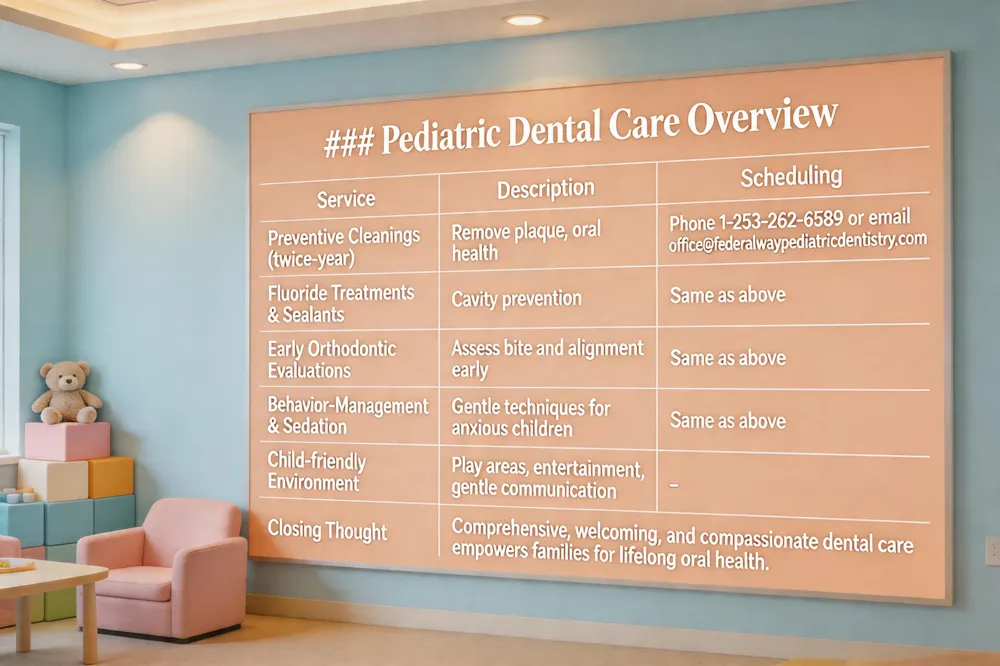 Federal Way pediatric dentistry offers a full spectrum of preventive and restorative services designed to keep children healthy and comfortable. The clinic provides twice‑year cleanings, fluoride treatments, sealants, early orthodontic evaluations, and specialty care such as behavior‑management techniques and sedation options for more complex procedures. A child‑friendly environment—complete with play areas, entertainment stations, and gentle communication—creates a family‑centered dental experience that eases anxiety and encourages lifelong oral‑health habits. Parents can easily schedule appointments by calling 1‑253‑262‑6589 or emailing office@federalwaypediatricdentistry.com. Key takeaways: comprehensive services, a welcoming atmosphere, and clear, compassionate education empower families to partner with clinicians for optimal dental health.
Conclusion
Key takeaways: Federal Way offers a robust network of pediatric and cardiology services—from primary‑care hubs like Pediatrics Northwest–Mary Bridge Children’s and Seattle Children’s South Clinic to specialty teams in Seattle Children’s Heart Center and independent cardiologists such as Dr. Nauman Ahmad. All sites emphasize compassionate, family‑centered care, easy MyChart access, interpreter services, and flexible scheduling (same‑day sick visits, telehealth, weekend hours). Building trust through clear communication, cultural humility, and consistent follow‑up is a core principle across these practices.
Future of compassionate pediatric care in Federal Way: Continued integration of technology (online portals, virtual visits), expansion of community‑based programs (developmental screening, car‑seat checks, health‑education workshops), and coordinated warm hand‑offs between primary and specialty providers will deepen family trust and improve outcomes. Ongoing emphasis on equity, multilingual support, and comprehensive cardiac services ensures that every child—regardless of background—receives the timely, empathetic care needed for a healthy future.