Opening Overview
Board certification is a voluntary credential granted by the American Board of Pediatrics (ABP) after a pediatrician completes a three‑year ACGME‑accredited pediatric cardiology fellowship and passes a rigorous subspecialty examination. It signals that the physician has met nationally recognized standards for knowledge, clinical skill, professionalism, and ongoing education. Specialized credentials matter because studies consistently show lower mortality, fewer complications, and reduced readmission rates for children cared for by board‑certified pediatric cardiologists. In Federal Way, Washington, pediatric cardiac programs follow national guidelines from the American College of Cardiology and the American Heart Association, offering comprehensive services from fetal echo and advanced imaging to catheter‑based interventions and heart‑failure management. Families can verify a physician’s board status through the ABP’s online tool, ensuring confidence that their child receives care from a clinician who is both highly trained and committed to continuous learning.
Board Certification vs Licensure and Its Significance
 Board certification is a voluntary, specialty‑specific credential that shows a physician (or nurse) has met rigorous training, passed a demanding exam and commits to ongoing education. A medical license by contrast, is state‑issued and is the legal prerequisite to practice. While over 93 % of U.S. physicians are board‑certified, many can still practice with a license alone; however, hospitals, insurers and families—especially in Federal Way—prefer board‑certified providers for complex care such as pediatric cardiology.
A board‑certified pediatrician has completed a pediatric residency and passed the American Board of Pediatrics exam, ensuring up‑to‑date, evidence‑based child health care. Board‑certified pediatric cardiologists add three years of ACGME‑accredited fellowship, mastering congenital and acquired heart disease; they can perform echocardiograms, cardiac MRI, and catheter‑based interventions.
Nurse board certification works similarly, validating advanced expertise in areas like critical care.
Choosing board‑certified specialists—whether physicians or nurses—offers families confidence in higher competence, lower complication rates, and better long‑term outcomes, making certification a key marker of quality pediatric cardiac care.
Training Pathway and Earnings for Pediatric Cardiologists
 How many years does it take to become a pediatric cardiologist?
It typically requires 14 years of post‑secondary education: 4 years undergraduate, 4 years medical school, a 3‑year pediatric residency, and a 3‑year pediatric cardiology fellowship.
How long does it take to become a board‑certified cardiologist?
For adult cardiology, the path is similar: 4 years undergrad, 4 years medical school, a 3‑year internal‑medicine residency, then a 3‑year cardiology fellowship, followed by the ABIM cardiology board exam.
What education is needed to become a pediatric cardiologist?
A bachelor’s degree, MD or DO, completion of the USMLE, a 3‑year pediatric residency, and a 3‑year ACGME‑accredited pediatric cardiology fellowship.
What are the certification requirements for pediatric cardiology in the USA?
After fellowship, the program director verifies competence and scholarly activity; the physician must then pass the ABP subspecialty exam and maintain certification through MOC.
What is the typical salary for a pediatric cardiologist?
Average total compensation ranges from $300,000 to $400,000, with a median around $335,000.
Pediatric cardiologist vs adult cardiologist salary comparison?
Adult cardiologists generally earn $350,000‑$450,000 median, higher than pediatric cardiologists due to procedural volume and reimbursement.
Is it hard to become a pediatric echocardiographer?
It requires completing an accredited sonography program, pediatric clinical experience, and professional certification, making it a focused but attainable specialty.
Scope of Practice and Subspecialty Expertise
 What are the subspecialties of pediatric cardiology?
Pediatric cardiology includes intensive cardiac care, neonatal cardiac care, interventional and diagnostic catheterization, electrophysiology for rhythm disorders, advanced imaging (echocardiography, cardiac MRI, CT), fetal cardiology, exercise physiology, preventive cardiology, heart‑failure and transplant, pulmonary hypertension, adult congenital heart disease, and genetic cardiology.
What are the subspecialties of pediatric cardiology?
Pediatric cardiology includes intensive cardiac care, neonatal cardiac care, interventional and diagnostic catheterization, electrophysiology for rhythm disorders, advanced imaging (echocardiography, cardiac MRI, CT), fetal cardiology, exercise physiology, preventive cardiology, heart‑failure and transplant, pulmonary hypertension, adult congenital heart disease, and genetic cardiology.
What are the pediatric subspecialties? Pediatric subspecialties span Adolescent Medicine; Allergy & Immunology; Child Abuse Pediatrics; Cardiology; Critical Care; Dermatology; Developmental & Behavioral Medicine; Emergency Medicine; Endocrinology; Gastroenterology; Hematology‑Oncology; Infectious Diseases; Neonatology; Nephrology; Neurology; Pulmonology; Rheumatology; Clinical Informatics; Hospital Medicine; Medical Toxicology; Sports Medicine; Transplant Hepatology; and dual‑certified fields such as Pediatric Critical Care and Pediatric Emergency Medicine.
Pediatric cardiologist vs cardiologist – what’s the difference? Pediatric cardiologists complete a pediatrics residency plus a pediatric cardiology fellowship, caring for infants‑adolescents with congenital and growth‑related heart disease. Adult cardiologists finish internal‑medicine residency and adult‑cardiology fellowship, treating acquired disease in mature hearts.
What type of cardiologist treats tachycardia? Electrophysiologists—specialists in cardiac rhythm—manage tachycardia using studies, Holter monitoring, and catheter ablation, including pediatric electrophysiology for children.
What is a Pediatric Cardiology Nurse? A registered nurse specialized in caring for children with heart disease, supporting diagnostics, procedures, family education, and post‑operative management in cardiac ICU and outpatient settings.
What skills do you need to be a pediatric cardiologist? Excellent communication, emotional resilience, teamwork, technical proficiency with imaging and catheterization, diagnostic acumen, and strong organizational and decision‑making abilities.
What does a pediatric cardiologist do? They diagnose, treat, and longitudinally manage pediatric heart conditions using echocardiograms, MRI, catheterization, and interventional procedures, while coordinating multidisciplinary care and educating families.
Clinical Impact of Board‑Certified Pediatric Cardiologists
 Board‑certified pediatric cardiologists provide care that is demonstrably superior, as multiple studies show lower patient mortality and a 15% reduction in 30‑day readmission rates compared with non‑certified peers. Their expertise is maintained through the American Board of Pediatrics’ Maintenance of Certification (MOC) program, which requires ongoing CME, self‑assessment, and periodic exams. Entrustable Professional Activities (EPAs) embedded in ACGME‑accredited fellowships ensure fellows achieve competence in critical tasks such as imaging, catheter‑based interventions, and multidisciplinary communication. The American Heart Association’s guidelines for specialized pediatric cardiac care—adopted by Federal Way programs—emphasize early detection, coordinated surgical pathways, and family‑centered education, all of which are consistently delivered by board‑certified specialists. Federal Way’s cardiac practices align with these national standards and benefit from proximity to top‑ranked institutions like Texas Children’s Heart Center®—the nation’s number one pediatric cardiology hospital—providing families with access to cutting‑edge, evidence‑based treatment close to home.
Choosing the Right Specialist: Resources for Families
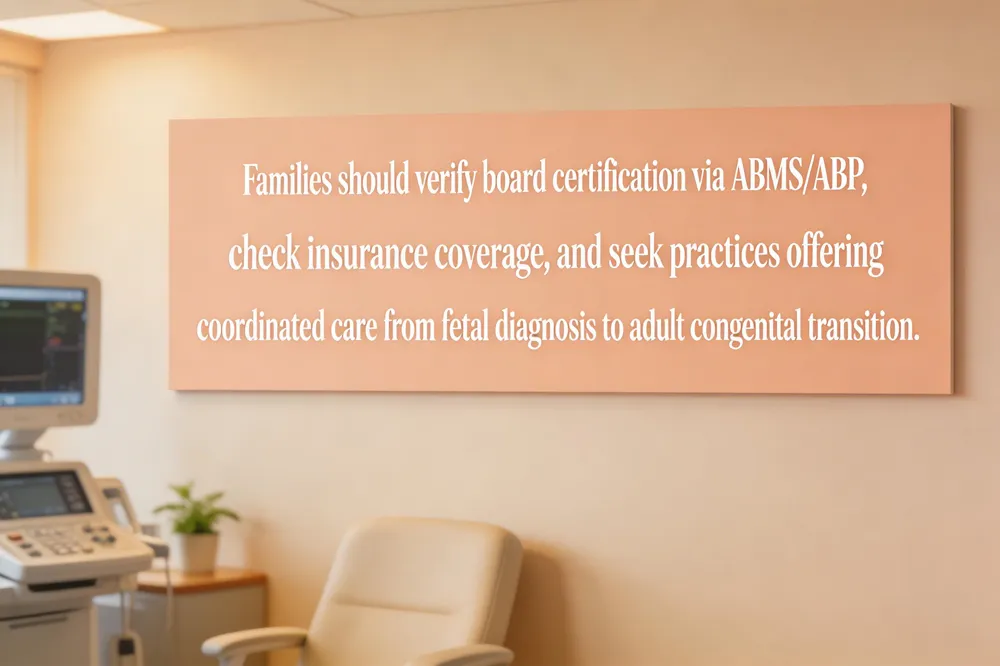 Start by confirming a cardiologist’s board certification. The American Board of Medical Specialties (ABMS) registry or the ABP’s “Find a Doctor” tool lets you search by name, location, and specialty to ensure the physician has met national standards. In Federal Way, many pediatric cardiac programs list their board‑certified specialists on their websites and offer telehealth visits for convenient follow‑up. Verify that your insurance plan includes pediatric cardiology services; most carriers require board certification for reimbursement. Finally, look for practices that provide a seamless continuum of care—from prenatal fetal echocardiograms through adolescent management and transition to adult congenital heart disease clinics—so your child receives coordinated, lifelong support.
Final Thoughts
Board certification confirms that a pediatric cardiologist has completed rigorous ACGME‑accredited fellowship, passed the ABP subspecialty exam, and engages in ongoing Maintenance of Certification, guaranteeing up‑to‑date expertise in congenital and acquired heart disease. Families who choose a board‑certified specialist benefit from lower complication rates, reduced readmissions, and evidence‑based treatment plans tailored to each child’s developmental stage. We invite you to verify a physician’s credentials through the ABMS or ABP registries, schedule an initial consultation, and join our multidisciplinary team dedicated to compassionate, family‑centered cardiac care. Our commitment is to deliver the highest quality outcomes for every young heart we serve.