Introduction: Setting the Stage for Informed Choices
Board certification is the gold‑standard credential that tells families a pediatrician has gone beyond state licensure, completed an accredited three‑year residency, and passed the rigorous American Board of Pediatrics (ABP) examinations. This process guarantees up‑to‑date knowledge of preventive care, immunizations, developmental screening, and management of complex conditions such as asthma, diabetes, and pediatric heart disease. The training pathway begins with a four‑year undergraduate degree, four years of medical school, and a three‑year pediatric residency; subspecialists such as pediatric cardiologists add an additional 3‑4‑year fellowship and separate ABP subspecialty certification. In Federal Way, Washington, families benefit from practices that employ board‑certified physicians and offer services ranging from routine well‑child visits and nutrition counseling to on‑site cardiac imaging, telehealth sick‑visit appointments, and 24‑hour urgent‑care lines. Choosing a board‑certified pediatrician ensures expertise, continuity of care, and seamless referrals to pediatric cardiology specialists when heart‑related concerns arise, giving parents confidence that their child’s health is managed by a clinician committed to lifelong learning and evidence‑based practice. Most Federal Way clinics provide online scheduling, walk‑in slots for same‑day sick visits, and after‑hours nurse lines.
Board‑Certified Pediatrician vs. General Pediatrician
Comparison of a General Pediatrician vs. a Board‑Certified Pediatrician
| Aspect | General Pediatrician | Board‑Certified Pediatrician |
|---|---|---|
| Training | MD/DO + 3‑year pediatric residency; unrestricted state license | MD/DO + 3‑year pediatric residency + passed ABP written & oral exams |
| Certification | Licensure only (voluntary) | American Board of Pediatrics (ABP) certification (voluntary) |
| Maintenance | No formal recertification; CME optional | ABP Maintenance of Certification (MOC) program: continuous learning, self‑assessment, practice‑based improvement, periodic re‑examination |
| Quality Assurance | Meets minimum state standards | Demonstrates ongoing competence, adherence to national standards, quality‑improvement initiatives |
| Impact on Care | Competent care; variability in up‑to‑date practices | Higher clinical safety, consistency, evidence‑based care, reduced diagnostic errors |
| Patient Assurance | Licensed, but certification status unknown | Explicit proof of expertise and commitment to lifelong learning |
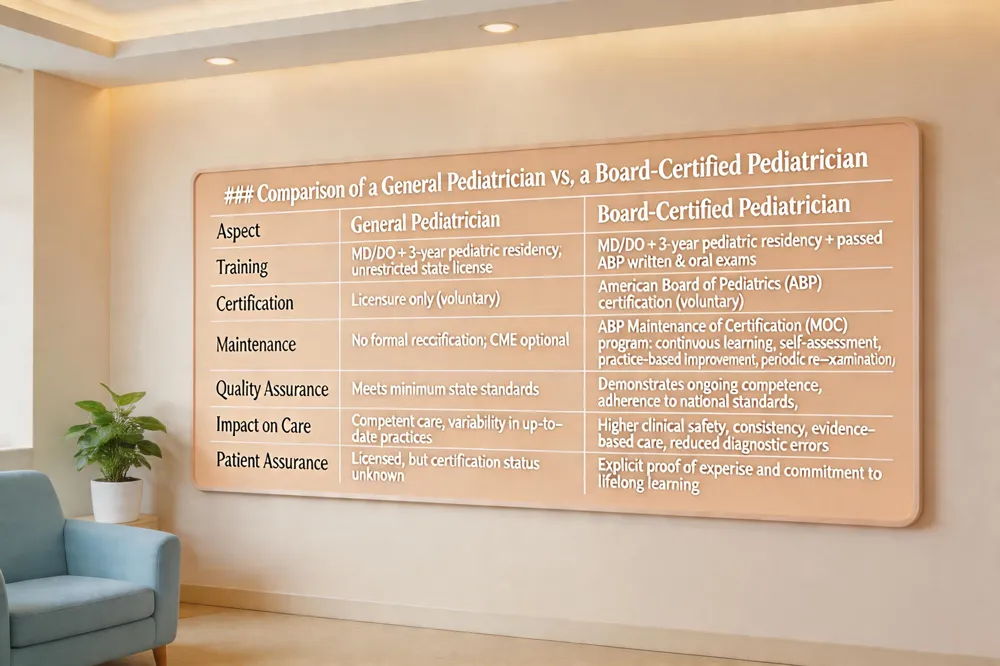 A pediatrician is a medical doctor who has completed a four‑year undergraduate degree, four years of medical school, a three‑year A pediatric youth residency, and holds an unrestricted state medical license to treat children from birth through adolescence. This training equips the physician to provide routine well‑child visits, immunizations, developmental screenings, and management of common illnesses.
A board‑certified pediatrician goes one step further. After residency, the physician passes the comprehensive written and oral examinations administered by the American Board of Pediatrics (ABP). Board certification is a voluntary process that exceeds the minimum licensing requirements. Certified pediatricians must maintain their status through the ABP’s Maintenance of Certification (MOC) program, which includes continual learning, self‑assessment, practice‑based improvement, and periodic re‑examination. This ongoing education ensures they stay current with the latest evidence‑based guidelines, emerging technologies, and specialty advances such as pediatric cardiology.
Impact on quality of care – Because board‑certified pediatricians regularly demonstrate competence and adhere to national standards, families can expect a higher level of clinical safety, consistency, and up‑to‑date practice. They are also required to follow ethical standards and quality‑improvement initiatives, which reduces diagnostic errors and improves preventive care outcomes. While any licensed pediatrician can deliver competent care, board certification provides an extra assurance of expertise and a commitment to lifelong learning.
Answer to the question “Board certified pediatrician vs pediatrician” – A pediatrician is a licensed child‑health physician; a board‑certified pediatrician has additionally passed the ABP exam and maintains certification through ongoing education and the MOC program. Certification is voluntary, so not all pediatricians are board‑certified. Choosing a board‑certified pediatrician signals that the doctor meets nationally recognized standards, stays current with advances in child health, and follows quality‑improvement practices, offering parents greater confidence in the care their child receives.
Education, Degrees, and Training Pathway
Typical Education & Training Pathway for a Pediatrician
| Phase | Duration | Key Milestones |
|---|---|---|
| Undergraduate | 4 years | Bachelor’s degree, pre‑medical coursework, MCAT preparation |
| Medical School | 4 years | MD or DO degree, clinical rotations (including pediatrics), USMLE/COMLEX exams |
| Residency | 3 years | ACGME‑accredited pediatric residency, board‑eligible status |
| Optional Fellowship | 3‑4 years | Subspecialty training (e.g., pediatric cardiology) |
| Board Certification | After residency | Pass ABP General Pediatrics Initial Certifying Examination |
| Maintenance | Ongoing | ABP MOC/MOCA‑Peds participation, CME, practice‑based improvement |
| State Licensure | Before practice | Obtain unrestricted medical license in Washington (or other state) |
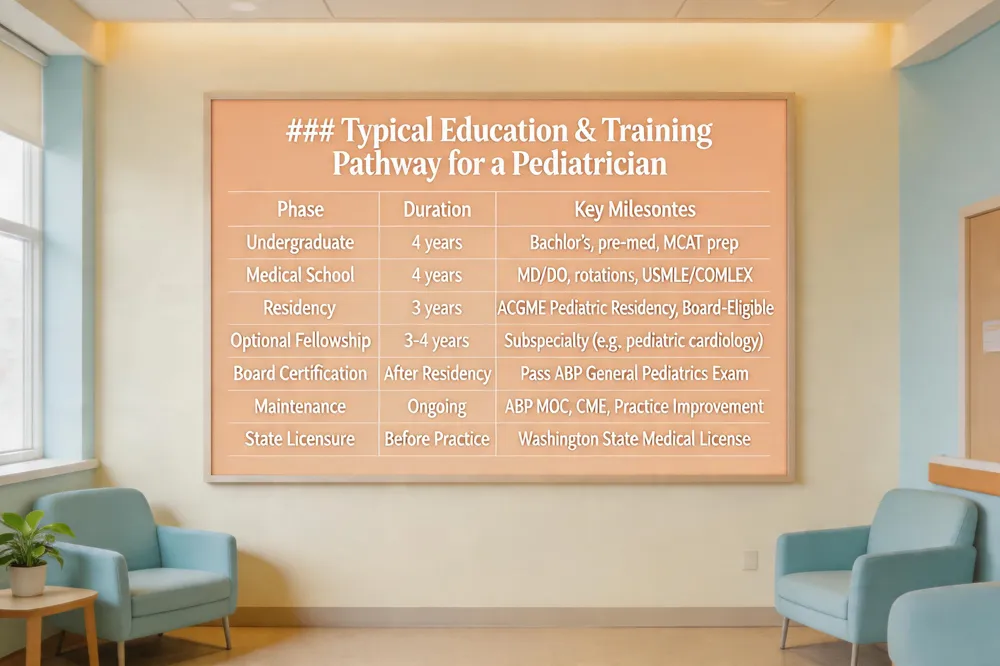 The highest academic credential for a pediatrician is a professional medical degree—Doctor of Medicine (MD) or Doctor of Osteopathic Medicine (DO)—earned after four years of accredited medical school. After the MD or DO, physicians must complete a three‑year pediatric residency to become board‑eligible, and many go on to fellowship training for subspecialties such as pediatric cardiology.
How to become a pediatrician: Begin with a bachelor’s degree that satisfies pre‑medical coursework and a strong MCAT score. Enroll in an accredited MD or DO program, finish the four‑year curriculum with clinical rotations in pediatrics, and pass the USMLE or COMLEX exams. Match into a three‑year pediatric residency, obtain a state medical license, and then achieve board certification through the American Board of Pediatrics (ABP) by passing its specialty examination and fulfilling ongoing continuing‑education requirements.
From high school to pediatric practice: Focus on advanced science and math courses, maintain a high GPA, and seek volunteer or shadowing experiences in children’s hospitals in Federal Way. Pursue a four‑year undergraduate degree with the required pre‑medical courses, prepare for the MCAT, and apply to medical school. After earning the MD or DO, complete the pediatric residency and optional fellowship in pediatric cardiology before obtaining ABP board certification.
Credentials required: A bachelor’s degree, MD or DO degree, successful completion of the USMLE/COMLEX licensing exams, a three‑year pediatric residency, a full state medical license, and—though optional for practice—American Board of Pediatrics board certification. Optional fellowship training provides additional expertise, especially for subspecialties like pediatric cardiology.
Certification Requirements and Maintenance
Board Certification & Maintenance of Certification (MOC) Steps
| Step | Requirement | Details |
|---|---|---|
| 1 | Medical School Graduation | LCME‑accredited (MD) or AOA‑accredited (DO) |
| 2 | State Medical License | Unrestricted license to practice medicine |
| 3 | Pediatric Residency | 3‑year ACGME‑accredited program |
| 4 | ABP Initial Certifying Exam | Written + oral exams → ABP‑BC credential |
| 5 | MOC Part 1 – Professional Standing | Maintain active medical license |
| 6 | MOC Part 2 – Lifelong Learning | CME activities, self‑assessment modules |
| 7 | MOC Part 3 – Assessment (MOCA‑Peds) | Online assessment satisfying Part 3 of the MOC cycle |
| 8 | MOC Part 4 – Practice‑Based Improvement | Quality‑improvement projects, data review |
| 9 | Recertification | Every 10‑years (or per ABP schedule) with continued MOC participation |
| 10 | Verification | ABP Physician Lookup tool (free) to confirm active certification and subspecialty status |
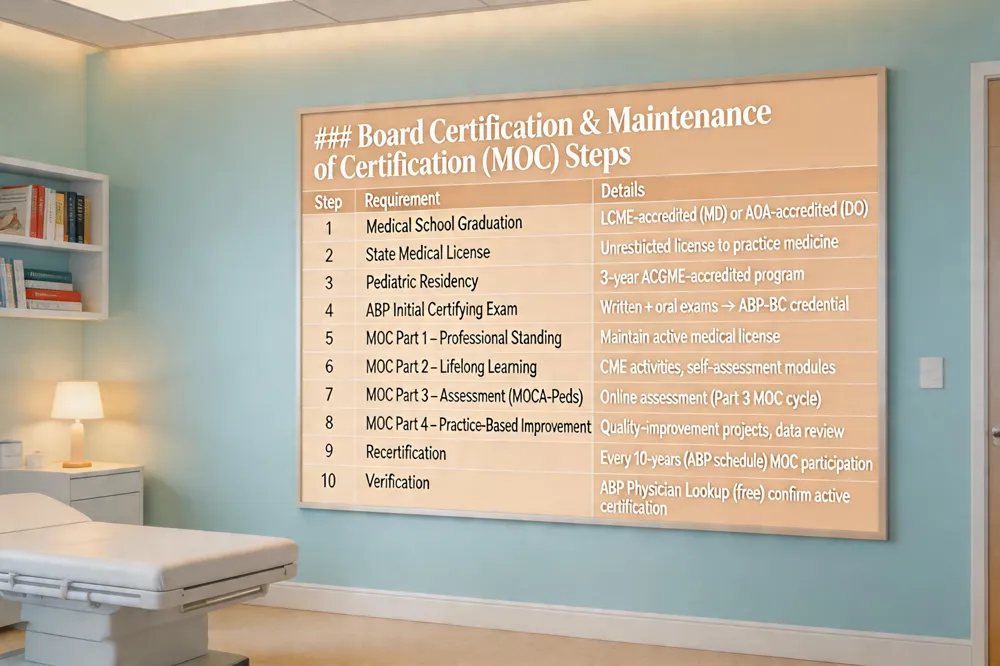 Choosing a pediatrician who is board‑certified gives families confidence that the doctor has met rigorous national standards. Step‑by‑step board certification begins with graduation from an LCME‑accredited medical school (or AOA‑accredited for DOs), obtaining an unrestricted state medical license, and completing a three‑year ACGME‑accredited pediatric residency. After residency, the physician must pass the American Board of Pediatrics (ABP) General Pediatrics Initial Certifying Examination to earn the ABP‑BC credential.
Maintenance of Certification (MOC) and MOCA‑Peds requires pediatricians to engage in lifelong learning, complete self‑assessment modules, and demonstrate practice improvement. The ABP’s MOCA‑Peds online assessment satisfies Part 3 of the MOC cycle, allowing physicians to earn credit toward recertification while staying current with evolving guidelines.
Subspecialty certification for pediatric cardiology adds a 3‑4‑year fellowship after residency, followed by a separate ABP subspecialty exam. Board‑certified pediatric cardiologists are thus equipped to diagnose and treat congenital and acquired heart disease in children.
Verification tools for parents: The ABP website offers a free Physician Lookup tool where you enter a doctor’s name to see certification status, date, and any subspecialty credentials. The database updates daily, providing transparent confirmation of “Certified and Actively Maintaining Certification.”
While board certification is voluntary most hospitals, insurers, and parents view it as a hallmark of expertise, ongoing education, and commitment to the highest quality of pediatric care.
Practical Guidance for Federal Way Parents
Practical Steps for Federal Way Parents to Choose a Pediatrician
| Action | How‑to | Resources |
|---|---|---|
| Verify Board Certification | Use ABP Physician Lookup (search by name) | https://www.abp.org/physician-lookup |
| Check AAP Fellowship (FAAP) | HealthyChildren.org “Find a Pediatrician” filter for FAAP | https://www.healthychildren.org/ |
| Start Search Early | Begin in 3rd trimester; schedule meet‑and‑greet before delivery | N/A |
| Schedule First Visit | Newborn well‑child visit 48‑72 hrs after birth | N/A |
| Insurance & Medicaid | Washington Medicaid directory or AAP filter for “Medicaid” | https://www.medicaid.gov/wa |
| Local Clinics | • Federal Way Pediatric Associates (710 S 348th St Ste B) | |
| • Mary Bridge Children’s Outpatient Center (505 South 336th St) | ||
| • Seattle Children’s Urgent Care (34920 Enchanted Pkwy S) | Phone: 206‑395‑6049 (FPA) ; 206‑987‑2211 (Urgent Care) | |
| Financial Assistance | Ask clinic about income‑based programs; Washington Healthplanfinder | https://www.healthplanfinder.org/ |
| Appointment Booking | MyChart portals or Zocdoc for online scheduling | MyChart, Zocdoc |
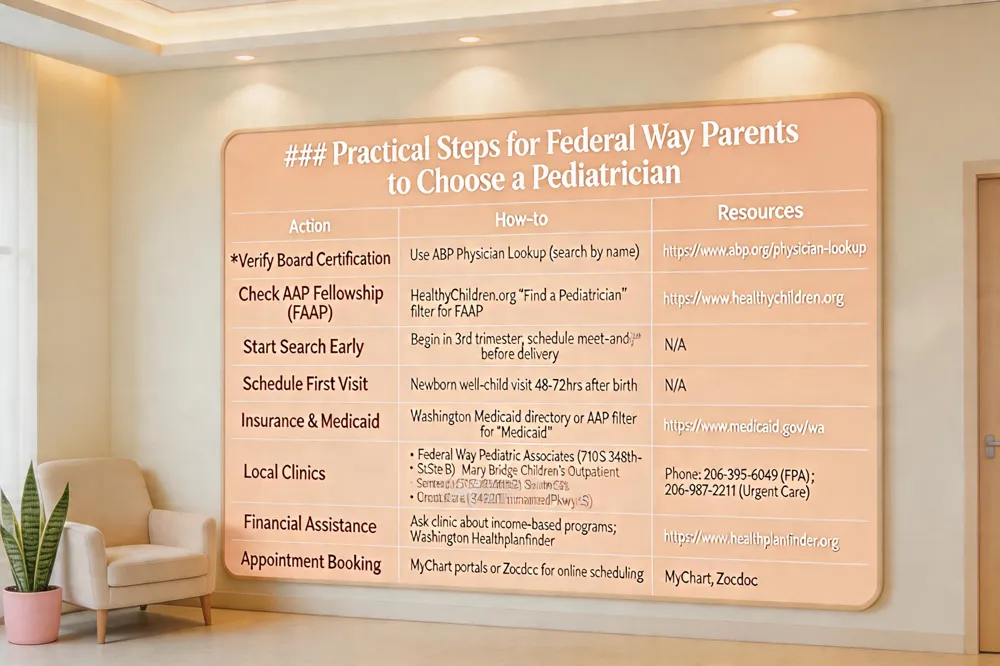 Parents in Federal Way have several reliable ways to confirm that a pediatrician is board‑certified and an AAP fellow (FAAP). The American Board of Pediatrics (ABP) verification tool lets you enter a physician’s name to see current certification status, while the AAP’s "Find a Pediatrician" search on HealthyChildren.org displays board‑certified doctors and flags the FAAP designation.
When to start the search – Begin looking during the third trimester. A brief "meet‑and‑greet" before delivery lets you verify insurance, office hours, and comfort with the provider. Schedule the newborn’s first well‑child visit for the first week after birth (48‑72 hours).
Insurance, Medicaid, and financial help – Use Washington’s Medicaid directory or the AAP tool filtered for “Medicaid” to locate in‑network pediatricians. Zocdoc and the Washington Healthplanfinder portal also list Medicaid‑accepting practices. Many Federal Way clinics offer financial‑assistance programs based on family income, ensuring care is affordable.
Local resources –
- Federal Way Pediatric Associates: 710 S 348th St Ste B, Federal Way, WA. Board‑certified physicians provide 24/7 on‑call services, comprehensive well‑child care, and a dedicated pediatric cardiology team. Appointments can be booked by phone (206‑395‑6049) or via MyChart.
- Mary Bridge Children’s Outpatient Center: 505 South 336th St, Suite 200 & 330, Federal Way, WA. Offers board‑certified pediatric and cardiology specialists, walk‑in lab, virtual urgent‑care, and a MyChart portal for scheduling.
- Seattle Children’s Urgent Care (Federal Way): 34920 Enchanted Pkwy S, Federal Way, WA 98003. Open evenings and weekends, staffed by board‑certified pediatricians for minor illnesses and injuries. Call 206‑987‑2211 or book online for faster service.
By confirming board status, planning before birth, checking Medicaid participation, and leveraging these local practices, families can secure high‑quality, child‑focused care in Federal Way.
Beyond Certification: Why Board‑Certified Care Improves Outcomes
Why Board‑Certified Pediatric Care Improves Outcomes
| Benefit | Evidence / Reason | Impact on Patient |
|---|---|---|
| Lower Complication Rates | Studies show certified physicians have fewer adverse events | Safer care for children |
| Higher Immunization Compliance | Certified pediatricians follow up‑to‑date vaccine schedules | Better disease prevention |
| Reduced Emergency Visits | Proactive preventive care & chronic disease management | Fewer costly ER trips |
| Continuity of Care (Medical‑Home Model) | Ongoing relationship from newborn to adolescence | Consistent growth tracking, reduced duplicate tests |
| Improved Communication | Board‑certified docs are trained in patient education | Parents understand diagnoses, treatment plans |
| Subspecialty Expertise (e.g., Cardiology) | Additional 3‑4 yr fellowship + subspecialty board exam | Accurate diagnosis & timely treatment for heart conditions |
| Five Core Pediatrician Responsibilities | 1. Well‑child exams 2. Acute/chronic illness care 3. Immunizations 4. Family education 5. Coordinated referrals | Comprehensive child health management |
| Key Skills | Assessment, developmental screening, communication, critical thinking, empathy | Holistic, patient‑centered care |
| When to Seek Care for Baby’s Chest Congestion | Breathing difficulty, chest retractions, fever (< 3 mo), poor feeding, lethargy, bluish lips | Prompt medical evaluation to prevent escalation |
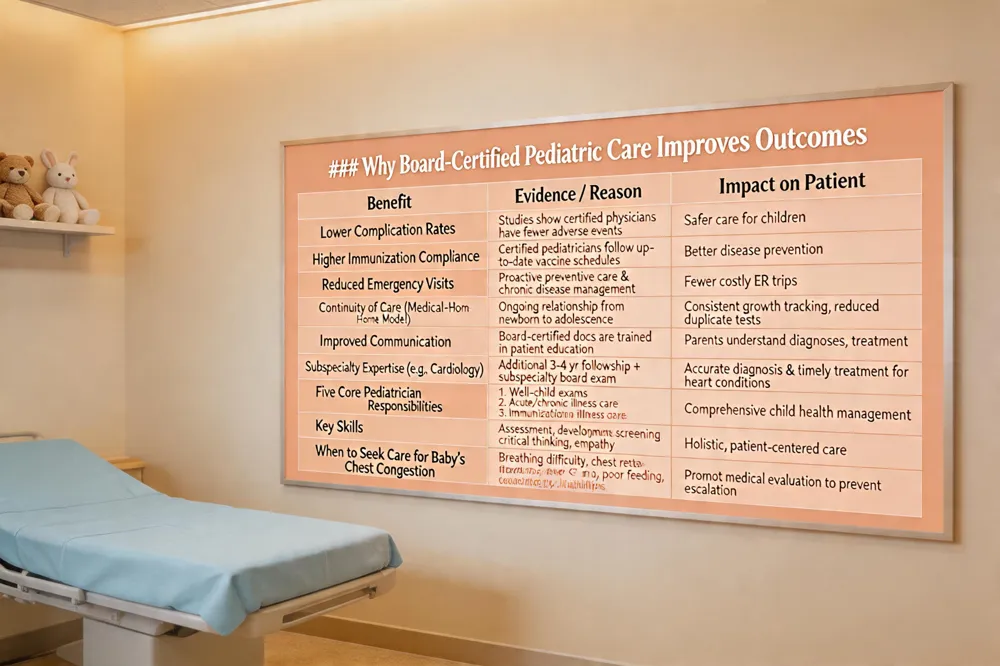 Choosing a board‑certified pediatrician improves child health. Studies show they have lower complication rates, higher immunization compliance, and fewer preventable emergency visits than non‑certified peers, due to residency training, a comprehensive exam, and mandatory Maintenance of Certification (MOC) that keeps them current with guidelines.
Board‑certified pediatric cardiologists complete an additional 3‑4‑year fellowship, offering expertise in congenital and acquired heart disease, accurate diagnosis, timely echocardiograms, and coordinating care with cardiac surgeons for children with heart conditions in Federal Way.
A medical‑home model anchored by a board‑certified pediatrician provides continuity from newborn visits through adolescence, tracking growth, development, and chronic disease in record, reducing duplicate tests.
Communication builds trust; board‑certified doctors explain diagnoses plainly, listen actively, and involve parents in decisions.
Are board certified doctors better? Yes—research shows better outcomes, lower costs, and up‑to‑date practice.
What are five responsibilities of a pediatrician? Well‑child exams, acute/chronic illness care, immunizations, family education, and coordinated referrals.
Pediatrician skills include assessment, developmental screening, communication, critical thinking, and empathy.
When to take baby to doctor for chest congestion? Seek care for breathing, chest retractions, fever in infants under three months, poor feeding, lethargy, or bluish lips; otherwise use home care and monitor.
Pediatrics Northwest Federal Way provides board‑certified providers, sick visits, developmental screenings, and MyChart scheduling at 505 South 336th St Suite 210.
Conclusion: Making an Informed Decision for Your Child’s Future
Board certification signals that a pediatrician has completed a rigorous residency, passed the American Board of Pediatrics exam, and commits to lifelong learning through the ABP’s Maintenance of Certification. This credential guarantees up‑to‑date knowledge of preventive care, immunizations, developmental screening, and complex conditions such as asthma, diabetes, and pediatric heart disease, which translates into safer, higher‑quality care for your child.
For families in Federal Way, start by identifying practices that list board‑certified physicians—such as the Center for Pediatric Medicine, Mary Bridge Children’s Outpatient Center, or Seattle Children’s South Clinic. Use the ABP online verification tool or the AAP “Find a Pediatrician” directory to confirm status, check for FAAP fellowship, and review any subspecialty certification in pediatric cardiology. Schedule a pre‑visit tour or virtual meet‑and‑greet to assess office hours, same‑day sick‑visit availability, telehealth options, and insurance compatibility.
Take the next step: verify the pediatrician’s board status, ask about their Maintenance of Certification activities, and enroll in the practice’s medical‑home model. Engaging a board‑certified pediatrician today builds a trusted partnership that supports your child’s health now and into the future.