Why Family‑Centered Care Matters
Family‑centered care (FCC) is a collaborative model that treats the child as part of a family unit and actively involves parents and caregivers in every step of the health‑care process. Research shows that FCC improves treatment adherence, reduces anxiety, and leads to better clinical outcomes, including lower readmission rates and higher satisfaction scores. In pediatric cardiology, shared decision‑making with families helps explain complex cardiac diagnoses, aligns treatment options with family values, and supports long‑term management of congenital heart disease. Federal Way’s multidisciplinary cardiology teams use FCC principles—clear, age‑appropriate communication, cultural competence, and regular feedback loops—to empower parents, foster trust, and ultimately improve the health and well‑being of every child.
Foundations of Family‑Centered Care Theory
Five Principles of Family‑Centered Care
| Principle | Core Idea |
|---|---|
| Dignity & Respect | Honor family values, choices, and cultural beliefs |
| Information Sharing | Provide complete, unbiased, and understandable information |
| Participation | Encourage family involvement at the desired level |
| Collaboration | Partner in planning, policy, and evaluation across providers |
| Access | Ensure equitable, flexible, and readily available care |
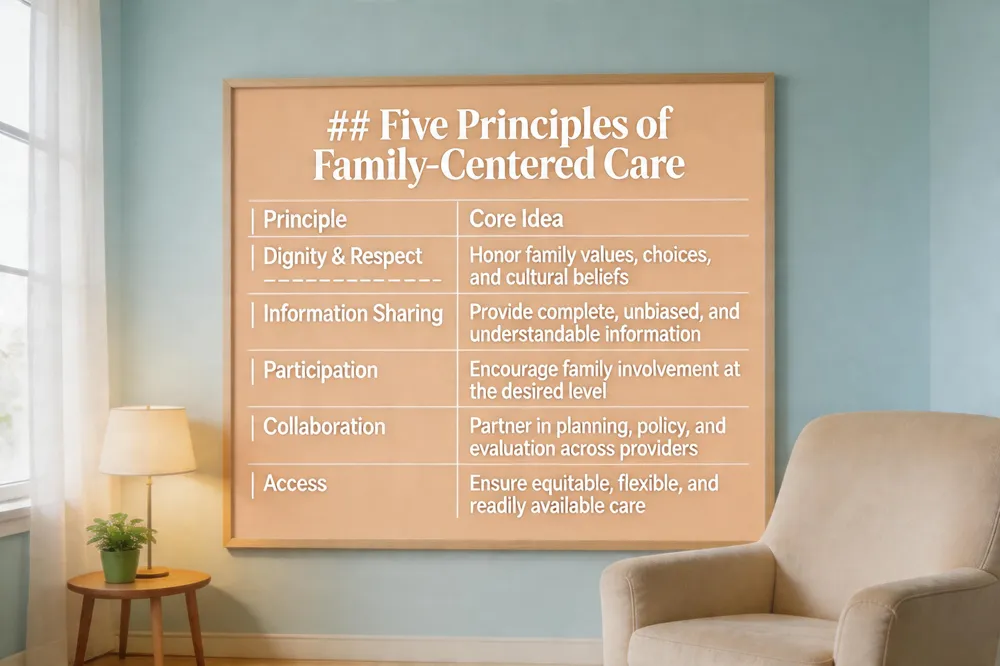 Family‑centered care theory posits optimal health outcomes are achieved when families are recognized as essential partners. It emphasizes respect for family expertise, shared decision‑making, and tailoring care to cultural, emotional, and practical needs. Core concepts include dignity and respect, transparent information sharing, active participation, and collaboration across providers, families, and health‑care systems. Empowered families improve satisfaction, safety, and quality of care, leading to better clinical results and more efficient resource use.
What is family‑centered care in pediatrics? It is a partnership model where health‑care providers collaborate with the child’s family to make decisions about diagnosis, treatment, and ongoing care. The family is treated as an essential team member, honoring their knowledge, cultural values, and preferences while sharing information openly. Principles of dignity, respect, information sharing, participation, and collaboration guide the process, improving outcomes and supporting the child’s developmental needs.
Five principles of family‑centered care: (1) Dignity and respect – honor family values and choices; (2) Information sharing – provide complete, unbiased, understandable information; (3) Participation – encourage family involvement at the desired level; (4) Collaboration – partner in planning, policy, and evaluation; (5) Access – ensure equitable, flexible, and readily available care.
Four elements of family‑centered care: respect and dignity, information sharing, participation, and collaboration. These elements create a collaborative environment where families and clinicians set goals, plan interventions, and evaluate outcomes together, especially vital in pediatric cardiology where long‑term decisions impact growth and quality of life.
Key Components of a Comprehensive Care Plan
Five Components of a Comprehensive Care Plan
| Component | Description |
|---|---|
| Assessment | Gather detailed data on physical health, development, emotions, and family environment |
| Diagnosis | Identify primary health issues based on assessment |
| Planning | Set measurable goals and outline interventions |
| Implementation | Execute interventions through coordinated actions |
| Evaluation | Review progress, adjust plan, and ensure goals remain appropriate |
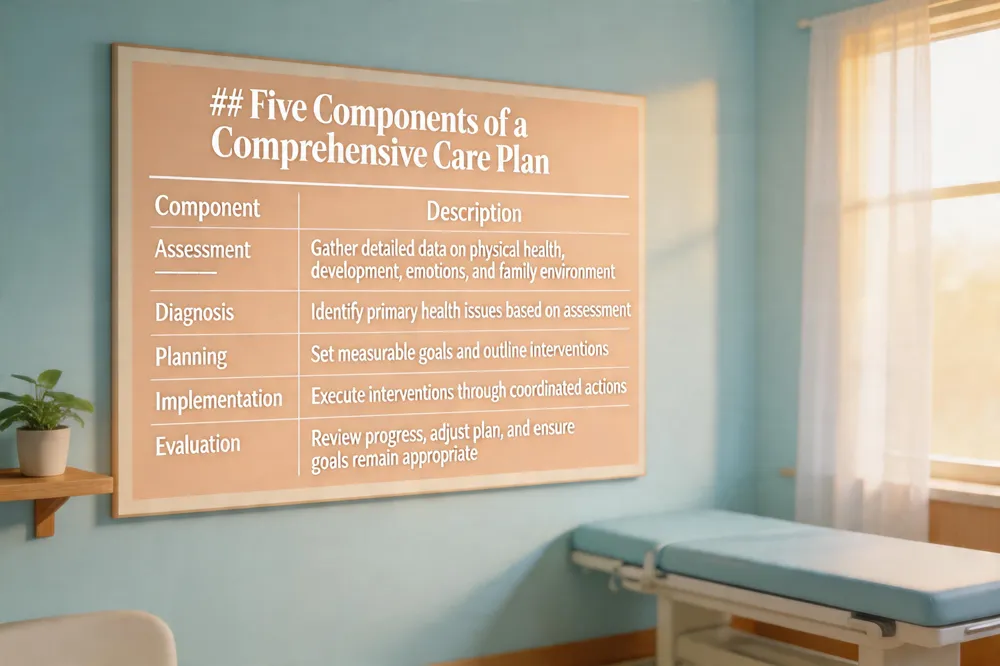 What are the 5 main components of a care plan? A comprehensive plan begins with assessment—gathering detailed information about the child’s physical health, developmental stage, emotional well‑being, and family environment. Next, the team makes a diagnosis that identifies the primary health issues. Planning follows, setting clear, measurable goals and outlining interventions. Implementation puts those interventions into action through coordinated care activities. Finally, evaluation reviews progress, adjusts the plan, and ensures goals remain appropriate.
What should be included in a child's care plan? The plan should summarize the child’s current developmental needs, list required services, and outline short‑ and long‑term health goals. It must capture family preferences, cultural values, and resources, and record parental input in the medical record.
Pediatric care plan examples – For a newborn with ineffective thermoregulation, goals focus on maintaining neutral temperature with skin‑to‑skin contact and parent education. A child with congenital heart disease after catheterization includes vitals monitoring, anticoagulation, activity restrictions, and signs of arrhythmia. A toddler with cerebral palsy targets muscle tone improvement through PT, medication management, and family training on positioning.
Nursing care plan for a hospitalized child – Begins with a full assessment (vitals, pain scale, developmental stage, family psychosocial status). Diagnoses such as “Risk for infection” or “Anxiety related to separation” lead to goals like stable temperature, pain control, and age‑appropriate coping. Interventions involve family education, comfort measures, and regular evaluation.
Nursing care plan for toddlers – Addresses milestones (language, gross‑motor), safety (child‑proofing), nutrition, immunizations, and parent teaching on behavior management and sleep hygiene, all tailored to the toddler’s developmental level.
Implementing Shared Decision‑Making & Communication
Shared Decision‑Making Four‑Step Model (AAP)
| Step | Action |
|---|---|
| 1. Confirm Options | Verify that more than one reasonable treatment option exists |
| 2. Evaluate Superiority | Determine if any option is medically superior |
| 3. Explore Values | Discuss family’s values, preferences, and cultural considerations |
| 4. Select Approach | Choose physician‑guided or family‑guided pathway based on shared understanding |
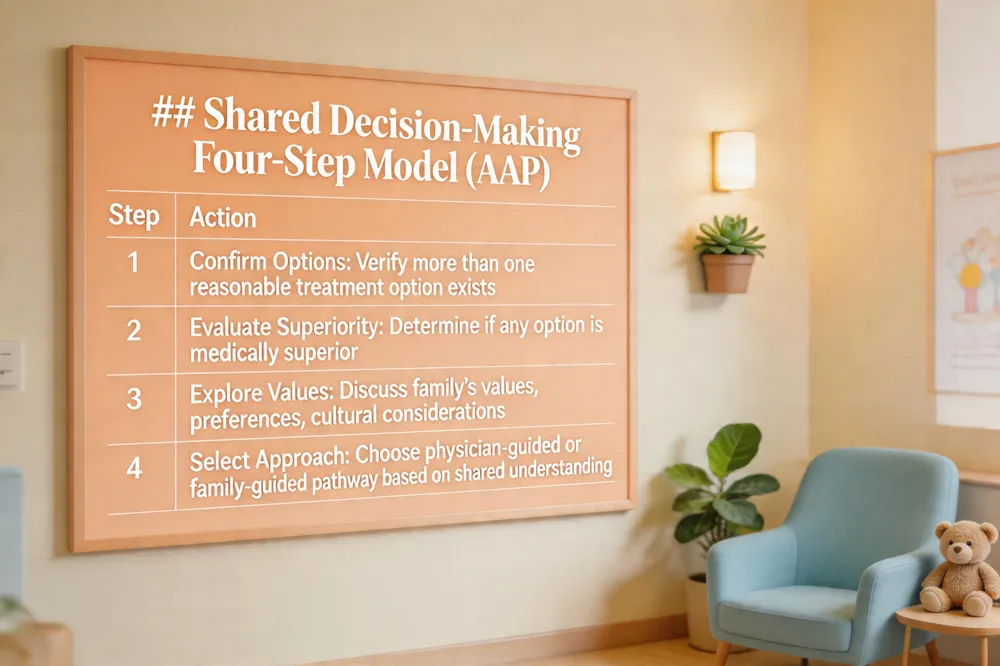 Shared decision‑making framework
In pediatric cardiology, we follow the American Academy of Pediatrics four‑step model: (1) confirm more than one reasonable treatment option exists, (2) evaluate if one option is medically superior, (3) explore the family’s values and preferences, and (4) select a physician‑guided or family‑guided approach. This structured dialogue ensures that parents and, when developmentally appropriate, the child are active partners in every care decision.
Effective communication techniques
We use plain‑language explanations, visual aids, teach‑back and show‑back methods, and professional interpreters when needed. Communication is tailored to each child’s developmental stage—"tell‑show‑do" for toddlers, decision aids for adolescents—and respects cultural and spiritual beliefs. Regular feedback loops and written summaries reinforce understanding and trust.
Technology tools supporting FCC
Patient portals, secure messaging, and telehealth platforms give families real‑time access to records, appointment reminders, and direct questions to the care team. These tools reduce readmission rates and improve satisfaction for families managing chronic cardiac conditions.
What are the 5 C’s of care planning?
Compassion, Communication, Competence, Confidence, and Continuity.
Examples of family‑centered care in nursing
Parents join bedside rounds, receive clear education, stay present during procedures, and co‑create discharge plans with written, literacy‑appropriate instructions.
Importance of family‑centered care in nursing
It reduces anxiety, builds trust, improves adherence, and leads to safer, more effective outcomes for children.
Nursing care for pediatric patients
Developmentally appropriate assessments, weight‑based dosing, safety checks, and education using visual aids and hands‑on demos.
Nursing interventions for school‑age child
Health education for self‑management, therapeutic play, collaboration with parents/teachers, coping‑strategy teaching, and goal‑oriented plan adjustments.
Legal, Ethical, and Cultural Dimensions
Key Legal & Ethical Elements
| Element | Summary |
|---|---|
| Parental Authority | Parents consent or refuse treatment; clinicians may seek ethics consultation if harm is imminent |
| Mature‑Minor Doctrine | Allows adolescents to consent to certain services when deemed mature |
| Assent | Obtain child’s agreement when developmentally appropriate |
| Ethics Consultation | Utilized when parental decisions conflict with child’s best interest |
| Cultural Competence | Tailor communication and care to respect cultural, spiritual, and linguistic needs |
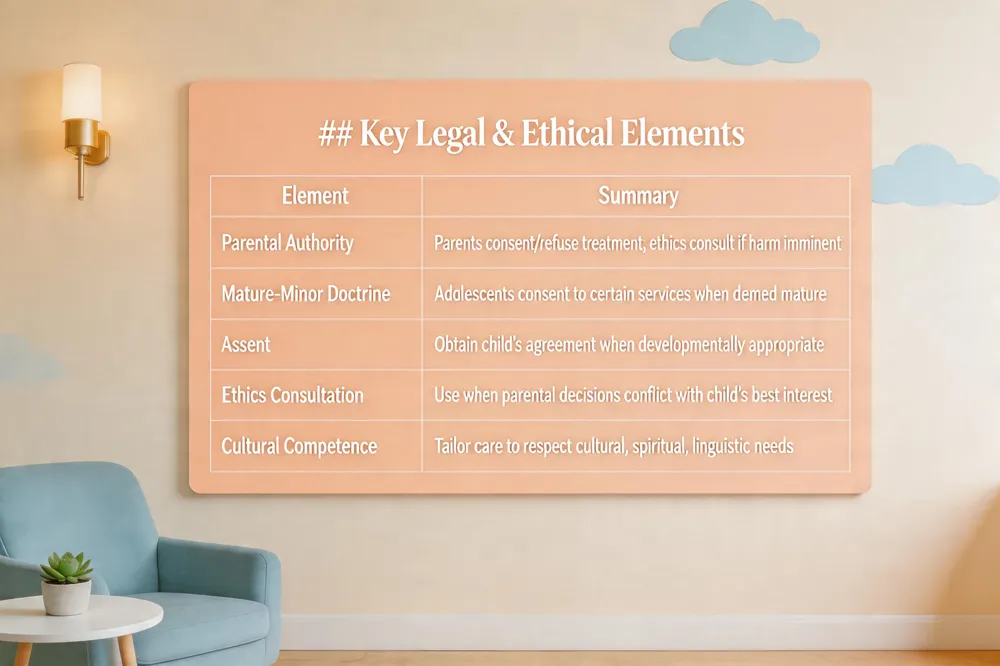 Parental decision-making in healthcare
Parents have the legal authority to consent to or refuse treatment for their children, grounded in the presumption that they act in the child’s best‑interest. When a decision threatens serious harm, clinicians may seek ethics consultation or court review. Shared decision‑making (SDM) blends parental authority with clinician expertise, respecting the child’s emerging autonomy.
Medical decision‑making for minors
U.S. law requires parental consent for most pediatric care, but the mature‑minor doctrine and emancipation statutes allow adolescents to consent to certain services. Clinicians obtain the child’s assent when developmentally appropriate, weighing the child’s preferences against medical necessity and intervening only when life‑saving care is required.
Parental involvement in decision making
Active partnership means parents review options, ask questions, and share values. Transparent information sharing, culturally sensitive communication, and shared goals improve adherence, satisfaction, and outcomes. Our Federal Way practice invites parents to multidisciplinary meetings and care‑plan development.
Parent involvement in child healthcare
Parents coordinate appointments, reinforce treatment at home, and access portals like MyChart. Empowered families—regardless of language, culture, or socioeconomic status—reduce anxiety, boost medication adherence, and promote overall well‑being.
Five principles of family‑centered care
- Dignity and respect
- Information sharing
- Participation
- Collaboration
- Access. These principles guide every interaction, ensuring culturally competent, equitable, and family‑focused pediatric care.
Practical Tools, Training, and Resources for FCC
Practical FCC Resources
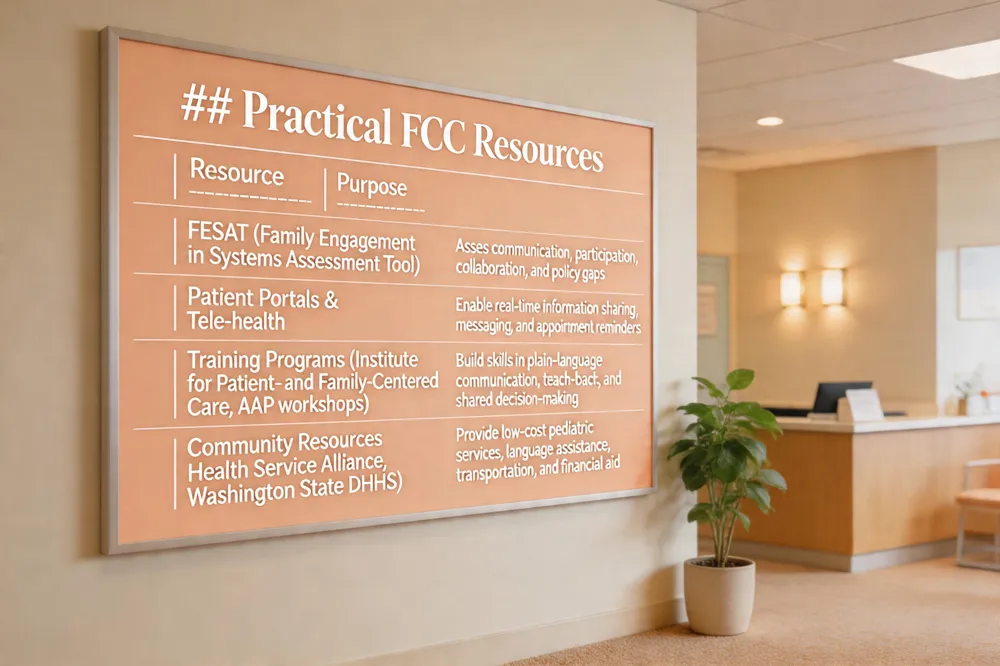
| Resource | Purpose |
|---|---|
| FESAT (Family Engagement in Systems Assessment Tool) | Assess communication, participation, collaboration, support, and policy gaps |
| Patient Portals & Tele‑health | Enable real‑time information sharing, messaging, and appointment reminders |
| Training Programs (Institute for Patient‑ and Family‑Centered Care, AAP workshops) | Build skills in plain‑language communication, teach‑back, and shared decision‑making |
| Community Resources (Health Service Alliance, Washington State DHHS) | Provide low‑cost pediatric services, language assistance, transportation, and financial aid |
 Assessment Tools (FESAT, Patient Portals)
Family‑centered care (FCC) begins with reliable assessment. The Family Engagement in Systems Assessment Tool (FESAT) evaluates communication, participation, collaboration, support, and policy/advocacy, helping practices identify gaps and set improvement priorities. Digital health tools such as patient portals and secure tele‑health platforms enable real‑time information sharing, appointment reminders, and two‑way messaging, keeping families engaged between visits.
Assessment Tools (FESAT, Patient Portals)
Family‑centered care (FCC) begins with reliable assessment. The Family Engagement in Systems Assessment Tool (FESAT) evaluates communication, participation, collaboration, support, and policy/advocacy, helping practices identify gaps and set improvement priorities. Digital health tools such as patient portals and secure tele‑health platforms enable real‑time information sharing, appointment reminders, and two‑way messaging, keeping families engaged between visits.
Training Programs for Clinicians Effective FCC requires clinicians skilled in clear, culturally‑sensitive communication, shared decision‑making, and teach‑back methods. Training programs offered by the Institute for Patient‑ and Family‑Centered Care, AAP‑accredited workshops, and local hospital education modules focus on these competencies and on using decision‑aid tools that respect family values and developmental stages.
Community Resources in Federal Way Federal Way families can access a network of support: the Health Service Alliance provides free or low‑cost pediatric services; local child‑life specialists, social workers, and peer‑support groups assist with coping and education; and the Washington State Department of Social and Health Services offers assistance programs that address transportation, language services, and financial barriers.
Frequently Asked Questions
- What are the top 10 pediatric diagnoses? The most common conditions are the common cold, influenza, ear infections, strep throat, sinus infections, bronchitis, urinary‑tract infections, skin infections, gastrointestinal viruses, and broader infections. Early recognition and appropriate treatment keep children healthy and reduce complications.
- What are the 5 main components of a care plan? Assessment, diagnosis, planning, implementation, and evaluation.
- What should be included in a child's care plan? It should detail current and long‑term care arrangements, developmental needs, and required services.
- What are the five principles of family‑centered care? Dignity and respect; information sharing; participation; collaboration; and access.
- Family‑centered care theory posits that optimal outcomes arise when families are recognized as essential partners, with respect, shared decision‑making, and culturally tailored care.
Putting It All Together for Better Pediatric Outcomes
Family‑centered care (FCC) consistently improves health outcomes: parents who participate in decision‑making adhere to treatment plans 30‑50 % more often, hospital readmissions drop, and child anxiety falls. For Federal Way families, the call to action is simple—bring your questions, cultural preferences, and daily‑life insights to every appointment, and ask clinicians to use plain‑language summaries, visual aids, and teach‑back techniques. Clinicians, in turn, should schedule multidisciplinary meetings that include parents, document their goals in the electronic record, and offer interpreter or telehealth options to bridge literacy or language gaps. Looking ahead, Federal Way pediatrics will expand digital portals, embed family advisory boards, and pilot age‑appropriate advance‑care tools that align with developmental milestones, ensuring FCC evolves with each child’s growing autonomy.