Why a tailored health plan matters
Every child’s health journey is unique, and an individualized care plan ensures that medical decisions reflect that uniqueness. For children with cardiac conditions, pediatric cardiology provides the expertise needed to monitor heart function, adjust medications, and prescribe safe activity levels. The American Academy of Pediatrics endorses a Shared Plan of Care (SPoC) as a concise, family‑centered summary that lists diagnosis, emergency actions, medication schedules, and specialist contacts, both in a binder and digitally for rapid access. Integrating the SPoC with school‑based documents such as IHP,,EP, or Section 504 plans creates a seamless safety net: nurses receive clear medication instructions, teachers know activity restrictions, and emergency responders have up‑to‑date cardiac information. A designated point person—often the primary pediatrician or care coordinator—keeps the plan current through monthly reviews, ensuring that medication dosages, monitoring goals, and insurance authorizations stay aligned with the child’s evolving needs.
Choosing the right health‑plan coverage
Comparison of Child Health‑Plan Options
| Plan Type | Eligibility | Core Benefits | Cost (Typical) | Enrollment Period |
|---|---|---|---|---|
| Medicaid | Income ≤ 133‑142 % FPL; Washington residents | Full pediatric coverage: dental, vision, EPSDT, specialist visits, hospital, prescriptions | Low/No premiums, minimal co‑pays | Year‑round (open enrollment) |
| CHP+ (Child Health Plan Plus) | Income ≤ 260 % FPL; not eligible for Medicaid | Primary care, hospital, prescriptions, immunizations; limited adult dental | Low‑cost premiums, modest co‑pays | Year‑round |
| Private HMO/PPO | Any income; purchase through Marketplace or directly | Varies by plan; may include dental/vision add‑ons | Premiums + co‑pays (higher than public) | Open enrollment (Nov‑Jan) or qualifying life event |
| Individual Marketplace (Child‑Only) | Any income; qualifies for subsidies based on FPL | Same as adult marketplace plans, tailored for child | Premiums after subsidies; co‑pays | Open enrollment or qualifying life event |
| State‑run Programs (e.g., Washington Healthplanfinder) | Residents; income criteria similar to Medicaid/CHP+ | Network of pediatricians & cardiology specialists; enrollment assistance | Varies; often low‑cost | Year‑round |
Use the Washington Healthplan Finder or Medicaid helpline (1‑855‑562‑3020) to verify network participation.
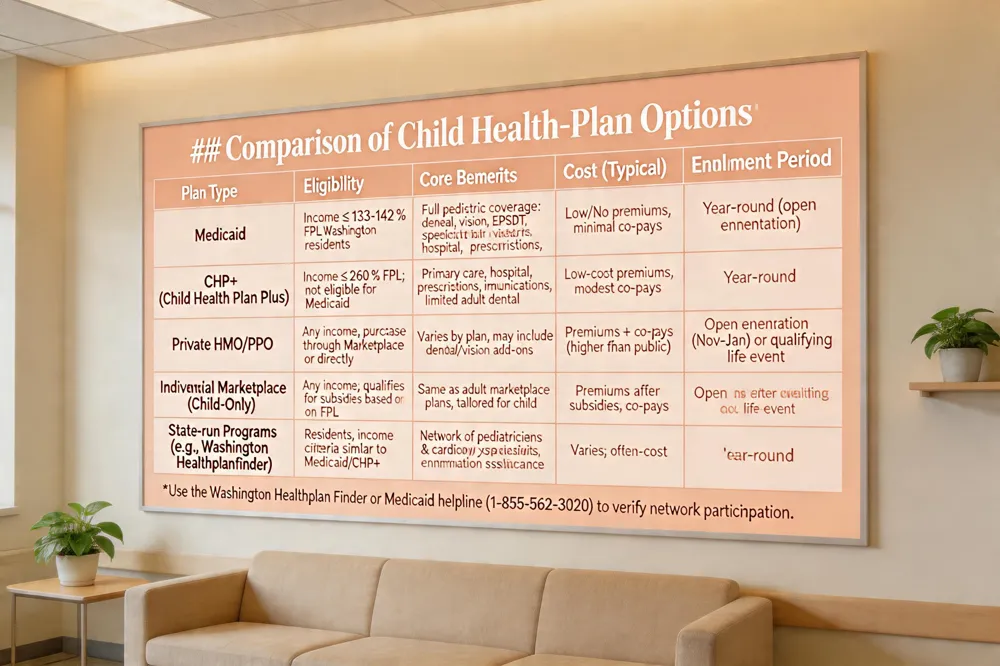 Child health‑plan providers – State‑run programs (Medicaid, CHIP) and private HMO/PPO plans all offer pediatric coverage. In Washington, families can enroll at any time, and the Washington Healthplanfinder or each insurer’s provider‑search tool helps locate pediatricians, cardiology specialists, and clinics that accept their plan. A network with strong pediatric cardiology coverage is essential for children with heart conditions.
Child health plan plus vs Medicaid – Medicaid serves families below the state’s income threshold (≈133‑142 % FPL) and includes comprehensive benefits such as dental, vision, and EPSDT. Child Health Plan Plus (CHP+) targets families earning up to 260 % FPL, offering low‑cost core services (primary care, hospital, prescriptions, immunizations) with modest co‑pays and limited adult dental. Medicaid is the most robust option; CHP+ provides an affordable safety net for those just above Medicaid limits.
Health insurance for child only – If a child isn’t covered under a parent’s plan, options include Medicaid, CHIP, or an individual Marketplace plan (often subsidized). Private carriers like Cigna also sell stand‑alone child policies that include medical, dental, and vision benefits. Eligibility and enrollment can be completed year‑round for public programs.
Local provider search tools – Washington families can use the Washington Healthplan Finder, call the Medicaid helpline (1‑855‑562‑3020), or visit the Federal Way Pediatric Cardiology Clinic’s website to verify network participation. These tools ensure you find a plan that includes the specialists your child needs.
Coordinating school health support
School Health‑Care Planning Elements
| Document | Purpose | Key Components | Legal Basis | Review Frequency |
|---|---|---|---|---|
| Individualized Health Plan (IHP) / Individualized Health Care Plan (IHCP) | Outline medical needs & emergency actions for a student | Medication schedule, vital sign monitoring, emergency triggers, contact list, accommodation requests | IDEA (Individuals with Disabilities Education Act) – legally binding | At least annually (or when condition changes) |
| School Nurse Template | Standardize care documentation | Assessment data, nursing diagnosis, measurable goals, interventions, rationales, evaluation plan | Nursing best‑practice guidelines | Updated per student’s health status |
| Emergency Action Procedure (EAP) | Provide rapid response steps for emergencies (e.g., cardiac event) | Trigger criteria, medication dosages, EMS notification, parent contact protocol | State health‑safety regulations | Reviewed annually and after drills |
| IEP (Individualized Education Program) | Address academic goals & accommodations | Academic objectives, related services, placement | IDEA – legally binding | Annually (or as needed) |
Collaboration among parents, pediatric cardiology specialist, and school staff ensures continuity of care.
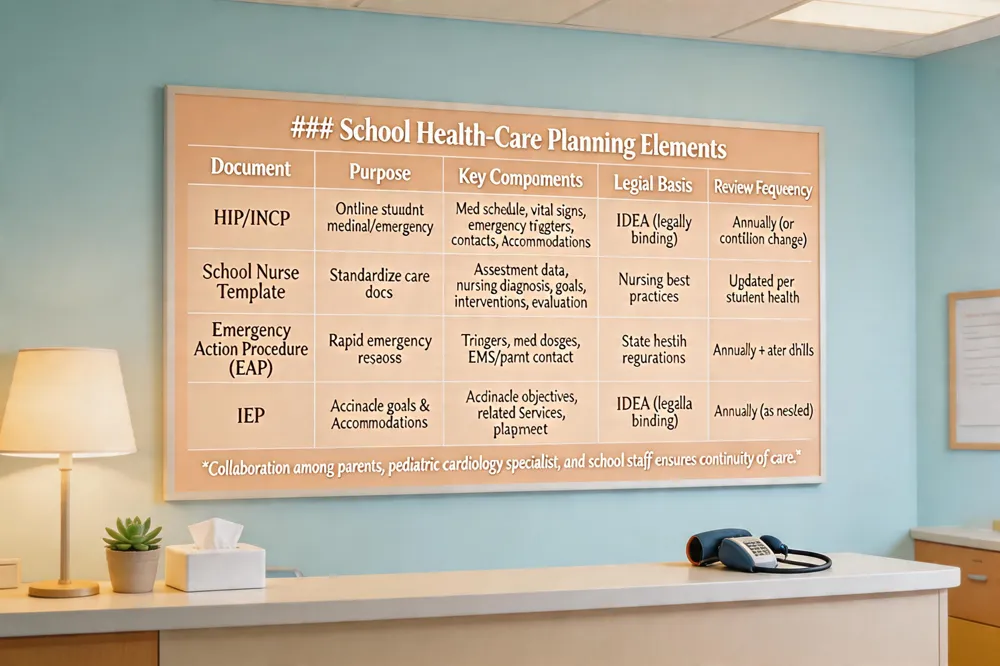 A school health‑care plan—often called an Individualized Health Plan (IHP) or an Individualized Health Care Plan (IHCP)—is a written agreement that outlines a child’s medical needs, medication schedules, emergency procedures, and classroom accommodations while at school. It is created through collaboration among parents, the child’s pediatrician (especially a pediatric cardiology specialist for heart conditions), and school staff, ensuring safety and continuity of care. The plan specifies who may administer medication, how vital signs are monitored, and the steps to take in an emergency, such as a cardiac event. Regular reviews keep the document up‑to‑date as the child’s condition or treatment changes.
School nurse templates use a structured IHP format that includes assessment data, nursing diagnosis, measurable goals, interventions, rationales, and an evaluation plan. Templates can be customized for asthma, diabetes, allergies, or cardiac disorders, and free versions are available from national nursing organizations.
Legal status: IHPs are legally binding under the Individuals with Disabilities Education Act (IDEA) and must be reviewed at least annually. The related Individualized Education Program (IEP) addresses academic goals, while the IHP focuses on health needs.
Emergency action procedures (EAPs) list triggers, required medications, dosage instructions, and emergency contacts. They authorize the nurse to share information on a need‑to‑know basis, include staff drills, and ensure rapid notification of parents and EMS. Integrating EAPs into the school’s emergency preparedness program keeps children safe and supports uninterrupted learning.
Integrating pediatric cardiology and shared care
Shared Care Tools for Pediatric Cardiology
| Tool | Description | Primary Users | Core Elements |
|---|---|---|---|
| Shared Plan of Care (SPoC) | Concise, family‑centered summary of diagnosis & treatment | Pediatric cardiologists, primary care, families, school staff | Diagnosis, medication list, emergency actions, daily monitoring parameters, clinician roster |
| Emergency Information Form (EIF) | Standardized snapshot of heart status for responders | EMS, emergency department staff, school nurses | Cardiac condition, device details, medication dosages, emergency contacts |
| Direct‑Primary‑Care Membership (e.g., Tailored Pediatric Medicine) | Unlimited primary‑care visits for a flat fee, removing insurance barriers | Families, primary‑care physicians, cardiology team | Well‑child visits, same‑day sick‑care, telehealth, home visits |
| School IHP (derived from SPoC) | Translates SPoC into classroom‑specific accommodations | School nurse, teachers, parents | Medication administration protocol, activity restrictions, emergency response steps |
These tools ensure coordinated, timely care across home, clinic, and school environments.
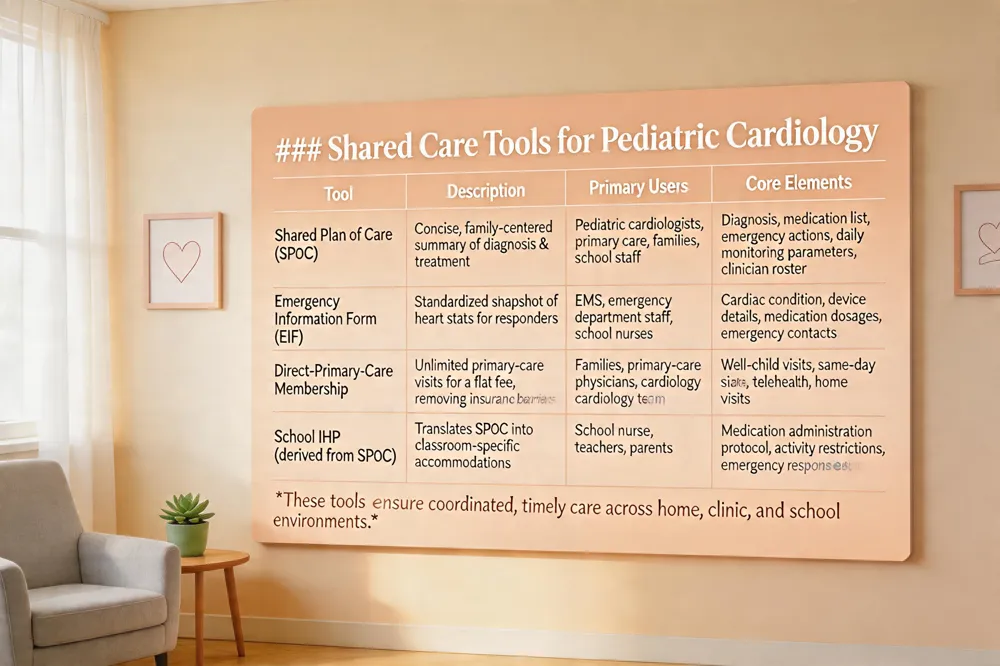 A Shared Plan of Care (SPoC) is a concise, family‑centered summary endorsed by the AAP that bundles diagnosis, medical history, emergency actions, medication lists, and care‑team contacts in both paper and digital formats. For children with cardiac conditions, the SPoC should also list daily monitoring parameters, equipment needs, and a clinician roster. Emergency Information Forms (EIF), completed by the pediatric cardiology team, provide responders with a standardized snapshot of the child’s heart status and belong in the go‑bag and electronic health record.
Our tailored pediatric medicine model in Federal Way offers a direct‑primary‑care membership that removes insurance barriers, allowing unlimited well‑child visits, same‑day sick‑care, telehealth, and home visits for newborns. This model supports a coordinated approach to cardiac monitoring, medication management, and emergency action plans, ensuring families receive timely, compassionate care.
At school, an Individualized Health Care Plan (IHP) translates the SPoC into classroom accommodations, medication administration protocols, and emergency response steps. We collaborate with parents, cardiologists, and school nurses to keep the IHP current, promoting safe participation in academics and activities.
Child Health Plan Plus (CHP+) is a Colorado public health‑insurance program that provides low‑cost coverage for children up to age 18 and pregnant women who earn too much for Medicaid but cannot afford private plans. To qualify, families must be Colorado residents with household incomes below 260 % the Federal Poverty Level and not already enrolled in Health First Colorado or another insurance. CHP+ covers a wide range of services—including primary and emergency care, hospital stays, dental and vision care, prescriptions, immunizations, maternity care, and mental‑health services—often with no co‑pay for preventive visits. Enrollment is free, and families only pay modest co‑pays for non‑preventive services, with an annual out‑of‑pocket limit of 5 % of household income. Applications can be submitted online through the state PEAK portal, by phone, by mail, or in person at a local human‑services office.
Public insurance programs, eligibility and mental‑health coverage
Public Insurance Programs Overview
| Program | Eligibility Criteria | Covered Services | Mental‑Health Coverage | Enrollment Method |
|---|---|---|---|---|
| Medicaid (Washington – Apple Health) | Income ≤ 133‑142 % FPL; residents | Pediatric primary/specialty care, dental, vision, EPSDT, hospital, prescriptions | Parity with physical health (must cover therapy, medication, inpatient) | Online, phone, in‑person at human‑services offices |
| CHIP (Washington) | Income between Medicaid ceiling and ~400 % FPL; under 19, citizen/resident | Well‑child visits, immunizations, specialist visits, dental, vision, emergency care | Must provide mental‑health benefits under MHPAEA & ACA | Washington Healthplan Finder, Medicaid helpline |
| CHP+ (Colorado) | Income ≤ 260 % FPL; Colorado resident; not enrolled in other public plans | Primary care, hospital, prescriptions, dental, vision, maternity, mental‑health services | Full mental‑health parity (including bipolar disorder) | PEAK portal, phone, mail, local human‑services office |
| Medicaid Waiver (Katie Beckett/1915(c) HCBS) | Income exceeds typical Medicaid limits; qualifying medical need | Home‑based cardiac care, equipment, home visits | Included as part of waiver services | Application through state Medicaid agency |
All public plans must comply with the Mental Health Parity and Addiction Equity Act, ensuring comparable coverage for conditions such as bipolar disorder.
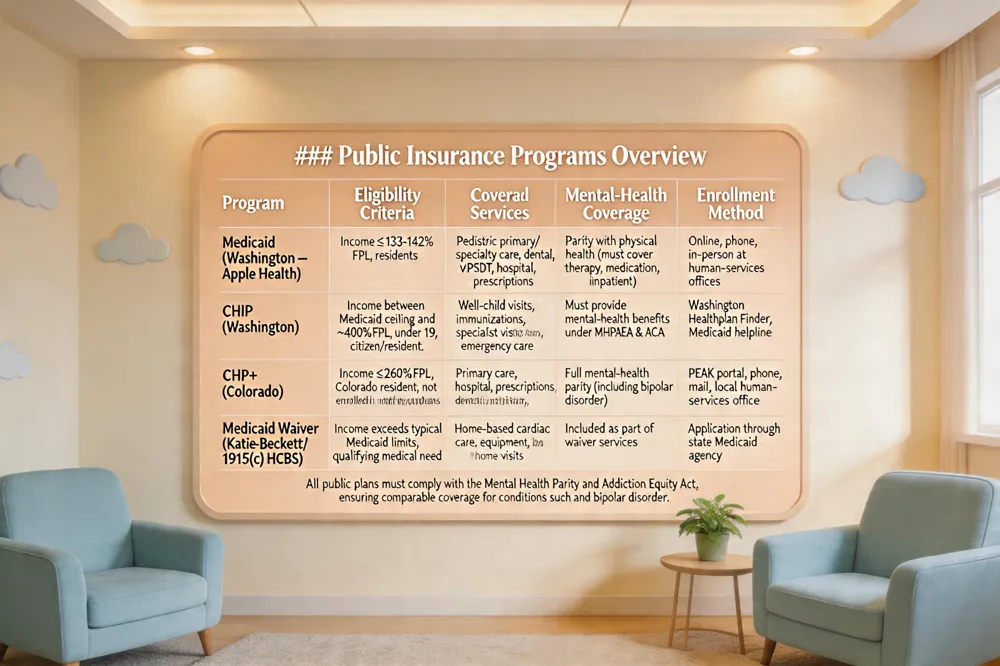 Families in Federal Way and across the United States can rely on public insurance programs such as the Children’s Health Insurance Program (CHIP) and Medicaid to secure low‑cost health coverage for children with special health needs.
CHIP eligibility and benefits – A child qualifies for CHIP when they are under 19, not covered by Medicaid or another qualifying plan, are a U.S. citizen or meet state immigration rules, and reside in Washington. Income must fall between the Medicaid ceiling and the CHIP upper limit (approximately 138 %–400 % of the Federal Poverty Level, varying by household size). Once enrolled, CHIP covers routine well‑child visits, immunizations, doctor and specialist appointments, prescription drugs, dental and vision care, and emergency services with little or no copays.
Bipolar disorder coverage – Under the Mental Health Parity and Addiction Equity Act and the Affordable Care Act, most health‑insurance policies—including public plans like CHIP—must provide mental‑health benefits on the same terms as physical‑health services. This includes treatment for bipolar disorder: medication, outpatient therapy, and inpatient hospitalization, subject to plan deductibles, copays, and any required prior authorizations.
State‑specific programs – Washington’s CHIP program follows the federal framework but includes extra support for pediatric cardiology and behavioral health services. Colorado offers a similar low‑cost option, Child Health Plan Plus (CHP+), which covers primary care, mental‑health visits, and specialty services such as pediatric cardiology. Both states encourage coordinated care through designated care coordinators to ensure children receive comprehensive, family‑centered treatment.
Overall, public insurance provides a safety net that includes essential mental‑health coverage, making it easier for parents to access needed care for conditions like bipolar disorder while also supporting chronic physical health needs.
Resources, providers, and next steps
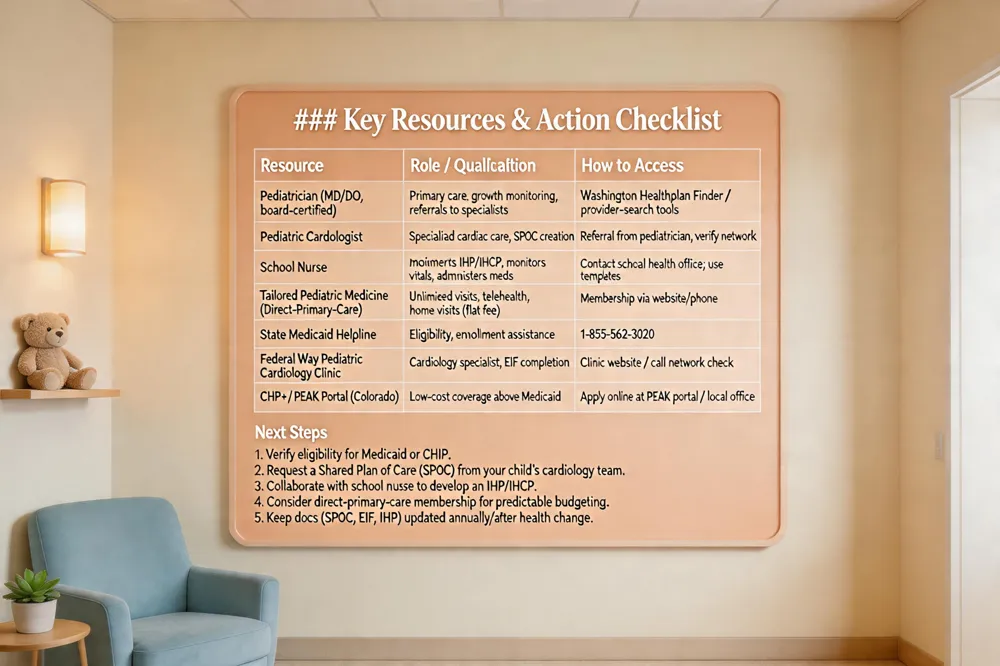
Key Resources & Action Checklist
| Resource | Role / Qualification | How to Access |
|---|---|---|
| Pediatrician (MD/DO, board‑certified) | Primary care, growth monitoring, referrals to specialists | Find via Washington Healthplan Finder or provider‑search tools |
| Pediatric Cardiologist | Specialized cardiac care, SPoC creation | Referral from pediatrician; verify network participation |
| School Nurse | Implements IHP/IHCP, monitors vitals, administers meds | Contact school health office; use provided templates |
| Tailored Pediatric Medicine (Direct‑Primary‑Care) | Unlimited visits, telehealth, home visits for flat fee | Membership enrollment via website or phone |
| State Medicaid Helpline | Eligibility verification, enrollment assistance | 1‑855‑562‑3020 |
| Federal Way Pediatric Cardiology Clinic | Cardiology specialist, EIF completion | Visit clinic website or call for network check |
| CHP+ / PEAK Portal (Colorado) | Low‑cost coverage for families above Medicaid | Apply online at PEAK portal or via local office |
Next Steps
- Verify eligibility for Medicaid or CHIP.
- Request a Shared Plan of Care (SPoC) from your child’s cardiology team.
- Collaborate with your school nurse to develop an IHP/IHCP.
- Consider a direct‑primary‑care membership for predictable budgeting.
- Keep all documents (SPoC, EIF, IHP) updated annually or after any change in health status.
 Pediatrician role and qualifications
A pediatrician is an MD or DO who has completed a pediatric residency and is board‑certified to care for patients from birth through age 22. They provide routine well‑child exams, immunizations, growth and developmental monitoring, preventive counseling, and coordination with subspecialists such as pediatric cardiologists.
Specialist terminology
- Shared Plan of Care (SPoC) – a concise, family‑centered summary of diagnosis, medications, emergency actions, and care‑team contacts, endorsed by the AAP.
- Individualized Health Care Plan (IHCP/IHP) – a school‑nursing document that details medication administration, activity restrictions, and emergency response for children with chronic conditions.
- Katie Beckett/1915(c) HCBS waiver – a Washington Medicaid waiver that funds home‑based cardiac care even when household income exceeds typical Medicaid limits.
Special‑needs categories
Children with special health care needs include those with chronic cardiac disease, developmental delays, or behavioral health concerns. Tailored plans must incorporate cardiology monitoring parameters, school‑based IHCPs, and coordinated therapy services.
Financial considerations for custom plans
Families in Federal Way can access low‑cost coverage through Washington CHIP (premiums ≤5 % of household income) or Medicaid (Apple Health). Private options like Colorado’s CHP+ offer $0 premiums and minimal copays. Direct‑primary‑care memberships (e.g., Tailored Pediatric Medicine) provide unlimited sick visits for a flat monthly fee, eliminating per‑visit costs.
Next steps
- Verify CHIP or Medicaid eligibility.
- Request a SPoC from your pediatric cardiology team.
- Work with your school nurse to develop an IHCP.
- Consider a direct‑primary‑care membership for streamlined access and predictable budgeting.
Putting it all together for your child’s health
Step‑by‑step plan creation – Begin with a Shared Plan of Care (SPoC) that lists diagnosis, medications, emergency actions, and contacts. Keep the SPoC in a binder at home and as a PDF on your phone. Add the school’s Individualized Health Care Plan (IHCP) or IHP, and copy the pediatric cardiology Emergency Information Form into the go‑bag. Designate a point person—often your primary‑care pediatrician or clinic care coordinator—to gather input from the cardiology team, therapists, and school staff.
Continuous review and coordination – Schedule a monthly check‑in (or before major appointments) to update medication dosages, cardiac monitoring goals, and insurance authorizations. Use the practice’s care‑coordination service in Federal Way to streamline referrals, track lab results via MyChart, and ensure HIPAA‑ and FERPA‑compliant information sharing.
Resources and support in Federal Way – Families can tap Medicaid Medicaid waivers (Katie Beckett/1915(c) HCBS), Washington CHIP, and local urgent‑care clinics such as Seattle Children’s Urgent Care. Mary Bridge Children’s Outpatient Center and the Federal Way Pediatrics practice offer multidisciplinary teams, telehealth visits, and free parking. State‑run rare‑disease support programs and the Washington State Department of Health’s resourcesRound additional safety nets for complex cardiac care.