Why Annual Well‑Child Visits Matter
Annual well‑child visits are a cornerstone of preventive pediatric care. Each visit provides a structured opportunity for the pediatrician to track growth, update immunizations, and review nutrition, safety, and behavior, while also creating a trusted relationship with the family. Consistent developmental monitoring across visits enables early detection of motor, language, cognitive, or social‑emotional delays; timely screening at 9, 18, and 30 months, plus autism checks at 18‑24 months, allows prompt referral to early‑intervention services, improving long‑term outcomes. In Federal Way, pediatric cardiology is seamlessly integrated into the well‑child schedule. Children with known heart conditions or a family history of congenital disease receive routine cardiac auscultation, blood‑pressure checks, and exercise‑tolerance assessments during each visit, ensuring that cardiac health does not interfere with overall development. This team‑based approach—pediatrician, cardiology specialist, and caregivers—optimizes physical, mental, and social health from infancy through adolescence.
The Recommended Visit Schedule – AAP vs. CDC
 The American Academy of Pediatrics (AAP) Bright Futures periodicity schedule begins with a newborn visit at 3–5 days and continues at 1 mo, 2 mo, 4 mo, 6 mo, 9 mo, 12 mo, 15 mo, 18 mo, 24 mo, 30 mo, and 3 yr. After age 3, annual visits provide growth checks, developmental screenings, immunizations, nutrition counseling, and safety guidance through adolescence.
The CDC’s well‑child timeline mirrors the AAP’s early‑life frequency: birth, 1 mo, 2 mo, 4 mo, 6 mo, 9 mo, 12 mo, 15 mo, 18 mo, 2 yr, 2½ yr, 3 yr, 4 yr, and 5 yr, then yearly through at least age 21. Each visit includes measurements, milestone review, vaccine updates, and anticipatory guidance.
Legal and school‑entry considerations: No federal law mandates well‑child visits, but Washington state requires up‑to‑date immunizations and health screenings for public‑school enrollment. Medicaid’s EPSDT benefit obligates coverage of preventive visits, making them effectively required for school eligibility.
Annual follow‑up through adolescence: After the 3‑year visit, yearly exams monitor height, weight, BMI, blood pressure, vision, hearing, mental‑health screening, and puberty changes, ensuring early detection of concerns and continuity of care.
Four Developmental Domains and Milestones from Birth to Five Years
 What are the 4 domains of Developmentally Appropriate Practices (DAP)?
The four DAP domains are physical development, cognitive development, social‑emotional development, and linguistic development (including bilingual growth). Physical development tracks gross‑ and fine‑motor skills, growth, and health. Cognitive development encompasses thinking, problem‑solving, memory, and concept formation. Social‑emotional development focuses on relationships, self‑regulation, and a sense of belonging. Linguistic development emphasizes language acquisition, communication, and expressive abilities in one or more languages.
Developmental milestones chart birth to 5 years
Birth‑2 mo: lifts head prone, tracks objects, social smile.
2‑6 mo: sits with little support, babbling, transfers objects hand‑to‑hand.
12 mo: stands with assistance, takes first steps, says a few words, points to objects.
24 mo: runs well, combines two words, engages in parallel play, builds a tower of six blocks.
3 yr: pedals a tricycle, uses three‑word sentences, dresses with minimal help, cooperates in play.
4 yr: hops on one foot, names colors, follows two‑step directions, draws a person.
5 yr: skips, draws basic shapes, uses five‑word sentences, dresses independently—signs readiness for school.
Developmental milestones checklist
A checklist lets parents and clinicians monitor motor, cognitive, language, and social‑emotional skills at each age interval. By comparing observed abilities to CDC‑approved milestones (e.g., smiling by 2 mo, sitting unsupported by 6 mo, first words by 12 mo), providers can quickly identify delays and refer for early‑intervention services. Our Federal Way practice offers printable sheets, a mobile tracker, and guidance on documenting progress, ensuring families have a clear, actionable record of their child’s development.
Screening, Surveillance, and the Tools You’ll Encounter
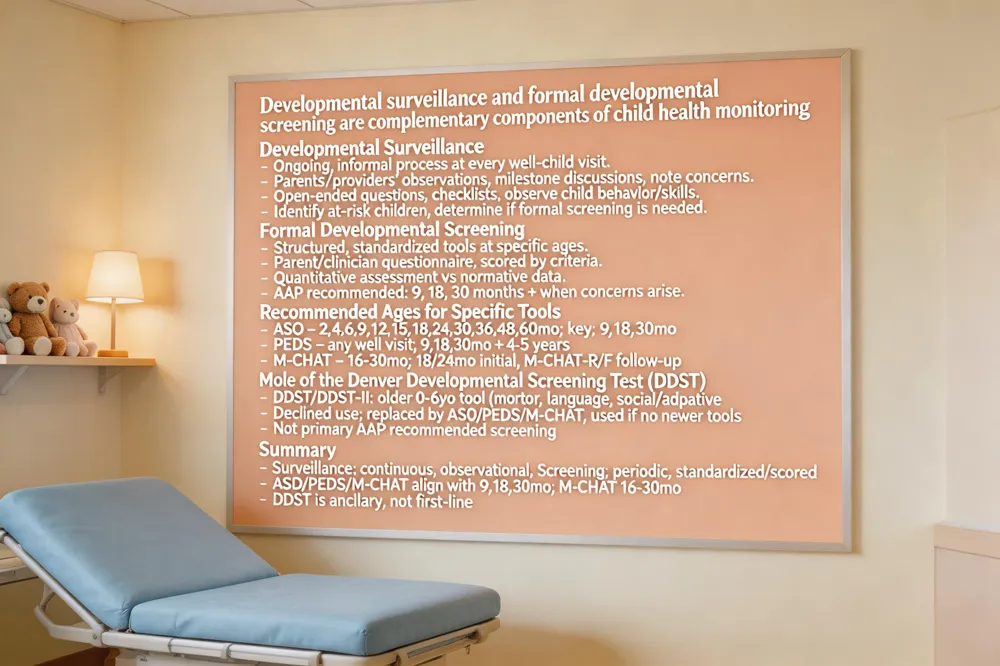 Well‑child visits are the backbone of preventive pediatric care, especially for families in Federal Way, Washington who may also receive coordinated pediatric cardiology monitoring. At each visit, the pediatrician blends continuous developmental surveillance with targeted formal screening to catch delays early and connect families with resources such as Washington State’s Birth‑to‑Three Early‑Intervention program.
Developmental surveillance vs. screening
Surveillance is a conversation‑based, ongoing process that occurs at every well‑child visit. The clinician asks parents about concerns, reviews the child’s developmental history, observes milestones, and documents risk or protective factors. Formal screening, by contrast, uses a validated questionnaire—such as the Ages & Stages Questionnaire (ASQ) or Parents’ Evaluation of Developmental Status (PEDS)—at specific ages to generate a measurable score that flags possible delays. Surveillance builds a longitudinal picture; screening provides a systematic, quantifiable check. Together they enable early identification and timely referral for intervention.
At what age should developmental screening be performed?
National guidelines from the American Academy of Pediatrics (AAP) and the CDC recommend formal screening at three key points: around 9 months, 18 months, and 30 months of age. Autism‑specific screening with the M‑CHAT is added at 18 months and 24 months. Additional screens are warranted whenever surveillance uncovers risk factors or parental concerns.
Is the Denver Developmental Screening Test (DDST) still used today?
The DDST, particularly its revised Denver II version, remains in many pediatric offices, but it is often paired with newer tools such as the ASQ, PEDS, or M‑CHAT to improve sensitivity. Using DDST alongside contemporary questionnaires aligns with current AAP recommendations and provides a broader view of gross‑motor and fine‑motor milestones.
Developmental screening test for children
Brief, research‑based questionnaires assess language, motor, cognitive, social, and emotional domains. The AAP recommends formal screening at 9, 18, and 30 months, with autism‑specific checks at 18 and 24 months. Common tools include ASQ, Denver II, PEDS, and M‑CHAT. Positive results trigger comprehensive evaluations and referrals to early‑intervention services such as speech‑language therapy, occupational therapy, or the Federal Way Birth‑to‑Three Developmental Center.
Free printable well‑child visit template
Parents can download age‑specific checklists and tracking sheets at no cost from the AAP Bright Futures toolkit, the CDC’s “Learn the Signs. Act Early” website, or Stanford Medicine’s pediatric encounter forms. These PDFs include sections for growth measurements, immunizations, developmental milestones, and anticipatory guidance—making it easy to prepare for each visit and ensure nothing is missed.
By staying proactive with both surveillance and scheduled screenings, families in Federal Way can help their children meet developmental milestones, receive timely cardiac monitoring if needed, and access early‑intervention resources that support optimal growth and learning.
Local Resources and Special Considerations for Federal Way Families
 Federal Way families can rely on Washington State’s Early Learning and Development Guidelines, which outline age‑appropriate physical, cognitive, language, and social‑emotional benchmarks from birth through third grade. These guidelines (available in English, Spanish, and Somali) help parents, educators, and pediatricians track progress and spot gaps early.
The Help Me Grow WA network offers free milestone checklists, a hotline (1‑800‑322‑2588), and the Milestone Tracker app for home monitoring. Partnering with the Child Find program, the Federal Way School District provides screening for ages 3‑5 and links families to the state’s Birth‑to‑Three early‑intervention services when delays are identified.
When a pediatrician notes a concern during a well‑child visit, the office can initiate a referral to the Washington State Department of Health’s Early Start program or to the local Birth‑to‑Three Developmental Center (253‑874‑5445).
Pediatric cardiology is integrated into routine visits: children with known heart disease receive cardiac auscultation, blood‑pressure checks, and exercise‑tolerance observation at each well‑child exam, ensuring cardiac health does not impede development.
Cultural and language support is built into every step—bilingual staff, translated handouts, and interpreter services are available to make guidance accessible for families speaking Spanish, Korean, Russian, or other languages.
A simple developmental‑milestones checklist, provided by our clinic, lets parents compare their child’s abilities (e.g., smiling at 2 months, sitting unsupported at 6 months, first words at 12 months) with CDC expectations and prompt timely referrals if needed.
Preparing for Your Annual Visit – A Practical Checklist for Parents
 What to bring: your child’s up immunization record, a recent growth chart (or weight‑length‑head‑circumference data), and a short list of 3‑5 concerns or questions. Typical anticipatory guidance topics: safety (car‑seat, sleep, water safety), nutrition (breast‑milk or formula, introduction of solids, healthy portion sizes), sleep hygiene, screen‑time limits, oral health, and age‑appropriate physical activity. Using a developmental checklist at home: Review the CDC "Learn the Signs. Act Early" milestones (e.g., smiling by 2 mo, sitting unsupported by 6 mo, walking by 12‑15 mo, two‑word phrases by 18 mo, counting to 10 by 4 yr) and note any skills not yet met; bring observations to the visit. When to request referrals or additional testing: If a child misses multiple milestones, loses previously acquired skills, or you notice concerns about speech, motor function, social interaction, or cardiac health, ask the pediatrician for a formal developmental screen (ages 9, 18, 30 mo) and, if positive, an early‑intervention referral or specialist evaluation (e.g., speech‑language therapy, pediatric cardiology).
Putting Developmental Vigilance Into Practice
Consistent use of the AAP Bright Futures schedule, CDC milestone checklists, and validated screening tools (ASQ, M‑CHAT, PEDS) creates a reliable safety net for every child. By aligning well‑child appointments with the 2‑, 4‑, 6‑, 9‑, 12‑, 15‑, 18‑, 24‑, and 30‑month visits, clinicians can systematically document growth, language, motor, and social‑emotional milestones and flag any deviation early. In Washington State, families can be promptly connected to early‑intervention services through the Birth‑to‑Three program, the Washington Early Start system, and the Help Me Grow WA hotline; pediatricians should submit referrals at the same visit when a screen is positive. Families play a central role: bringing a brief list of concerns, using the CDC Milestone Tracker app at home, and reinforcing safety, nutrition, and activity guidance. Pediatric cardiology integrates into each visit, monitoring heart health that could affect development and ensuring that cardiac findings trigger coordinated referrals, fostering holistic physical and cognitive well‑being.