Understanding the Landscape of Prior Authorizations
Prior authorizations (PAs) are insurer‑mandated approvals that confirm a pediatric service, test, or medication is medically necessary before it is provided. In children, PAs are especially critical because many therapies require child‑specific formulations—liquid antibiotics, ADHD drugs, or cardiac medicines—that insurers often cover only in a single adult version. Delays of days to months can push families to emergency departments, increase out‑of‑pocket costs (e.g., $300 for liquid nitrofurantoin), and even lead to serious events such as status epilepticus. The ecosystem includes insurers (who set PA policies), providers (who submit clinical justification and manage appeals), and policymakers (the AMA, CMS, and state legislatures) pushing reforms like the AMA’s Gold Card program and H.R. 4968 to streamline approvals and reduce physician burnout.
Insurance Carrier Acceptance at Seattle Children’s
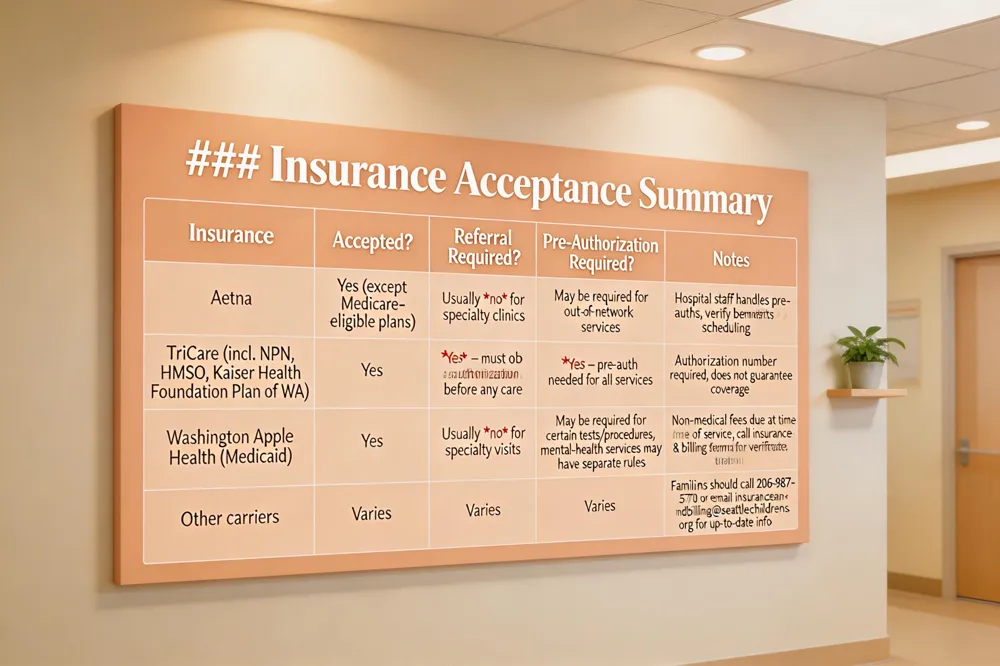
Insurance Acceptance Summary
| Insurance | Accepted? | Referral Required? | Pre‑Authorization Required? | Notes |
|---|---|---|---|---|
| Aetna | Yes (except Medicare‑eligible plans) | Usually not for specialty clinics | May be required for out‑of‑network services | Hospital staff handles pre‑auths; verify benefits before scheduling |
| TriCare (incl. NPN, HMSO, Kaiser Health Foundation Plan of WA) | Yes | Yes – must obtain authorization before any care | Yes – pre‑auth needed for all services | Authorization number required; does not guarantee coverage |
| Washington Apple Health (Medicaid) | Yes | Usually not for specialty visits | May be required for certain tests/procedures, mental‑health services may have separate rules | Non‑medical fees due at time of service; call insurance & billing team for verification |
| Other carriers | Varies | Varies | Varies | Families should call 206‑987‑5770 or email insuranceandbilling@seattlechildrens.org for up‑to‑date info |
 Does Seattle Children take Aetna?
Yes. Seattle Children’s accepts Aetna health‑insurance plans for medical care, though Medicare‑eligible Aetna plans are excluded. Most Aetna plans do not require a referral for a specialty clinic visit, but out‑of‑network services may. The hospital’s insurance team handles any required pre‑authorizations for tests or procedures, and urgent‑care locations also list Aetna as an in‑network carrier. Families should verify specific plan benefits with the insurer or the hospital’s billing office before scheduling.
Does Seattle Children take Aetna?
Yes. Seattle Children’s accepts Aetna health‑insurance plans for medical care, though Medicare‑eligible Aetna plans are excluded. Most Aetna plans do not require a referral for a specialty clinic visit, but out‑of‑network services may. The hospital’s insurance team handles any required pre‑authorizations for tests or procedures, and urgent‑care locations also list Aetna as an in‑network carrier. Families should verify specific plan benefits with the insurer or the hospital’s billing office before scheduling.
Does Seattle Children’s take TriCare? Yes. Seattle Children’s accepts TriCare insurance plans. TriCare (and related plans such as NPN, HMSO, and Kaiser Health Foundation Plan of Washington) always requires a pre‑authorization before scheduling any care. Obtain the authorization number from TriCare before booking; the authorization does not guarantee coverage or eliminate cost‑sharing. If denied, Seattle Children’s will notify the family, who must work directly with TriCare to resolve it.
Does Seattle Children’s Hospital take Apple Health? Yes—Seattle Children’s accepts Washington Apple Health (Medicaid) for medical services. For most specialty clinic visits, a pre‑authorization is not required, though specific tests or procedures may need approval. Mental‑health services can have separate rules, so confirming details with the hospital’s insurance team or the Apple Health plan is advisable. Appointments must be scheduled in advance, and any non‑medical fees are typically due at the time of service.
Families can call Seattle Children’s Insurance and Billing team (206‑987‑5770 or insuranceandbilling@seattlechildrens.org) for up‑to‑date verification and assistance with referrals, prior‑authorizations, and appeal processes. This ensures smoother navigation of insurance requirements and timely access to the pediatric cardiology care their child needs.
Eligibility and Coverage for Children in Washington
CHIP & Apple Health for Kids Overview
| Program | Eligibility Criteria | Income Range (FPL) | Premium | Coverage Highlights |
|---|---|---|---|---|
| Children’s Health Insurance Program (CHIP) | Children < 19, U.S. citizens or qualified immigration status, no other creditable coverage, Washington resident | ~170 % – 400 % of FPL | None (no‑premium CHIP) | Preventive care, specialist referrals, prescription drugs; excludes those already on Medicaid or private insurance |
| Apple Health for Kids (Medicaid‑CHIP) | Same as CHIP; enrollment immediate | Varies; families above no‑premium threshold pay modest premium | $20‑$40/month (based on income) | Comprehensive medical & dental coverage; prior‑auth often required for pediatric specialty services (e.g., cardiology) |
Premium Payment: Billed by Office of Financial Recovery; payable online via MyAccess portal or by mail. Assistance: 1‑800‑562‑3022 or AskMAGI@hca.wa.gov |
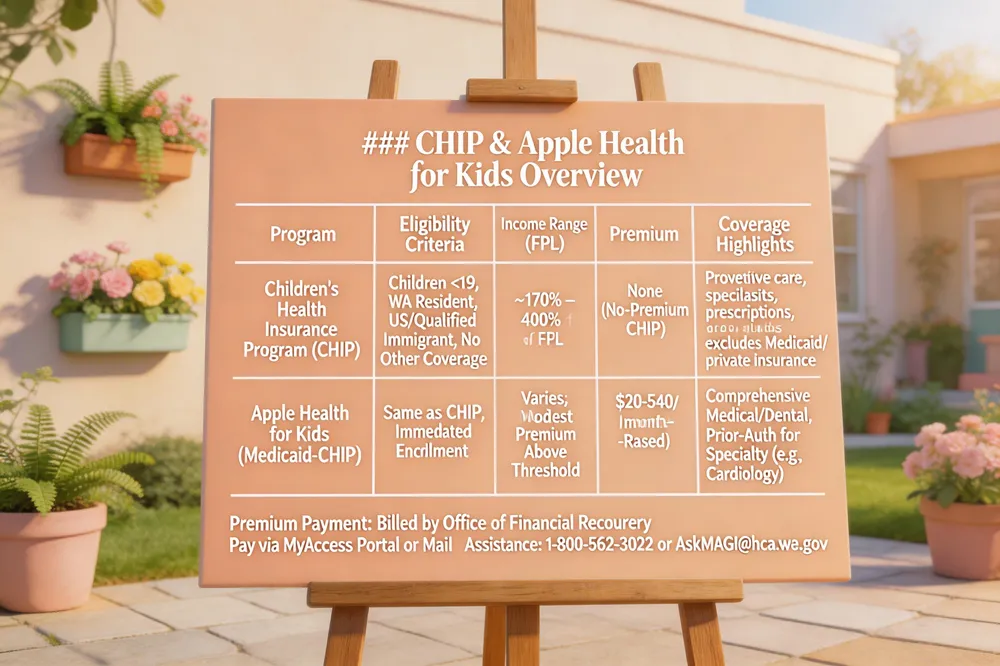 In Washington, the Children’s Health Insurance Program (CHIP) and Apple Health for Kids (Medicaid‑CHIP) work together to keep families uninsured children in care.
CHIP eligibility criteria – Children under 19 who lack other creditable coverage, are U.S. citizens or have qualified immigration status, and reside in Washington may qualify for CHIP if their household income falls roughly between 170 % and 400 % of the Federal Poverty Level (FPL). The program excludes those already covered by Medicaid, a group health plan, or private insurance.
Apple Health for Kids basics – Apple Health for Kids provides comprehensive medical and dental coverage for eligible children. Enrollment is immediate; coverage starts the day after approval. The plan covers preventive visits, specialist referrals, and prescription drugs, though many pediatric specialty services (e.g., cardiology) still require a prior‑authorization from the insurer.
Apple Health for Kids with premiums – Families whose income exceeds the no‑premium threshold must pay a modest monthly premium (typically $20‑$40). Premiums are billed by the Office of Financial Recovery and can be paid online via the MyAccess portal or by mail. Assistance is available at 1‑800‑562‑3022 or AskMAGI@hca.wa.gov.
FAQs
- Who qualifies for CHIP insurance? Children under 19, uninsured, meeting citizenship/residency and income limits (≈170‑400 % FPL).
- Does Seattle Children’s Hospital take Apple Health? Yes; the hospital accepts Apple Health (Medicaid) for services, though pre‑authorizations may be needed for certain tests.
- Apple Health for Kids with premiums – Premiums apply based on income, are payable online or by mail, and coverage begins the next day after enrollment.
The Mechanics of Prior Authorization and Referrals
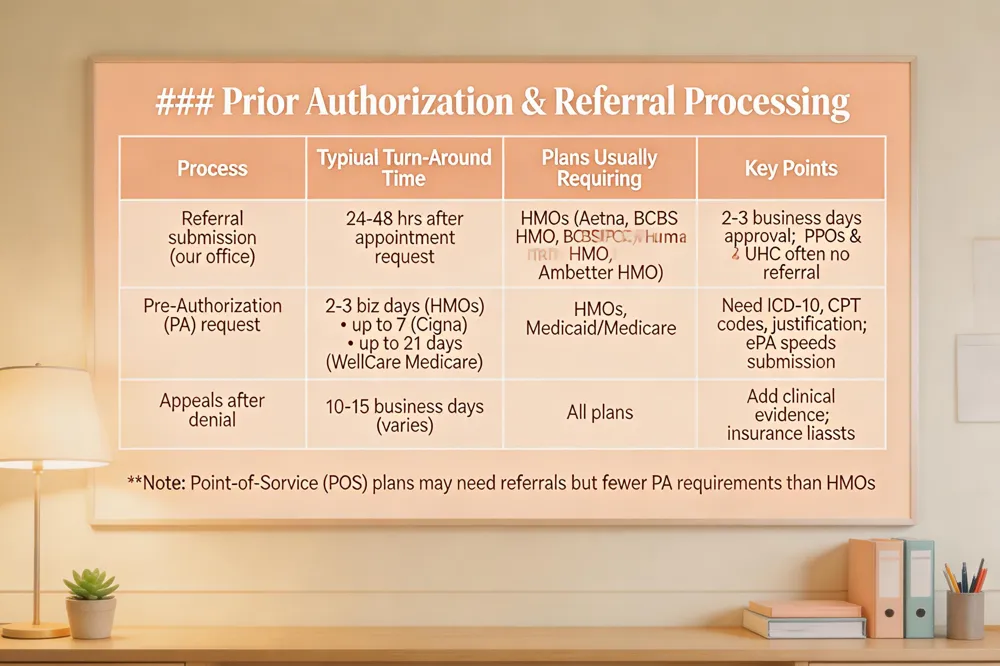
Prior Authorization & Referral Processing
| Process | Typical Turn‑Around Time | Plans Usually Requiring | Key Points |
|---|---|---|---|
| Referral submission (by our office) | 24‑48 hrs after appointment request | HMOs (Aetna, BCBS HMO, BCBS POS, Humana HMO, Ambetter HMO) | 2‑3 business days for approval; PPOs & many UnitedHealthcare plans often no referral needed |
| Pre‑Authorization (PA) request | 2‑3 business days (HMOs) – up to 7 business days (Cigna) – up to 21 calendar days (WellCare Medicare Advantage) | HMOs, many Medicaid & Medicare plans | Must include ICD‑10 diagnosis, CPT codes, justification; ePA can speed up submission |
| Appeals after denial | Varies; often 10‑15 business days | All plans | Provide additional clinical evidence; hospital’s insurance liaison can assist |
Note: Point‑of‑Service (POS) plans may need referrals but generally have fewer PA requirements than HMOs.
 Definition of pre‑authorization
Pre‑authorization (also called prior authorization, prior approval, or prior‑certification) is an insurer’s decision that a specific service, medication, test, or device is medically necessary and therefore reimbursable. The insurer reviews the request before care is provided and may require documentation from the physician. If approved, the cost is covered according to the plan’s benefits; if denied, families must appeal or seek an alternative. This safeguard is intended to control costs and direct care to the most appropriate setting, and it is especially common for pediatric cardiology imaging, procedures, and specialty drugs.
Typical referral processing times
Our office submits referrals within 24‑48 hours of your appointment request. After the insurer receives the request, turnaround varies by plan: Aetna, BCBS HMO, BCBS POS, Humana HMO and Ambetter HMO typically approve in 2‑3 business days; Cigna (including HMO, POS, Healthspring and Medicare) may take up to 7 business days; WellCare Medicare Advantage can require up to 21 calendar days. PPO plans and many UnitedHealthcare commercial, Medicaid, and Medicare plans often do not need a separate referral authorization. Families can track status through the patient portal or by calling our referrals department.
Plans that require referrals and precertification
Health Maintenance Organizations (HMOs) most commonly require a primary‑care referral before a specialist visit and also demand pre‑authorization for many tests, procedures, and medications. Point‑of‑Service (POS) plans may also need referrals but generally impose fewer prior‑authorization requirements than HMOs. Understanding your plan’s rules helps prevent delays in accessing pediatric cardiology care.
Frequently asked questions
What does a pre‑authorization mean for insurance? Pre‑authorization is the insurer’s review of medical necessity before a service is delivered. Approval ensures coverage; denial may require an appeal or alternative treatment.
How long does it take for insurance to accept a referral? Most referrals are submitted by our office within 24‑48 hours. Processing times range from 2‑3 business days for many HMO plans to up to 21 calendar days for some Medicare Advantage plans.
Which type of insurance requires referrals to specialists and precertification? Health Maintenance Organizations (HMOs) most frequently require both a referral and prior‑authorization for non‑routine services. Some Point‑of‑Service (POS) plans also need referrals, but they usually have fewer prior‑authorization mandates.
Pediatric Specialty Care in Federal Way: Access and Resources
Federal Way Pediatric Clinics
| Clinic | Address | Phone(s) | Services Offered | Referral / PA Process |
|---|---|---|---|---|
| Pediatrics Federal Way (Northwest at Mary Bridge Children’s) | 505 South 336th St., Suite 210, Federal Way, WA | (206) 395‑6049 | Primary care, well‑child, immunizations, chronic disease, urgent‑illness, pediatric cardiology, allergy & immunology, mental‑health | Referral via PCP; ePA submission through ProviderOne; insurance liaison available |
| Federal Way Pediatrics, C & C Medical Associates | 710 S 348th St., STE B, Federal Way, WA | (425) 243‑2293 | Same as above + telehealth | Same referral workflow; ePA encouraged |
| Federal Way Pediatric Associates | 32124 1st Ave S, Suite 100, Federal Way, WA 98003 | (206) 395‑6049 / (425) 243‑2293 | Primary care, walk‑in sick visits, 24/7 on‑call, telehealth, pediatric cardiology (collaboration with Saint Francis Hospital) | PCP referral; ePA via ProviderOne; dedicated insurance liaison for PA |
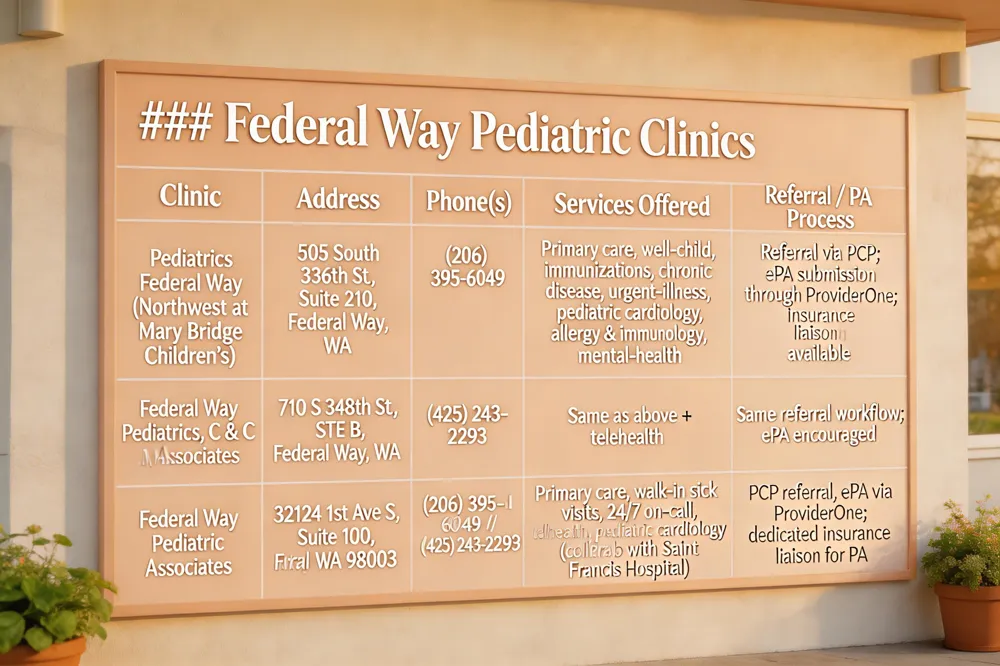 Federal Way offers comprehensive pediatric care through several trusted clinics. Pediatrics Federal Way includes Pediatrics Northwest at Mary Bridge Children’s (505 South 336th St., Suite 210) and Federal Way Pediatrics, C & C Medical Associates (710 S 348th St., STE B). Both provide full‑service primary care—well‑child visits, immunizations, chronic disease management, urgent‑illness treatment—and specialty services such as pediatric cardiology, allergy & immunology, and mental‑health support. Appointments can be scheduled by calling (206) 395‑6049 or (425) 243‑2293, or via the MyChart portal.
Federal Way Pediatric Associates is a multi‑physician practice at 32124 1st Ave S, Suite 100, Federal Way, WA 98003. It offers well‑child visits, immunizations, chronic disease management, walk‑in sick visits, 24/7 on‑call care, and telehealth appointments. The practice’s pediatric cardiology program, led by Dr. Nauman Ahmad, MD, collaborates with local hospitals— including Saint Francis Hospital—to diagnose and treat childhood heart conditions. Families can schedule visits or telehealth consults using the same phone numbers or MyChart. Both clinics prioritize clear communication, electronic prior‑authorization (ePA) submission through ProviderOne, and a dedicated insurance liaison to streamline referrals and reduce delays for federal Way families.
Systemic Challenges and Practical Tips for Getting Approvals
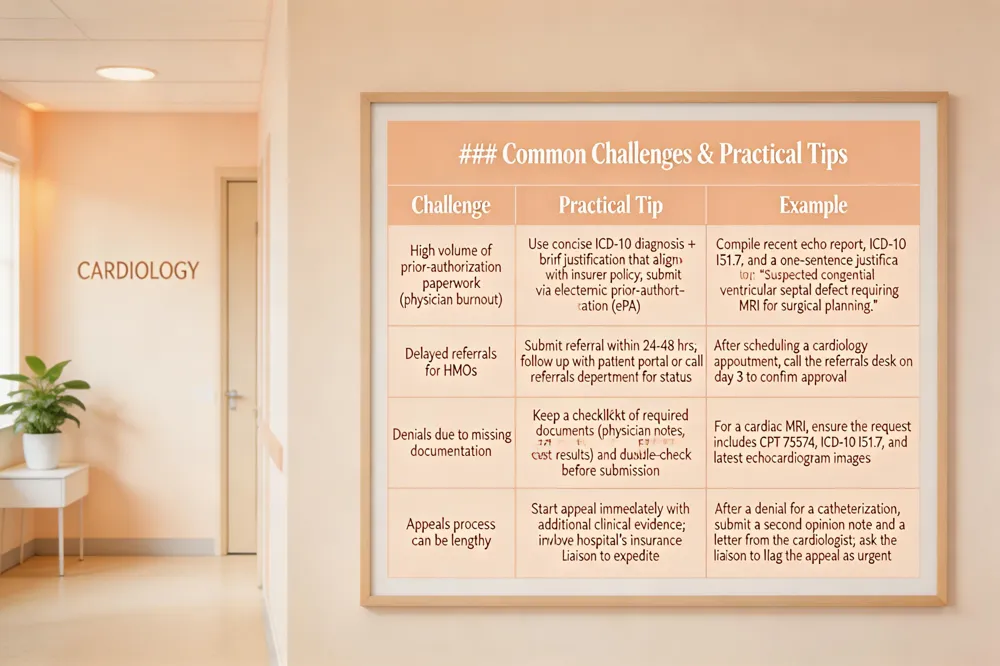
Common Challenges & Practical Tips
| Challenge | Practical Tip | Example |
|---|---|---|
| High volume of prior‑authorization paperwork (physician burnout) | Use concise ICD‑10 diagnosis + brief justification that aligns with insurer policy; submit via electronic prior‑authorization (ePA) | Compile recent echo report, ICD‑10 I51.7, and a one‑sentence justification: “Suspected congenital ventricular septal defect requiring MRI for surgical planning.” |
| Delayed referrals for HMOs | Submit referral within 24‑48 hrs; follow up with patient portal or call referrals department for status | After scheduling a cardiology appointment, call the referrals desk on day 3 to confirm approval |
| Denials due to missing documentation | Keep a checklist of required documents (physician notes, CPT codes, prior test results) and double‑check before submission | For a cardiac MRI, ensure the request includes CPT 75574, ICD‑10 I51.7, and latest echocardiogram images |
| Appeals process can be lengthy | Start appeal immediately with additional clinical evidence; involve hospital’s insurance liaison to expedite | After a denial for a catheterization, submit a second opinion note and a letter from the cardiologist; ask the liaison to flag the appeal as urgent |
 Physician burnout ranks fourth among pediatric specialties, driven by endless prior‑authorization paperwork. The AMA’s Gold Card reform would exempt doctors with ≥90 % approval rates from routine PA steps.
How to get insurance to approve a pre‑authorization? Compile record, a clear ICD‑10 diagnosis, and a brief justification that matches the insurer’s policy. Have the pediatric cardiology office submit recent test results and physician notes via ePA, verify the request. If denied, appeal with evidence.
Steps for requesting referrals and authorizations. Verify whether your plan needs a referral or PA, then let the PCP send a written recommendation with CPT and ICD‑10 codes. Insurer reviews and decides in days; schedule the appointment promptly. If denied, discuss alternatives or file an appeal.
Putting It All Together for Your Child’s Care
Key take‑aways for families: Prior authorizations are a major source of delay in pediatric specialty care, especially cardiology, and can lead to emergency visits, higher costs, and even serious clinical events. Most insurers cover only one drug formulation, so children often need multiple PA requests for liquid or age‑appropriate meds. The AMA’s Gold Card program and legislation such as H.R. 4968 aim to shorten turnaround times, but state law still allows up to 30‑day waits for non‑urgent referrals.
Resources for assistance: Use your insurer’s electronic PA portal (ePA) to speed up decisions—Washington’s ProviderOne and e‑Prior systems can cut processing to 48‑72 hours. Contact your pediatric practice’s insurance liaison (e.g., Dr. Ahmad’s office at 253‑661‑5939) or the Washington Health Care Authority’s Help Me Grow Hotline (1‑800‑322‑2588) for guidance. Families can also call the Apple Health for Kids help line (1‑800‑562‑3022) or visit the Washington State Health Care Authority website for step‑by‑step PA guides.
Next steps when facing delays: Keep a log of all PA communications, dates, and staff names. Follow up with the practice’s billing team 2–3 business days after submission and be ready to provide extra documentation quickly. If a request is denied, appeal within the 30‑day window, attaching test results or a specialist’s letter of medical necessity. While waiting, discuss alternative formulations or interim treatments with your pediatrician to avoid gaps in care. Remember, early and persistent communication with both your PCP and insurer can often prevent prolonged waits and protect your child’s health.