Why Personalized Care Matters
Children’s diabetes is one of the most common endocrine disorders in the United States and is rising steadily, with about 1 in 500 children in Washington state diagnosed. Because each child’s growth stage, activity level, genetics, and family dynamics differ, a one‑size‑fits‑all approach cannot achieve optimal glycemic control. Individualized treatment plans that incorporate real‑time continuous glucose monitoring, insulin‑pump or automated‑delivery systems, carbohydrate‑counting education, and culturally sensitive counseling have been shown to lower HbA1c by 0.5‑1 % and reduce hypoglycemia episodes. These benefits are maximized when a multidisciplinary team—including a pediatric endocrinologist, certified diabetes educator, dietitian, mental‑health specialist, and when needed, cardiology or genetics experts—collaborates to address medical, nutritional, and psychosocial needs. Family‑centered care, telehealth data sharing, and regular psychosocial screening ensure that the child’s plan evolves with puberty, lifestyle changes, and emerging technologies, supporting long‑term health and quality of life.
Understanding Blood Sugar Targets and Monitoring
Blood Sugar Targets by Age
| Age Group | Pre‑meal Target (mg/dL) | Bedtime Target (mg/dL) | Fasting Target (mg/dL) |
|---|---|---|---|
| < 5 yr | 80‑200 | 90‑150 | 70‑120 |
| 5‑11 yr | 70‑180 | 90‑150 | 70‑120 |
| ≥ 12 yr | 70‑150 | 90‑150 | 70‑120 |
| Symptoms of High (>200 mg/dL) | Symptoms of Low (<70 mg/dL) |
|---|---|
| Fatigue, stomachache | Sweating, hunger, shakiness |
| Headache, “off‑balance” | Confusion, irritability |
 Pediatric diabetes care relies on age‑specific glucose goals: children < 5 years aim for 80‑200 mg/dL, ages 5‑11 years for 70‑180 mg/dL, and adolescents ≥ 12 years for 70‑150 mg/dL, with fasting values usually 70‑120 mg/dL. High readings (>200 mg/dL) may cause fatigue or stomachache; low readings (<70 mg/dL) can trigger sweating, hunger, or shakiness.
Child blood sugar levels chart – The ADA recommends pre‑meal targets of 90‑130 mg/dL and bedtime 90‑150 mg/dL. Individual goals may shift with growth, puberty, activity, or illness, so always confirm your child’s range with the pediatric endocrinologist.
How to test child for diabetes at home – Wash hands, prick the side of a finger (or forearm), collect a drop of blood, apply it to a fresh strip in a calibrated meter, and record the value. For continuous data, a CGM sensor is placed subcutaneously and streams real‑time glucose to a smartphone or receiver, allowing rapid insulin adjustments.
What is the #1 worst food for your blood sugar? – Sugary drinks (sodas, fruit juices, energy drinks) cause the quickest glucose spikes and are the single most detrimental item for glycemic control. Reducing these beverages is the most effective dietary change for stable blood sugar.
Life Expectancy and Long‑Term Outlook
Survival Estimates for Pediatric Type 1 Diabetes
| Cohort (Diagnosis Years) | Avg. Survival (years) | Relative to General Population |
|---|---|---|
| 1950‑s5 | ca 53 years | ~15 years shorter |
| 1965‑1980 | ~68 years | ~5‑6 years shorter |
| European <10 yr diagnosis | 15‑18 years less | Significant cardiovascular impact |
Modern therapies (CGM, pumps, AID, aggressive risk‑factor management) are narrowing these gaps.
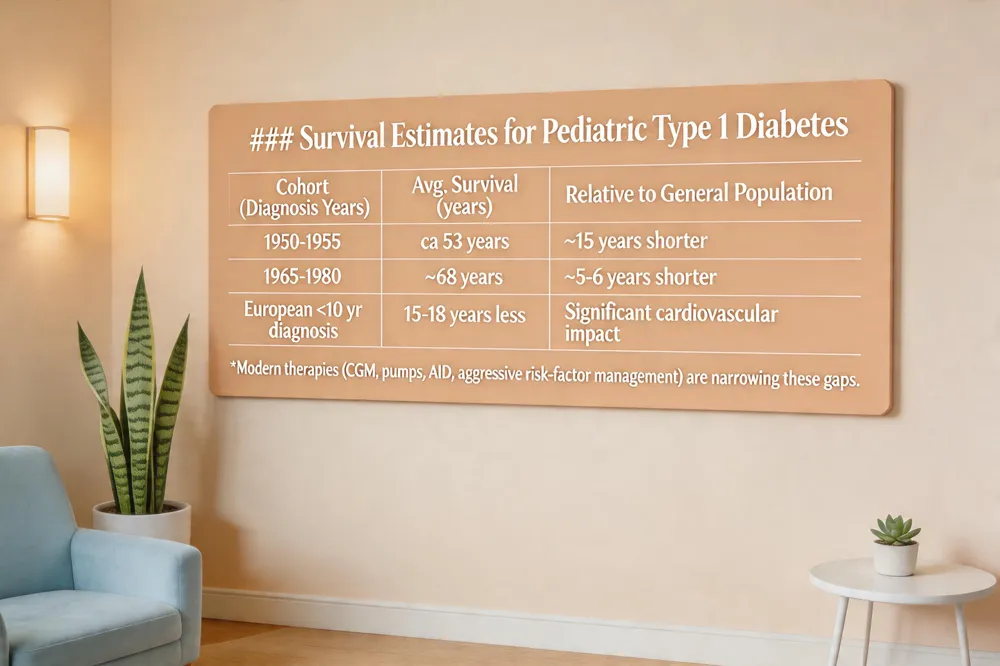 Children diagnosed with type 1 diabetes today have a life expectancy that is close to normal, yet still modestly shorter than peers without the disease. Long‑term U.S. cohorts show an average survival of about 68 years for those diagnosed between 1965‑1980—approximately 15 years longer than the 1950s cohort but still a few years below the general population. European studies suggest a diagnosis before age 10 may reduce life expectancy by 15‑18 years, largely because of cardiovascular complications that begin early and accelerate atherosclerosis. Modern advances—real‑time continuous glucose monitoring, insulin pump therapy, automated insulin delivery, and aggressive management of blood pressure, lipids, and weight—have markedly improved glycemic control, reduced hypoglycemia, and slowed heart‑risk progression, narrowing the longevity gap. Ongoing, individualized, multidisciplinary care that includes pediatric cardiology, nutrition, and mental‑health support remains essential for maximizing both lifespan and quality of life.
The most common endocrine disorder in U.S. children is thyroid disease, closely followed by type 1 diabetes and growth‑related conditions.
Guidelines, Standards, and Resources
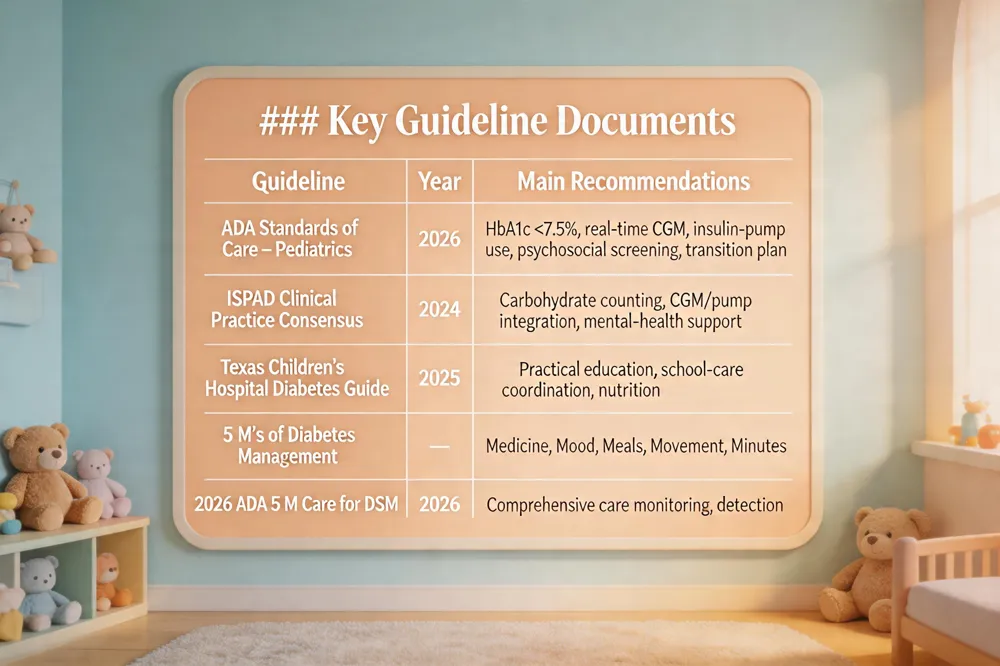
Key Guideline Documents
| Guideline | Year | Main Recommendations |
|---|---|---|
| ADA Standards of Care – Pediatrics | 2026 | HbA1c < 7.5 %, real‑time CGM, insulin‑pump use, psychosocial screening, transition plan |
| ISPAD Clinical Practice Consensus | 2024 | Carbohydrate counting, CGM/pump integration, mental‑health support |
| Texas Children’s Hospital Diabetes Guide | 2025 | Practical education, school‑care coordination, nutrition |
| 5 M’s of Diabetes Management | — | Medicine, Mood, Meals, Movement, Minutes |
| 2026 ADA 5 M Care for DSM | Es 202 Comprehensive Mult3,, | , care monitoring com detection |
| –hood | . |
 American Diabetes Association pediatric guidelines
The ADA’s Standards of Care in Diabetes dedicates a chapter to children < 18 years. It sets HbA1c targets < 7.5 % for most youth, recommends real‑time CGM and insulin‑pump use, and stresses individualized nutrition, growth monitoring, psychosocial screening, and a transition plan to adult care.
American Diabetes Association pediatric guidelines
The ADA’s Standards of Care in Diabetes dedicates a chapter to children < 18 years. It sets HbA1c targets < 7.5 % for most youth, recommends real‑time CGM and insulin‑pump use, and stresses individualized nutrition, growth monitoring, psychosocial screening, and a transition plan to adult care.
Pediatric diabetes Guidelines PDF Downloadable PDFs are available from ISPAD (2024 Clinical Practice Consensus Guidelines) and the ADA (2026 Standards of Care—children & adolescents). Texas Children’s Hospital also offers a Type 1 Diabetes Education Guide. Search the ISPAD website, ADA Diabetes Care journal page, or Texas Children’s Hospital resources for direct links.
Pediatric type 1 diabetes management guidelines PDF Key documents include ISPAD’s free PDF, the ADA’s 2025 pediatric section, and the Texas Children’s Hospital education guide. All cover glycemic targets, insulin therapy, carbohydrate counting, CGM/pump integration, and mental‑health support.
What are the 5 M’s of diabetes management? Medicine, Mood, Meals, Movement, and Minutes. Medicine = meds & glucose checks; Mood = emotional‑health coping; Meals = balanced, carb‑aware nutrition; Movement = regular age‑appropriate activity; Minutes = adequate sleep/rest for optimal insulin sensitivity.
14 children and adolescents Standards of Care in diabetes 2026 The 2026 ADA standards highlight comprehensive DSMES, personalized nutrition, frequent glucose monitoring, psychosocial screening, lifestyle‑first treatment for type 2, and early comorbidity detection. They also mandate a structured transition plan beginning in early adolescence to ensure seamless adult‑care handoff.
Local Care Options in Federal Way
Pediatric Diabetes Care Locations (Federal Way, WA)
| Facility | Address | Phone | Services |
|---|---|---|---|
| Mary Bridge Children’s Outpatient Center | 505 South 336th St, Suite 200 & 330, Federal Way, WA 98003 | 253‑792‑6630 (clinic) / 253‑697‑5200 (therapy) | Endocrinology, developmental‑behavioral, gastroenterology, cardiology, OT/PT/SLP |
| Seattle Children’s Endocrinology (South Clinic) | 34920 Enchanted Parkway S, Federal Way, WA 98003 | 206‑987‑2640 | Multidisciplinary diabetes care, transition clinics, research trials |
| Pediatrics Northwest | 505 South 336th St, Suite 210, Federal Way, WA 98003 | 253‑927‑3243 | Well‑child exams, asthma, allergy, pulmonology, sleep medicine |
| Seattle Children’s South Clinic (affiliated) | 505 South 336th St, Federal Way, WA 98003 | 206‑987‑2640 | Urgent‑care, specialty referrals, coordinated care with main Seattle Children’s Hospital |
Referral from a pediatrician is typically required; most providers see patients up to age 21.
 Mary Bridge Federal Way
Mary Bridge Children’s Outpatient Center is located at 505 South 336th St, Suite 200 & 330, Federal Way, WA 98003. It offers pediatric specialty clinics (including endocrinology, developmental‑behavioral, gastroenterology, cardiology) and therapy services (occupational, physical, speech). Hours are Mon‑Fri 8 a.m.–4:30 p.m. for clinics and 8 a.m.–6 p.m. for therapy. Call 253‑792‑6630 (specialty clinics) or 253‑697‑5200 (therapy) to schedule. MyChart provides online appointments and test‑result access.
Seattle Children’s Endocrinology
Seattle Children’s Endocrinology and Diabetes program provides comprehensive, multidisciplinary care for diabetes, growth, and other hormone disorders. The team includes pediatric endocrinologists, certified diabetes educators, dietitians, social workers, and mental‑health professionals. Services feature medical management, education, transition clinics, and research trial access. To request an appointment call 206‑987‑2640 or visit the South Clinic at 34920 Enchanted Parkway S, Federal Way, WA 98003.
Children’s Hospital Federal Way
Federal Way has no standalone children’s hospital; families receive pediatric care at nearby specialty clinics such as Seattle Children’s South Clinic and Mary Bridge Children’s Outpatient Center. Both locations provide urgent‑care, specialty referrals, and coordinated care with the main Seattle Children’s Hospital in Seattle for emergencies.
Pediatrics Northwest – Federal Way
Pediatrics Northwest, 505 South 336th St, Suite 210, Federal Way, WA 98003, offers well‑child exams, same‑day sick visits, asthma, allergy, pulmonology, and sleep medicine. Hours are Mon‑Fri 8 a.m.–5:30 p.m.; new patients call 253‑927‑3243 or use MyChart. The practice affiliates with Mary Bridge Children’s Hospital for specialty referrals.
Referral & Age Limits
A referral from your child’s pediatrician is typically required to see a pediatric endocrinologist, and most providers see patients up to age 21 years. After that, care transitions to adult endocrinology.
Finding a Pediatric Endocrinologist Near You
Ask your pediatrician for a referral, search the Washington State provider directory, or use platforms like Healthgrades setting zip 98001. Many clinics offer telehealth for initial consultations.
Personalized Management Strategies
Core Strategies for Managing Pediatric Type 1 Diabetes
| Strategy | Components |
|---|---|
| Behavioral & Psychosocial | Mood monitoring, mental‑health counseling, consistent daily routines |
| Nutrition & Activity | Carbohydrate‑counted meals, ≥ 60 min aerobic activity, culturally tailored meal plans |
| Technology Integration | CGM, insulin pump, hybrid closed‑loop, AI‑driven dosing alerts |
| Support & Transition | Peer support groups (Breakthrough T1D, JDRF), early transition planning to adult care |
| Clinical Follow‑up | Quarterly HbA1c, thyroid/celiac screening, retinal exam, multidisciplinary team visits |
These elements are coordinated by a pediatric endocrinologist, certified diabetes educator, dietitian, and mental‑health professional.
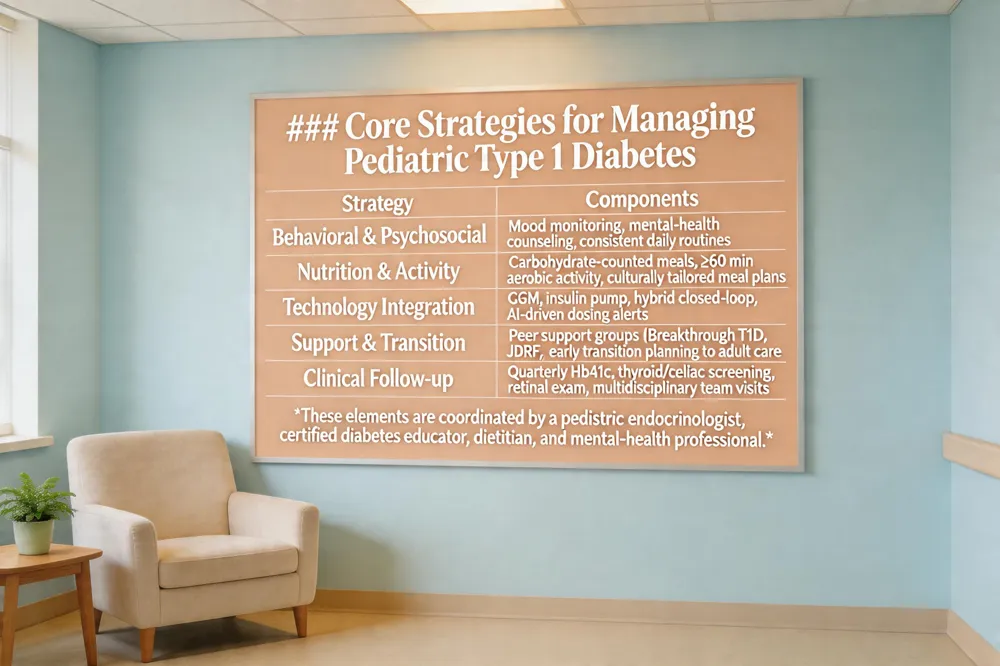 Behavioral and psychosocial considerations – Children with type 1 diabetes often show mood swings, irritability, or concentration difficulties linked to fluctuating glucose levels and chronic‑condition stress. Low glucose can cause fatigue and confusion; high glucose may trigger headache and a sense of being “off‑balance.” Consistent routines, balanced meals, regular monitoring, and access to mental‑health counseling help stabilize emotions and prevent persistent neuro‑behavioral changes.
Nutrition and activity planning – A carbohydrate‑counted diet paired with at least 60 minutes of daily aerobic activity supports growth and glycemic control. Pediatric dietitians tailor meal plans to cultural preferences and activity levels, while exercise‑adjusted insulin dosing prevents hypoglycemia during play.
Technology integration (CGM, pumps, AI) – Real‑time continuous glucose monitoring (CGM) and insulin pump therapy, including hybrid closed‑loop systems, lower A1c by 0.5‑1 % and reduce hypoglycemia. Emerging AI‑driven decision support can predict lows and suggest dosing adjustments, enhancing telehealth‑based care.
Support groups and transition planning – Local resources such as Breakthrough T1D Greater Northwest and JDRF virtual meet‑ups provide peer support. Early transition programs begin in early adolescence, ensuring a smooth move to adult care.
Why see a pediatric endocrinologist? – Referral is warranted for growth concerns, puberty issues, diabetes, thyroid or adrenal disorders, and rare genetic endocrine conditions. Specialized evaluation and coordinated multidisciplinary care optimize long‑term health.
Newly diagnosed type 1 diabetes guidelines – Confirm diagnosis with glucose, HbA1c, and antibody testing; screen for thyroid, celiac disease, and retinopathy. Initiate intensive education on carbohydrate counting, insulin regimens, and sick‑day rules. Assemble a team of endocrinologist, diabetes educator, dietitian, and mental‑health professional to craft a personalized care plan and schedule regular follow‑up.
Managing type 1 diabetes in children – Lifelong insulin therapy (multiple daily injections or pump), frequent glucose checks (CGM preferred), balanced nutrition, and regular physical activity are core. Ongoing DSMES, multidisciplinary follow‑up, and school‑care coordination empower families and reduce complications.
Seattle Children’s Endocrinology contact – 206‑987‑2640 (central scheduling); South Clinic, Federal Way: 253‑838‑5878.
Future Directions and Community Support
Emerging artificial‑intelligence tools are being integrated into pediatric diabetes care to analyze continuous‑glucose‑monitor data, predict hypoglycemia, and suggest real‑time insulin adjustments, while precision‑medicine approaches target genetic subtypes such as monogenic diabetes for tailored therapy. In Federal Way, telehealth services now include virtual visits, remote CGM data sharing, and AI‑driven coaching, reducing travel barriers and allowing rapid treatment tweaks. The care model also prioritizes psychosocial health: routine screening for anxiety, depression, and diabetes distress, referrals to mental‑health specialists, and family‑focused education programs ensure emotional resilience and sustained adherence. These initiatives create a seamless, family‑centered network that supports long‑term health for children.