Why Heart Screening Matters
Congenital heart defects (CHDs) affect roughly 1 % of U.S. births—about 40,000 newborns each year—making them the most common birth defect. Early detection, especially through pulse‑oximetry screening before hospital discharge, dramatically improves survival; mandatory CCHD screening has cut early infant deaths by about 33%, averting roughly 120 deaths annually. National initiatives, such as the American Academy of Pediatrics’ universal CCHD algorithm and the CDC’s NewSTEPS toolkit, standardize screening, educate families, and streamline rapid follow‑up with echocardiography. Together, these efforts ensure that critical heart defects are identified promptly, allowing timely surgical or catheter‑based interventions that preserve life and quality of life for infants and their families.
Understanding Critical Congenital Heart Disease Screening
Pulse‑oximetry Pass Criteria
| Site | Minimum Saturation | Maximum Acceptable Difference |
|---|---|---|
| Pre‑ductal (right hand) | ≥ 95 % | |
| Post‑ductal (foot) | ≥ 95 % | |
| Hand‑Foot Gradient | ≤ 3 % |
Fail Triggers
- Any reading < 90 % in either limb
- Two consecutive readings < 95 % on both sites
- Two consecutive hand‑foot differences > 3 % |
Algorithm Summary
| Step | Action |
|---|---|
| 1 | Measure both sites after ≥ 24 h of age, infant alert, off supplemental O₂ |
| 2 | If criteria met → Pass (document, discharge) |
| 3 | If any fail trigger → Repeat after ≥ 1 h |
| 4 | If repeat fails → Urgent cardiology referral and echocardiogram |
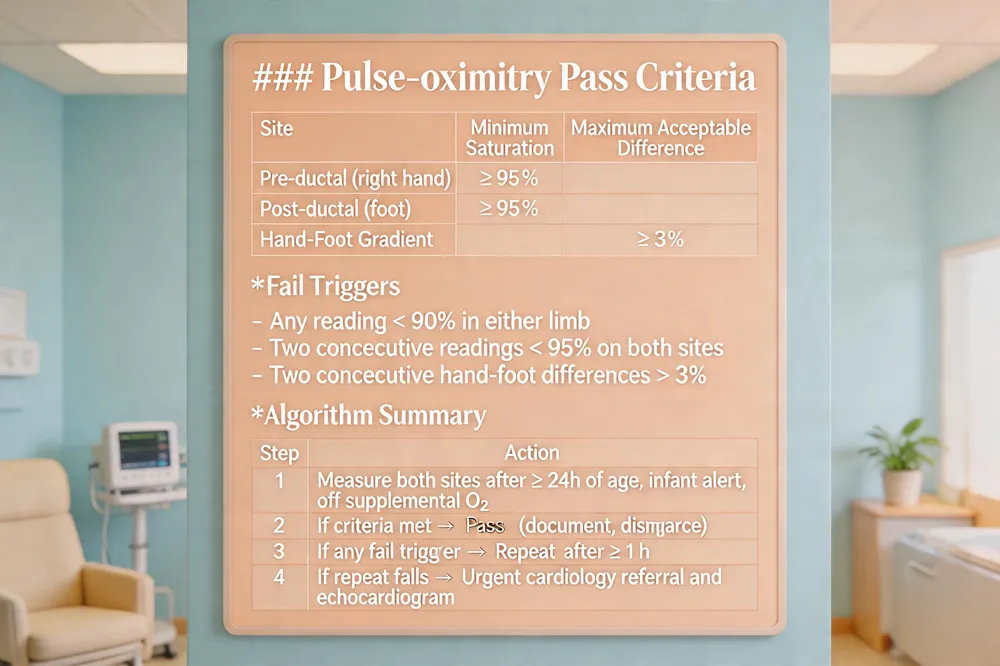 Pulse‑oximetry screening is a universal newborn test that detects critical congenital heart disease (CCHD) by measuring oxygen saturation in the right hand (pre‑ductal) and a foot (post‑ductal) after the infant is at least 24 hours old. The algorithm requires both sites to read ≥95 % and the absolute difference to be ≤3 %; any reading <90 % or two consecutive readings <95 % or >3 % difference trigger a failed screen and prompt an echocardiogram. The American Academy of Pediatrics (AAP) mandates this screening for all healthy‑appearing newborns before discharge, stresses alert state after weaning supplemental oxygen, and calls for precise documentation and rapid referral when the screen fails. By identifying hypoxemia that may be invisible on physical exam, the program reduces early infant mortality from CCHD by roughly one‑third and offers families timely, life‑saving care.
What Happens If a Newborn Fails the Screen?
Immediate Management Flowchart
| Step | Description |
|---|---|
| 1 | Repeat pulse‑oximetry after ≥ 1 h (infant alert, warm, off O₂) |
| 2 | If repeat still fails (≥ 90 % or gradient > 3 %) → Flag as failed |
| 3 | Notify bedside nurse → pediatrician → Pediatric cardiology consult |
| 4 | Cardiology orders urgent echocardiogram |
| 5 | If echo normal → evaluate non‑cardiac causes (lung disease, sepsis, hemoglobinopathies, hypothermia, PPHN) |
| 6 | Treat underlying cause; if cardiac lesion identified → plan surgical or interventional repair |
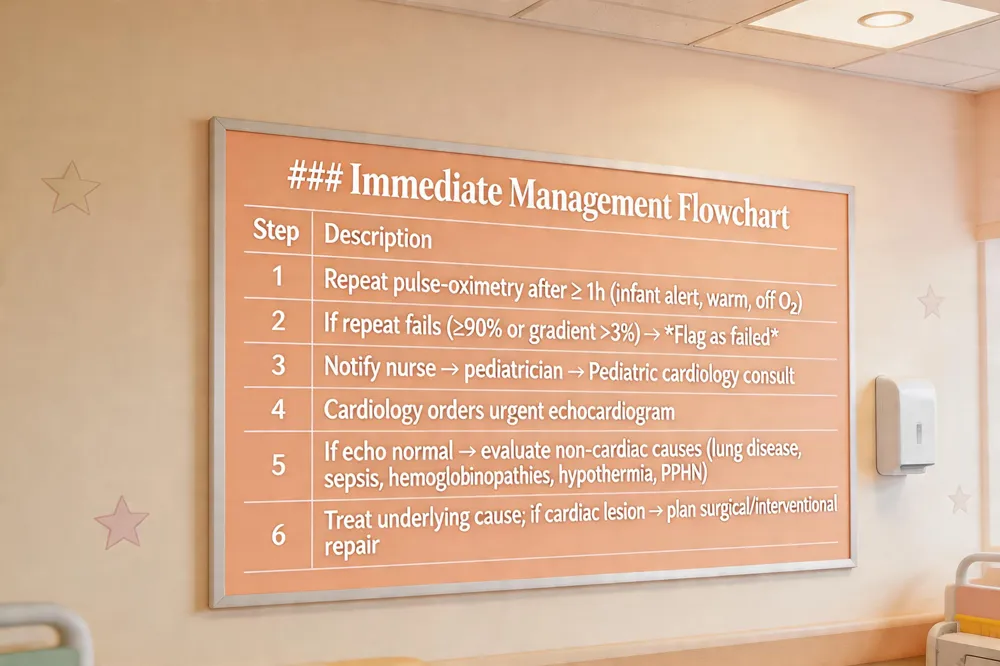 When a newborn does not meet the pulse‑oximetry pass criteria, the first step is to repeat the measurement after at least one hour while the infant is alert, off supplemental oxygen, and warm. If the second screen still shows a saturation < 90 % in either limb, a value < 95 % on two sites, or a hand‑foot gap > 3 % on two separate readings, the screen is considered failed.
Immediate pediatric cardiology referral – The bedside nurse alerts the pediatrician, who promptly arranges a pediatric cardiology consult. The cardiologist usually orders an urgent echocardiogram to visualize cardiac anatomy and blood flow.
Evaluation for non‑cardiac causes – If the echocardiogram is normal, clinicians investigate other sources of hypoxemia such as lung disease, sepsis, hemoglobinopathies, hypothermia, or persistent pulmonary hypertension, using chest X‑rays, labs, and clinical assessment.
Strategies to reduce false‑positives – Screen after 24 hours of age, when the infant is calm and weaned from oxygen; ensure proper probe placement and use hospital‑grade equipment; and repeat abnormal readings before labeling the screen as failed.
FAQ
- What should be done if a newborn fails the CCHD screen? If a newborn fails the CCHD pulse‑oximetry screen, the first step is to repeat the test after an hour to confirm the abnormal result. Persistent low oxygen saturation or a significant hand‑foot gradient then prompts a rapid pediatric cardiology referral. The cardiologist will usually order an echocardiogram to visualize the heart’s anatomy and blood flow. If the echocardiogram is normal, clinicians will look for other causes of hypoxemia such as lung disease, anemia, infection, or hemoglobin abnormalities and may obtain chest X‑rays or laboratory studies. All findings are reviewed together to determine whether the infant needs further cardiac intervention, monitoring, or treatment of a non‑cardiac condition.
- What are the normal values for CCHD pulse oximetry screening? Normal CCHD pulse‑oximetry screening results show an oxygen saturation of 95 % or higher in both the pre‑ductal (right hand) and post‑ductal (foot) sites. The two measurements should be within 3 % of each other. In healthy newborns, values typically range from 95 % to 100 % with a limb‑to‑limb difference of less than 4 % also considered acceptable. Any reading below 90 % at either site, a repeat measurement below 95 % on both sites, or a consistent difference greater than 3 % triggers a failed screen and warrants further evaluation.
Is CCHD Screening Mandatory Across the United States?
U.S. Adoption Overview
| Year | Milestone |
|---|---|
| 2011 | CCHD added to RUSP (Recommended Uniform Screening Panel) |
| 2015‑2022 | All 50 states & DC implement mandatory pulse‑oximetry screening in newborn‑screening panels |
| 2023 | AAP reinforces universal screening recommendation for all healthy‑appearing infants ≥ 24 h |
Enforcement – State health departments require reporting of screening results; hospitals must document pass/fail before discharge.
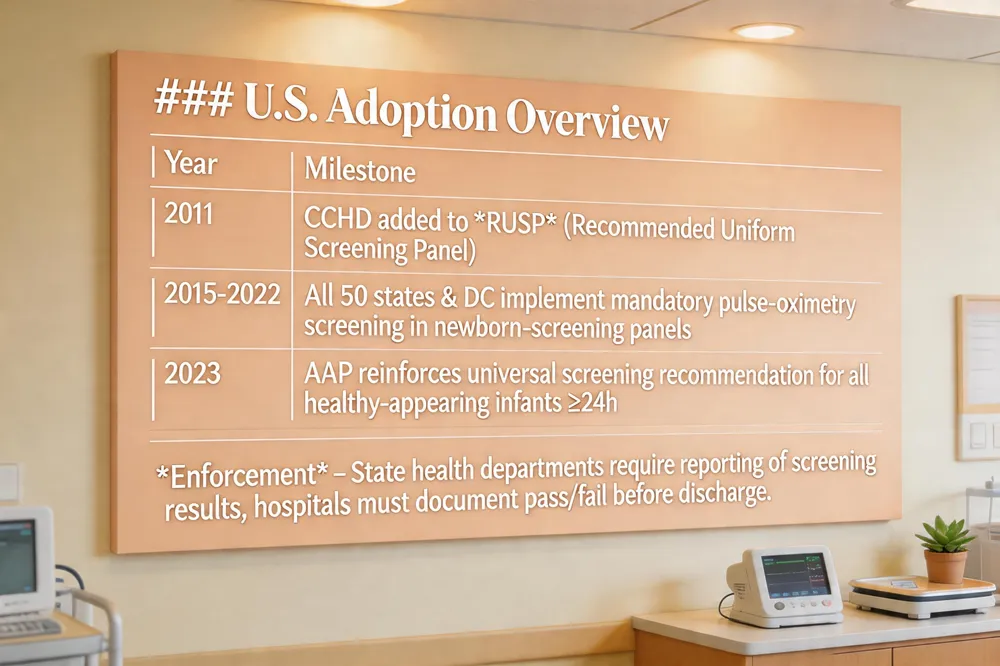 All 50 states have incorporated pulse‑oximetry screening for critical congenital heart defects (CCHD) into their newborn‑screening programs, making it a required component of routine newborn care. While there is no single federal law, the test was added to the U.S. Recommended Uniform Screening Panel (RUSP) in 2011, and the American Academy of Pediatrics (AAP) endorses universal screening for every healthy‑appearing infant after 24 hours of age (or before discharge). The AAP algorithm measures pre‑ductal (right hand) and post‑ductal (foot) saturations, a a pass when both are ≥9595 and with a difference of ≤3 % and repeat abnormal result prompts an echocardiogram. State health departments enforce the requirement, so in practice CCHD screening is nationwide mandatory.
Early Warning Signs and Causes of Congenital Heart Disease
Clinical Red Flags
| Sign | Typical Context |
|---|---|
| Cyanosis (lips, fingertips, skin) | Feeding, crying, or at rest |
| Rapid breathing (tachypnea) | Early infancy |
| Persistent cough / wheeze | Chronic respiratory irritation |
| Poor feeding / failure to thrive | Energy expenditure ↑ |
| Excessive sweating (head/neck) | During feeds |
| New heart murmur | Detected at well‑child visit |
Major Etiologic Factors
| Category | Examples |
|---|---|
| Genetic | Familial CHD, de‑novo mutations, chromosomal syndromes |
| Maternal Infections | Rubella, CMV |
| Metabolic/Environmental | Uncontrolled diabetes, phenylketonuria, teratogens (retinoids, ACE inhibitors), smoking, toxins |
| Nutritional | Folate deficiency, maternal alcohol use |
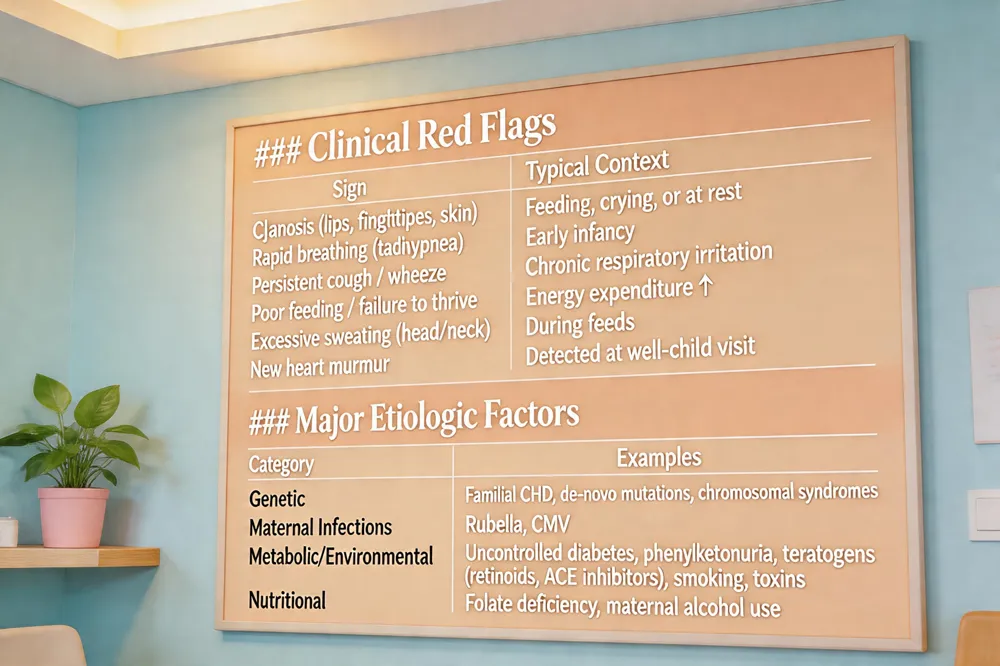 Infants with congenital heart disease often show cyanosis—bluish lips, fingertips, or skin—especially during feeding or crying, rapid breathing, persistent cough or wheeze, poor feeding, frequent vomiting, and failure to gain weight. Excessive sweating on the head and neck while feeding and unusual fatigue or lethargy are also red flags, and a heart murmur detected at a well‑child visit prompts further evaluation. CHD arises when the fetal heart does not form correctly in early pregnancy; most cases are idiopathic, but genetic mutations—familial or de‑novo—are major contributors, and a family history raises risk. Maternal rubella infection, uncontrolled diabetes, phenylketonuria, exposure to teratogenic drugs (e.g., retinoids, ACE inhibitors), smoking, and other environmental toxins increase the likelihood of structural defects. The five classic cyanotic lesions—often called the “five T’s”—are Transposition of the Great Arteries, Tetralogy of Fallot, Truncus Arteriosus, Total Anomalous Pulmonary Venous Connection, and Tricuspid Valve Abnormalities.
Long‑Term Outlook: Treatment, Life Expectancy, and Normal Life
Treatment & Prognosis Summary
| Intervention | Indications |
|---|---|
| Medications (e.g., prostaglandins, diuretics) | Stabilize circulation, manage heart failure |
| Catheter‑based procedures (device closure, stenting) | Isolated septal defects, ductus arteriosus |
| Surgical repair (valve repair, arterial switch, VSD closure) | Complex structural lesions |
| Palliative shunts (Blalock‑Taussig) | Non‑resectable cyanotic lesions |
| Heart transplant / VAD | End‑stage heart failure |
Life Expectancy – > 80 % survive to age 35; many repaired defects achieve near‑normal adult lifespan.
Normal Life – > 95 % reach adulthood; most can participate in sports and regular activities with periodic follow‑up.
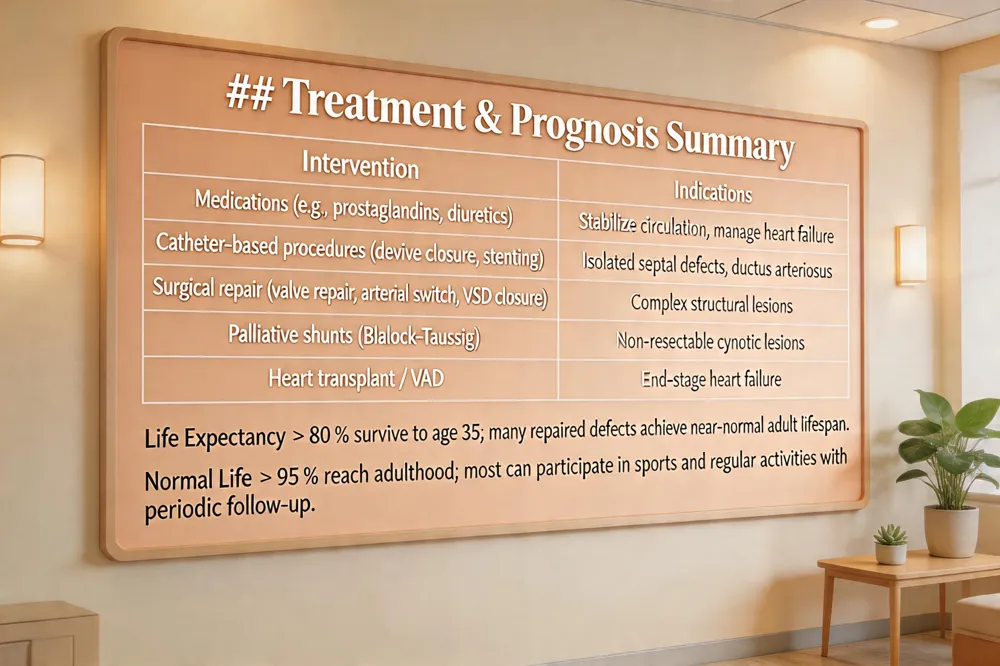 Treatment options: Medications, monitoring, procedures to close holes or enlarge vessels, and surgery for valve repair, septal closure, or arterial reconstruction. If repair is impossible, palliative shunts, ventricular assist devices, or transplantation are used.
Curability: Many defects are curable or treatable with surgery or interventions, allowing a normal life. Cyanotic lesions often require monitoring and interventions; they are managed rather than cured.
Life expectancy: Care yields >80 % survival to age 35 and near‑normal expectancy for mild or repaired defects; uncorrected lesions have lower survival but improve with treatment.
Normal life: Over 95 % of cases reach adulthood, and survivors thrive with follow‑up, participating sports.
Common defects: Ventricular septal defect, atrial septal defect, patent ductus arteriosus, pulmonary stenosis, Tetralogy of Fallot.
Inheritance: CHD can be inherited from either parent via autosomal, recessive, or X‑linked patterns; many cases are sporadic. Genetic counseling is recommended.
Beyond Newborn Screening: Ongoing Heart Health and Lipid Checks
Routine Pediatric Cardiac & Lipid Screening Schedule
| Age | Screening Component |
|---|---|
| 5 years | Blood pressure, height/weight, physical exam, optional ECG if indicated |
| 9‑11 years | Universal non‑fasting lipid panel (total cholesterol, LDL‑C, HDL‑C, triglycerides, non‑HDL‑C) |
| 12‑15 years | Blood pressure, repeat lipid panel if risk factors present |
| 17‑21 years | Universal lipid panel repeat (fasting optional) |
| Any age | Red‑flag signs (persistent cyanosis, new murmur, unexplained fatigue) → immediate cardiac evaluation |
Risk‑Based Adjustments – Children with obesity, diabetes, hypertension, or strong family history may need earlier or more frequent lipid testing.
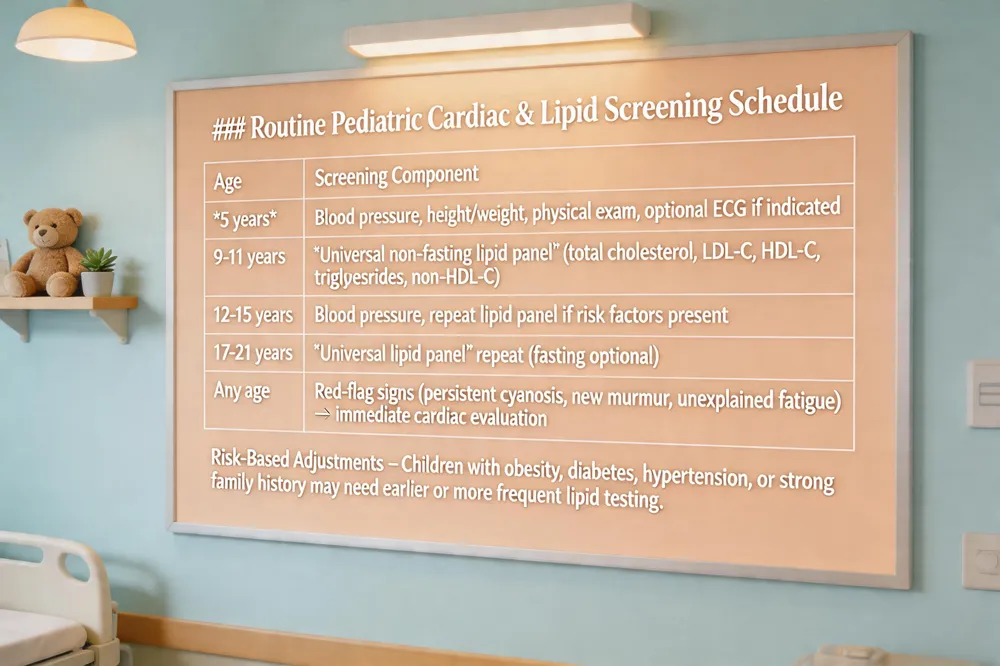 Routine pediatric heart screenings begin around age 5 and continue through adolescence, typically including blood‑pressure checks, height/weight measurements, and when indicated, an electrocardiogram. These evaluations help detect congenital heart disease, cardiomyopathy, or rhythm disorders before symptoms appear.
The American Academy of Pediatrics recommends universal lipid screening for all children between ages 9‑11 and again at 17‑21, using a non‑fasting panel that measures total cholesterol, LDL‑C, HDL‑C, triglycerides, and non‑HDL‑C. Children with obesity, diabetes, hypertension, or a family history of early heart disease may need earlier or repeat testing. Lifestyle changes are the first‑line response to abnormal results; only a small minority require medication.
Red‑flag signs that should prompt immediate cardiac assessment include persistent cyanosis, unexplained fatigue, poor feeding, rapid breathing, a new heart murmur, or abnormal heart rates.
Congenital heart defects (CHDs) affect about 1% of newborns in the U.S. each year (≈40,000).
Taking Action for Your Child’s Heart Health
Schedule your newborn’s pulse‑oximetry screen before leaving the hospital, ideally after 24 hours of age and once the baby is alert and off supplemental oxygen. A passed screen (both hand and foot ≥95 % saturation and ≤3 % difference) is reassuring, but it does not replace a thorough physical exam or family history. Watch for early warning signs such as persistent cyanosis, rapid or labored breathing, poor feeding, excessive sweating while feeding, or a new heart murmur. If any of these appear, contact your pediatrician immediately; an echocardiogram may be ordered. Arrange a follow‑up appointment with a pediatric cardiology team within a few days of a failed screen or concerning symptoms. Take advantage of community resources—AAP guidelines, CDC toolkits, local CHD support groups, and education videos—to stay informed and ease the care journey.