Understanding the Value of Specialized Cardiac Care for Children
Board‑certified pediatric cardiologists have completed a pediatric residency and at least three years of fellowship, confirming mastery of congenital and acquired heart disease in children. Their certification guarantees use of evidence‑based guidelines, advanced imaging (echo, MRI, CT) and minimally invasive procedures, which reduces complications and readmissions. In Federal Way, board‑certified specialists provide access to fetal echocardiography, cardiac catheterization and multidisciplinary care, eliminating long travel. Early detection and monitoring of murmurs, arrhythmias, cardiomyopathy and hypertension protect growth, development and long‑term health.
What does a pediatric cardiologist do?
 Board‑certified pediatric cardiologists are physicians who have completed a pediatric residency and a minimum three‑year fellowship in pediatric cardiology, confirming expertise in the unique anatomy, physiology, and disease patterns of children’s hearts. They diagnose and treat a wide spectrum of pediatric heart disease, from congenital heart defects present at birth to arrhythmias, cardiomyopathy, hypertension, and acquired conditions that arise later in childhood. Using child‑appropriate diagnostic tools—such as echocardiography (including fetal echo), electrocardiograms, cardiac MRI, CT, and cardiac catheterization— they obtain accurate images and functional data without unnecessary radiation exposure.
These specialists develop individualized treatment plans that may involve medication, lifestyle counseling, minimally invasive catheter‑based interventions, or coordination of surgery. They work within multidisciplinary teams that include pediatric surgeons, neonatologists, cardiac intensivists, genetic counselors, radiologists, and allied health professionals, ensuring comprehensive, family‑centered care from diagnosis through long‑term follow‑up and transition to adult congenital heart disease services. Families benefit from clear communication, education about genetic risk, and a seamless continuum of care that reduces complications, hospital readmissions, and anxiety for children and caregivers.
Pediatric vs. Adult Cardiology
 Pediatric cardiology focuses on patients from the fetal stage through adolescence, whereas adult cardiology treats individuals typically older than 18 years. Children’s hearts are still growing, so Board‑certified pediatric cardiologists manage a distinct spectrum of disease—including congenital heart defects, early‑onset cardiomyopathies, arrhythmias, and pediatric hypertension—while adult cardiologists address coronary artery disease, age‑related valve disorders, and hypertension‑driven complications.
The training pathway reflects this difference. Board‑certified pediatric cardiologists first complete a three‑year pediatric residency, then a minimum three‑year ACGME‑accredited fellowship in pediatric cardiology, passing a sub‑board examination administered by the American Board of Pediatrics. Adult cardiologists complete an internal medicine residency followed by a three‑year adult cardiology fellowship. This extra fellowship equips pediatric specialists with expertise in fetal echocardiography, pediatric‑specific echocardiography, cardiac MRI, CT, and catheterization using age‑appropriate equipment and dosing protocols.
What is the difference between a cardiologist and a pediatric cardiologist?
A cardiologist is a physician who diagnoses and treats heart disease primarily in adult patients, focusing on conditions such as coronary artery disease, hypertension‑related problems, and age‑related valve disorders. A pediatric cardiologist, by contrast, completes additional fellowship training in pediatric medicine and specializes in heart problems that affect patients from birth through adolescence, most often congenital defects, arrhythmias, and early‑onset cardiomyopathies. Because children’s hearts are smaller and still growing, Board‑certified pediatric cardiologists use age‑specific imaging techniques, dosing guidelines, and procedural tools tailored to a child’s size and developmental stage. They also provide lifelong monitoring for congenital conditions that may require surgery or catheter interventions during childhood and continued follow‑up into adulthood. In short, the two specialties differ in patient age range, the types of heart disease they manage, and the specialized training and equipment needed for caring for young patients.
Training Pathway to Becoming a Pediatric Cardiologist
 Board‑certified pediatric cardiologists follow a rigorous, step‑by‑step educational pathway that ensures they can safely diagnose and treat heart disease in children from the fetal stage through young adulthood.
Educational milestones – After a four‑year bachelor’s degree (often with a strong emphasis on biology, chemistry, and physics), a future cardiologist completes four years of medical school to earn an M.D. or D.O. degree.
Residency and fellowship requirements – The physician then enters a three‑year ACGME‑accredited pediatric residency, gaining broad experience in infant and child health. This is followed by a minimum three‑year pediatric cardiology fellowship, where the fellow masters pediatric‑specific imaging (echocardiography, cardiac MRI, CT, cardiac catheterization), catheterization, electrophysiology, and the management of congenital and acquired heart conditions. Some programs may add a research year, extending training slightly.
Board certification process – After residency, the physician becomes board‑certified in general pediatrics. The subspecialty board exam administered by the American Board of Pediatrics Sub‑board of Pediatric Cardiology must then be passed, confirming mastery of pediatric cardiac knowledge and skills. Ongoing Maintenance of Certification (MOC) keeps physicians current with evolving guidelines and technologies.
Answering the key questions:
- How many years of training are required? Roughly fourteen years after high school (four years undergraduate, four years medical school, three years residency, three years fellowship).
- How to become a pediatric cardiologist? Earn a bachelor’s degree, attend an accredited medical school, complete a three‑year pediatric residency, pursue a three‑year pediatric cardiology fellowship, achieve board certification in pediatrics and pediatric cardiology, and maintain certification through continuous education.
This structured training guarantees that families receive care from physicians who meet nationally recognized standards of expertise and safety.
Career Outlook and Compensation in Pediatric Cardiology
 Board‑certified pediatric cardiologists enjoy strong financial rewards and high job satisfaction. The specialty’s median total compensation in the United States is roughly $335,000–$350,000 per year, with most physicians earning between $300,000 and $450,000. Salary varies by practice setting, experience and geography; the Midwest (Illinois, Ohio) offers the highest median packages, often exceeding $340,000. Compared with adult cardiologists, pediatric cardiologists earn slightly less (median ~ $335,000 vs. $400,000 for adults), but the gap narrows in high‑demand markets or academic centers where compensation can be comparable.
Is pediatric cardiology a good career? Yes. Physicians report high fulfillment from caring for infants, children and adolescents with complex heart disease, and the field shows robust demand, particularly in growing regions such as Federal Way, Washington. The career outlook is positive, with projected workforce growth of 83 % by 2040 and expanding fellowship opportunities.
What is the average salary? Approximately $335,000–$350,000 annually, according to MGMA and industry surveys.
Where do they earn the most? The Midwest (Illinois, Ohio) and large academic hubs provide the top compensation packages.
Local Advantages of Board‑Certified Pediatric Cardiologists in Federal Way
 Choosing a board‑certified pediatric cardiologist in Federal Way means your child receives care from a physician who has completed a pediatric residency, a minimum three‑year fellowship in pediatric cardiology, and passed the rigorous American Board of Pediatrics subspecialty exam. This certification guarantees up‑to‑date expertise in diagnosing congenital heart disease, pulmonary hypertension, cardiomyopathy, and even fetal heart conditions. Local specialists such as Dr. Nauman Ahmad perform all key tests—EKG, echocardiogram, Holter monitoring, and blood‑pressure assessments—on‑site, allowing rapid results and coordinated follow‑up with nearby hospitals, andet Health and Saint Francis. When selecting a board‑certified pediatric cardiologist, look for board certification, experience with your child’s specific condition, affiliation with a reputable children’s hospital (e.g., Seattle Children’s), strong patient reviews, and a multidisciplinary team that includes surgeons, nurses, and genetic counselors. Practical considerations such as convenient location, telehealth options, and insurance network familiarity are also important. Northwest Congenital Heart Care in Tacoma welcomes Federal Way families, offering comprehensive services—including echocardiograms, cardiac MRI, and catheterizations—via easy appointment scheduling. Seattle Children’s Cardiology in Federal Way provides IAC‑accredited fetal and transthoracic echocardiograms, rhythm monitoring, minimally invasive catheter procedures, newborn cardiac assessments, and transition care for adolescents, ensuring seamless, lifelong heart health for your child.
Subspecialties and Advanced Care Options in Pediatric Cardiology
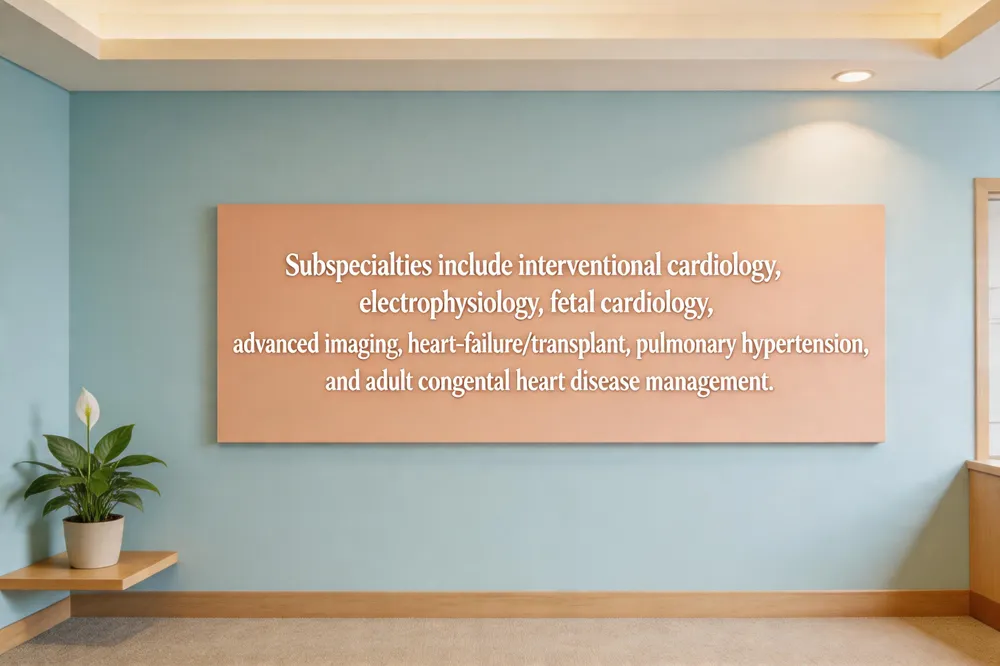 Board‑certified pediatric cardiologists in the Federal Way region offer a full spectrum of subspecialty care that extends from the womb through adulthood. Interventional cardiology uses catheter‑based techniques to close septal defects, place stents, and repair valve problems without open‑heart surgery, shortening recovery and preserving the child’s growth potential. Electrophysiology evaluates rhythm disturbances with advanced mapping, ablation, and device implantation, protecting children from fainting spells, palpitations, and sudden cardiac events. Fetal cardiology and imaging employ fetal echocardiography, cardiac MRI, and CT to detect congenital defects before birth, allowing families to plan timely interventions and counseling. Heart‑failure and transplant teams manage severe cardiomyopathy with medications, mechanical support, and, when needed, pediatric heart transplantation, ensuring continuity of care from childhood into adult congenital heart disease management.
Is there a pediatric cardiology fellowship program near Federal Way? Yes—Seattle Children’s Hospital, about 15 miles north, hosts the University of Washington Pediatric Cardiology Fellowship, an ACGME‑accredited program covering inpatient care, echo, cath, electrophysiology, heart‑failure/transplant, and research.
What subspecialties exist within pediatric cardiology? Key areas include interventional cardiology, electrophysiology, fetal cardiology, advanced cardiac imaging, heart‑failure/transplant, pulmonary‑hypertension, and adult congenital heart disease, all delivered by multidisciplinary teams.
Can a pediatric cardiologist help with shortness of breath in children? Yes. The specialist performs a focused exam, orders ECG and echocardiography, and creates a treatment plan—medication, lifestyle changes, or referral for procedures—to address cardiac causes of dyspnea and improve the child’s activity tolerance.
Ensuring the Best Heart Health for Every Child in Federal Way
Board‑certified pediatric cardiologists in Federal Way have completed a pediatric residency and a minimum three‑year fellowship, passing rigorous ABP exams that guarantee expertise in congenital and acquired heart disease. Their training includes fetal imaging, MRI, catheter‑based interventions, and follow‑up from birth through adulthood. We collaborate with surgeons, genetic counselors, and primary pediatricians to create individualized plans. Schedule an appointment today to ensure your child receives comprehensive cardiac care.