Why Understanding Cost‑Sharing Matters
Navigating health‑insurance cost‑sharing—copays, deductibles, coinsurance, and out‑of‑pocket maximums—helps families in Federal Way plan for the true expense of pediatric care. A copay is a fixed fee paid at the time of service (e.g., $25 for a routine pediatrician visit), while a deductible is the amount you must pay out‑of‑pocket before the insurer begins to share costs; once met, coinsurance (a percentage of the allowed charge) applies. Preventive pediatric services such as well‑child check‑ups and immunizations are often covered without any copay or deductible, but families should verify their plan’s benefit details. By understanding which services are cost‑shared, parents can budget for routine visits, specialist appointments—including pediatric cardiology—and prescription medications, and can use tools such as HSAs, FSAs, or the plan’s online portal to track deductible progress and out‑of‑pocket spending. This financial awareness reduces surprise bills and supports timely, family‑centered care.
Getting Health Insurance for Your Child in Washington State
Options for Child Health Coverage in Washington
| Option | Eligibility / Notes | Key Features | Typical Cost |
|---|---|---|---|
| Washington Healthplanfinder (Marketplace) | Open enrollment or qualifying life event | Subsidized premium tax credits, plan choices | Varies; $0‑$200/mo after subsidies |
| Apple Health (Medicaid) | Income ≤ 138 % FPL, Washington residency, child citizenship/ lawful presence | No premiums, no copays, full coverage | $0 |
| Apple Health (CHIP) | Income > 138 % ≤ % FPL, same residency/citizenship requirements | Low‑cost premium, modest copays for non‑preventive care | $0‑$50/mo (income‑based) |
| CHIP+ (Child Health Plus) | Income up to ≈ 300 % FPL | Small income‑based premium, no copays/deductibles/coinsurance | $0‑$30/mo (income‑based) |
| Employer‑provided child‑only plan | Parent’s employer offers coverage | May have lower premiums than marketplace, network of providers | Varies by employer |
| Private plan (directly from insurer/broker) | Any family meeting residency/citizenship | Full range of plan types, may require higher premiums | $150‑$300/mo (typical child‑only) |
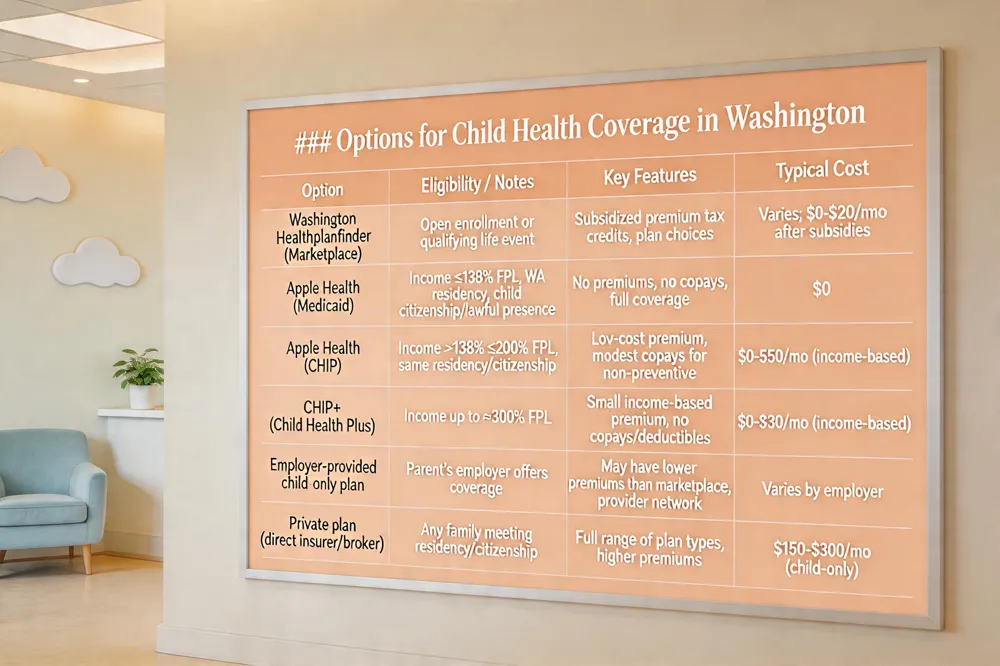 How can I obtain health insurance for my child in Washington State?
Parents can secure coverage by:
How can I obtain health insurance for my child in Washington State?
Parents can secure coverage by:
- Enrolling through Washington Healthplanfinder during open enrollment or after a qualifying life event.
- Applying for Medicaid or the Children’s Health Insurance Program (CHIP) if family income falls below state thresholds. Washington’s Apple Health program administers both, offering low‑ or no‑cost coverage for eligible children.
- Adding the child to an employer‑provided plan, if available.
- Purchasing a private plan directly from an insurer or broker. All options require proof of Washington residency, household income, and the child’s citizenship or lawful presence.
Is Medicaid CHIP+ and how does it differ from regular Medicaid? CHIP+ (Washington’s Child Health Plus) is a low‑cost insurance option for children whose families earn too much for standard Medicaid but not enough for private plans. It covers medical, dental, vision, and behavioral‑health services with a modest income‑based premium. Medicaid serves families with lower incomes, while CHIP+ extends eligibility up to roughly 300 % of the federal poverty level. CHIP+ may include a small cost‑share, whereas Medicaid typically has none.
Are there copays with Child Health Plus? No. Child Health Plus does not require any copayments, coinsurance, or deductibles for covered services. Families only pay the monthly premium, which can be $0 for qualifying incomes.
How can families find the most affordable health‑insurance options for children? Start by checking eligibility for Apple Health (Medicaid/CHIP) using Washington’s online tool, as it often provides the lowest‑cost coverage. Next, compare subsidized marketplace plans on Washington Healthplanfinder; premium‑tax‑credit calculators reveal the cheapest qualified options. If an employer offers child‑only coverage, weigh it against marketplace choices. For higher‑income families, a high‑deductible health plan paired with an HSA can lower premiums. Consult your pediatric office’s billing staff to confirm in‑network providers and cost‑sharing details, ensuring the chosen plan meets both budget and care needs.
Copayments, Deductibles, and Out‑of‑Pocket Maximums Explained
Cost‑Sharing Terms for Pediatric Care
| Term | Definition | Typical Pediatric Example | Impact on OOP Max |
|---|---|---|---|
| Copayment (Copay) | Fixed fee paid at time of service | $25‑$35 for routine pediatrician visit; $50‑$70 for specialist | Counts toward OOP max |
| Deductible (Individual) | Amount a child must pay before insurer shares costs | $1,000‑$2,500 per child per year | Pays toward OOP max |
| Deductible (Family) | Combined household spending threshold | $3,000‑$5,000 for whole family | Pays toward OOP max for all members |
| Coinsurance | % of allowed charge after deductible is met | 20‑30 % of service fee | Counts toward OOP max |
| Out‑of‑Pocket Maximum | Cap on annual personal spending; insurer pays 100 % after reached | $2,500‑$4,000 for family | Stops further cost‑sharing costs |
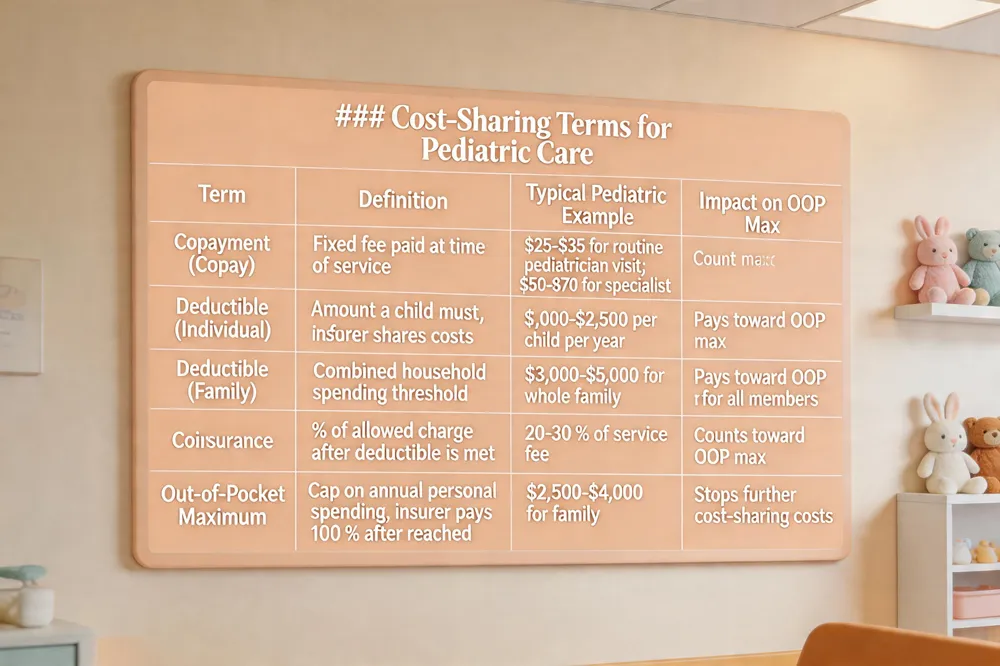 Understanding cost‑sharing is essential for families navigating pediatric and pediatric‑cardiology care. A copayment (copay) is a fixed fee you pay at the time of service—often $25‑$35 for a routine pediatrician visit and $50‑$70 for a specialist—while the insurer covers the remaining allowed amount. A deductible is the amount you must spend out‑of‑pocket on covered services before the insurer begins to share costs; it resets each plan year.
Individual vs. family deductible: An individual deductible applies to one child’s expenses. A family deductible is the household‑wide threshold; once the combined spending of all children reaches this amount, the insurer starts paying for everyone, even if some children have not met their own individual deductible.
After the deductible is met, coinsurance—a percentage of the allowed charge (e.g., 20‑30%)—is your share, while the insurer pays the rest. All cost‑sharing amounts—copays, coinsurance, and any portion of the deductible—contribute toward the out‑of‑pocket maximum, which caps total annual out‑of‑pocket spending. Once that cap is reached, the plan pays 100 % of additional covered services.
Frequently asked questions
- What is the difference between a family deductible and an individual deductible? An individual deductible is the amount a single covered person must pay before the insurer pays for that person’s services. A family deductible is the total amount the entire household must meet before the plan will cover services for any member.
- Are copayments covered by health insurance? Copayments are a form of cost‑sharing; the service is covered, but you pay the fixed copayment (copay) at the time of service, and it counts toward the out‑of‑pocket maximum. Preventive care may have a $0 copayment (copay).
- What does a $75 copay mean? It is a fixed $75 you pay at each visit (e.g., a cardiology appointment). The insurer covers the remaining negotiated charge; the copayment (copay) is required regardless of deductible status unless the plan states otherwise.
- What happens when an individual deductible is met but the family deductible is not? The individual’s services move to coinsurance or copayment (copay) after the individual deductible is satisfied, but other family members still pay full amounts until the family deductible is reached. Preventive services may still be covered at 100 % before either deductible is met.
Specialty Care and High‑Cost Services
Specialty Care Cost‑Sharing (e.g., Pediatric Cardiology)
| Service | Cost‑Sharing Structure | Typical Copay | Deductible / Coinsurance | Notes |
|---|---|---|---|---|
| Specialist visit (cardiology) | Fixed copay + deductible | $30‑$50 | Deductible applies first; then 20‑30 % coinsurance | In‑network preferred to avoid higher rates |
| Diagnostic test (e.g., echocardiogram) | Meets deductible then coinsurance | $0 copay (often) | Usually subject to deductible; after met, 20‑30 % coinsurance | HDHP plans may have high deductible but lower premium |
| Hospital admission (cardiac surgery) | Coinsurance after deductible | $0 copay | 20‑30 % of allowed charge after deductible; OOP max caps total | HSA can be used for HDHP to cover out‑of‑pocket costs |
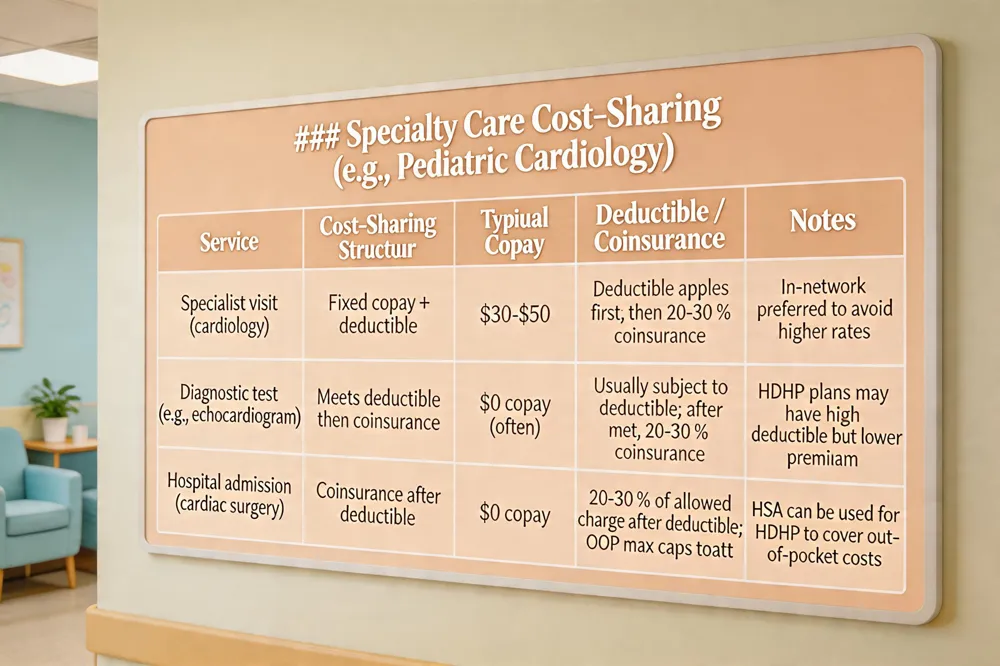 In Federal Way, families seeking pediatric cardiology should expect a cost‑sharing structure that combines a fixed copay (often $30‑$50 for a specialist visit) with a deductible that must be met before the insurer shares costs. After the deductible, coinsurance percentages typically range from 20 % to 30 % of the allowed charge, meaning the insurer pays 70‑80 % of the service. High‑deductible health plans (HDHPs) are common for families who prefer lower monthly premiums; these plans pair well with Health Savings Accounts (HSAs), allowing pre‑tax dollars to cover out‑of‑pocket expenses such as deductibles, copays, and coinsurance until the annual out‑of‑pocket maximum is reached.
Does health insurance cover bipolar disorder?
Yes—under the Affordable Care Act every qualified health‑insurance plan must include essential health benefits, which cover mental‑health and substance‑use services. Diagnosis, therapy, medication management, and inpatient care for bipolar disorder are generally covered, though plans may impose visit limits, copays, or prior‑authorization requirements. Medicaid, Medicare, and private insurers all provide coverage, and children can receive services from pediatric psychiatrists or tele‑health providers within network.
How much does a typical pediatrician visit cost in Washington State?
A typical pediatrician visit in Washington State costs roughly $99 to $139 when paid in cash. Families with insurance usually pay a fixed copay (often $20–$40) or a percentage of the cash fee. In Federal Way, a routine well‑child exam is typically $115‑$130 out‑of‑pocket if paying cash. Insurance contracts and negotiated rates keep the out‑of‑pocket cost lower than the cash price.
What is the typical cost of a Blue Cross Blue Shield child‑only health insurance plan?
In Washington, a Blue Cross Blue Shield child‑only plan generally costs between $150 and $300 per month for a healthy child. Premiums vary by plan level, deductible amount, and whether the enrollee receives a marketplace subsidy. Plans with lower deductibles and broader networks are toward the upper end of that range, while high‑deductible or basic plans fall near the lower end.
Is anemia coverage under health insurance in the United States?
Yes. Both public (Medicaid, CHIP) and private plans that meet ACA essential‑health‑benefits requirements cover anemia diagnosis and treatment when medically necessary. Coverage includes physician visits, laboratory tests, iron‑supplement prescriptions, and inpatient care if needed. Copays, prior‑authorization rules, and deductible applicability vary by plan, but core services are reimbursed.
Public Programs: Medicaid, CHIP, and CHIP+ in Washington
Washington Public Child Health Programs
| Program | Income Eligibility (% FPL) | Premium | Copay / Deductible | Coverage Highlights |
|---|---|---|---|---|
| Medicaid (Apple Health) | ≤ 138 % FPL | $0 (≤ 5 % of income) | None | Full medical, dental, vision, behavioral health |
| CHIP | > 138 % – ≈ 200 % FPL | Low‑cost premium (≤ 5 % of income) | $30 copay for non‑preventive services; low deductible for specialty | Well‑child visits, immunizations, specialist care |
| CHIP+ (Child Health Plus) | ≤ 300 % FPL | Small income‑based premium (often $0) | None (no copays, deductible, coinsurance) | Same benefits as Medicaid, broader income range |
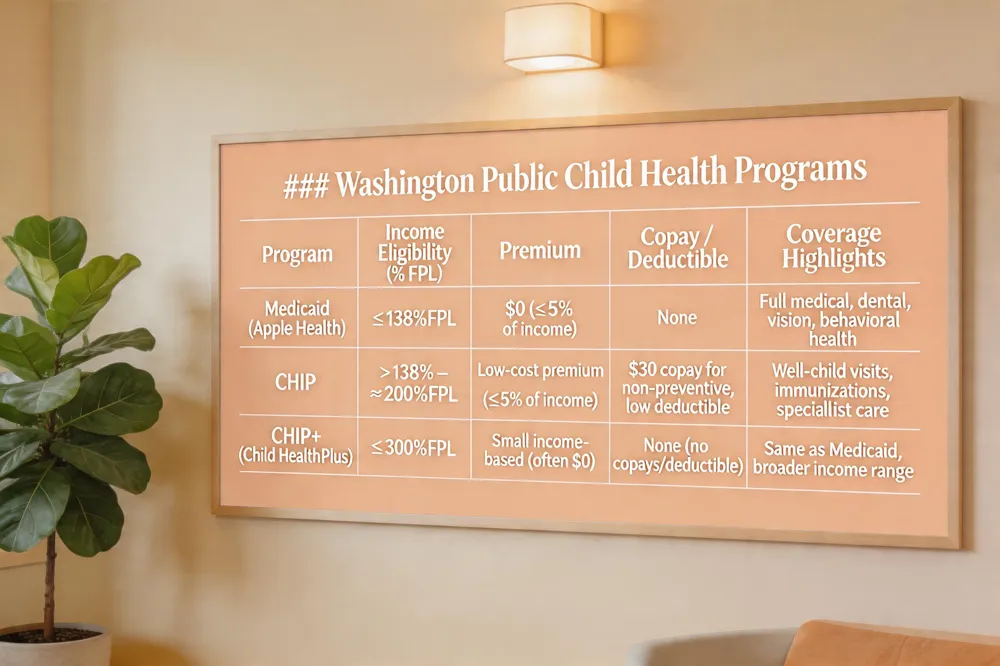 Washington’s Medicaid (Apple Health) provides full‑coverage medical, dental, vision, and behavioral‑health services for children in low‑income families, with no copays, deductibles or out‑of‑pocket maximums, beyond the modest premium cap of 5 % of family income. CHIP (Children’s Health Insurance Program) serves families whose earnings are too high for Medicaid but too low for private plans; it offers routine well‑child visits, immunizations and specialist care with typically a $30 copay for non‑preventive services and a low deductible that may apply to specialty procedures such as pediatric cardiology. CHIP+ (Child Health Plus) is Washington’s low‑cost option for children up to about 300 % of the federal poverty level; unlike Medicaid it may require a small income‑based premium but has no copays, coinsurance or deductible. Out‑of‑pocket limits are capped at 5 % of household income for both programs, protecting families from catastrophic costs.
What is Medicaid CHIP+ and how does it differ from regular Medicaid? CHIP+ covers families with higher incomes (up to ~300 % FPL) and may include a modest premium, whereas Medicaid targets lower‑income families and has no premium.
Are there copays with Child Health Plus? No—Child Health Plus eliminates copays, deductibles and coinsurance; families only pay the monthly premium if applicable.
How can families find the most affordable health‑insurance options for children? Start by checking Apple Health eligibility online, then compare subsidized marketplace plans on Washington Healthplanfinder. Review employer‑offered child‑only coverage, and consult the pediatric office’s billing staff for in‑network provider guidance to minimize out‑of‑pocket expenses.
Practical Tips for Families Managing Pediatric Health Costs
Practical Cost‑Management Tips
| Tip | How to Implement | Benefit |
|---|---|---|
| Choose in‑network providers | Verify provider/facility contracts via insurer portal before appointments | Lower copays, deductible contributions, and avoids surprise bills |
| Use FSAs or HSAs | Contribute pre‑tax dollars; use HSA with HDHP for deductible/coinsurance payments | Reduces net out‑of‑pocket cost; tax‑free spending on qualified expenses |
| Track deductible & OOP progress | Check insurer app/portal weekly; set alerts for nearing limits | Prevents unexpected expenses; helps schedule care before max is reached |
| Pay with credit/debit at point of service | Bring insurance card and payment method; use online payment portals if offered | Immediate fulfillment of copay/coinsurance; keeps account current |
| Ask pediatric office about in‑network status | Call billing staff ahead of visits/specialist referrals | Ensures services count toward deductible and OOP max |
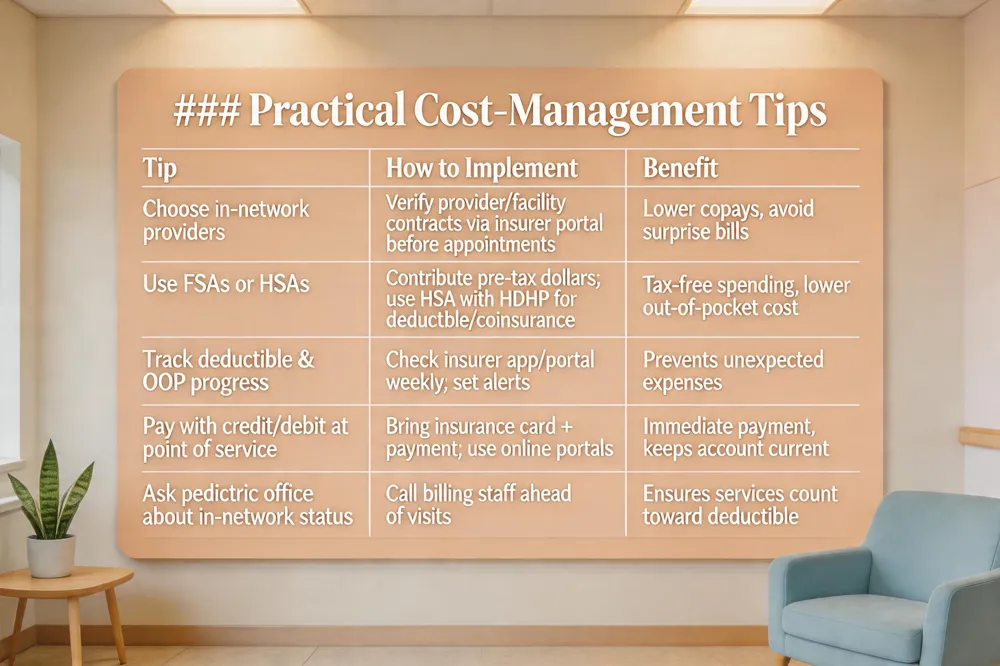 Choosing in‑network providers is the first step to keep costs down. In‑network pediatricians, specialists, and cardiology clinics have negotiated rates that result in lower copays, coinsurance percentages, and deductible contributions than out‑of‑network care. Before each appointment, verify that the provider and the facility are contracted with your plan; this prevents surprise bills and ensures that your payments count toward the deductible and out‑of‑pocket maximum.
Families can stretch dollars by using flexible‑spending accounts (FSAs) or health‑savings accounts (HSAs) for copays, deductibles, and coinsurance. Contributions are pre‑tax, reducing the net cost of out‑of‑pocket expenses. HSAs are especially useful for high‑deductible plans, while FSAs are a good option for those without an HSA‑eligible plan.
Regularly tracking deductible and out‑of‑pocket progress helps avoid unexpected expenses. Most insurers offer online portals or mobile apps that show how much of the individual and family deductible has been met and how close you are to the out‑of‑pocket maximum. Reviewing these figures before scheduling a specialist visit or diagnostic test can inform budgeting decisions.
At the office, bring your insurance card and be prepared to pay the required copay or coinsurance at the time of service. Accepted payment methods typically include cash, check, and major credit cards. Many practices also offer online payment portals or mobile payment options, making it easy to settle balances promptly and keep your account current.
Putting It All Together
Start each year by pulling your health‑plan Summary of Benefits (SOB) and noting the copay, deductible, and coinsurance amounts that apply to routine pediatric visits, specialist care, and prescription drugs. Pay special attention to any separate family pediatric or specialist deductibles that may affect pediatric cardiology services. Next, log into your insurer’s online portal or mobile app to track how much of your deductible and out‑of‑pocket maximum you have already met; most portals let you filter by service type so you can see exactly where your dollars are going. Finally, contact Federal Way Pediatrics before scheduling an appointment. The office staff can confirm that a given cardiologist, imaging center, or lab is in‑network, explain the expected cost‑share for that provider, and help you arrange any necessary pre‑authorizations. By reviewing the SOB, monitoring your spending in real time, and leveraging the practice’s network expertise, you can keep pediatric health expenses predictable while ensuring your child receives timely, high‑quality cardiac care.