Setting the Stage: What Are Well‑Child Visits?
Well‑child visits are preventive appointments that let pediatricians monitor a child’s growth, milestones, and health while building a partnership with families. The AAP Bright Futures schedule starts with a newborn check‑up at 3‑5 days, then continues at 1 month, 2 months, 4 months, 6 months, 9 months, 12 months, 15 months, 18 months, and 2 years before moving to visits through age 21. At each visit the clinician measures height, weight, and head circumference; performs an exam; screens vision and hearing; updates immunizations; and offers counseling on safety, sleep, and behavior.
The AAP Periodicity Schedule and Bright Futures Guidelines
AAP Periodicity Schedule (Bright Futures)
| Age | Visit Timing | Core Services |
|---|---|---|
| 3‑5 days | Newborn check‑up | Growth & vitals, newborn screening, parental counseling |
| 1 month | 1‑month visit | Weight, length, feeding, safety guidance |
| 2 months | 2‑month visit | Growth, developmental surveillance, DTaP, IPV, Hib, PCV13, Rotavirus |
| 4 months | 4‑month visit | Growth, developmental surveillance, repeat DTaP, IPV, Hib, PCV13 |
| 6 months | 6‑month visit | Growth, developmental surveillance, repeat DTaP, IPV, Hib, PCV13, rotavirus, hearing screen |
| 9 months | 9‑month visit | Growth, developmental surveillance, anemia screen |
| 12 months | 12‑month visit | Growth, developmental surveillance, MMR, Varicella, HepB, anemia screen |
| 15 months | 15‑month visit | Growth, developmental surveillance |
| 18 months | 18‑month visit | Growth, developmental surveillance, ASD screen, vision screen |
| 24 months | 24‑month visit | Growth, developmental surveillance, ASD screen, BMI, anemia screen |
| 30 months | 30‑month visit | Growth, developmental surveillance, vision screen |
| 36 months | 36‑month visit | Growth, developmental surveillance, vision screen |
| 3 years‑21 years | Annual visit each year | Growth, BMI, blood‑pressure, vision/hearing (as needed), mental‑health screen, immunizations, anticipatory guidance |
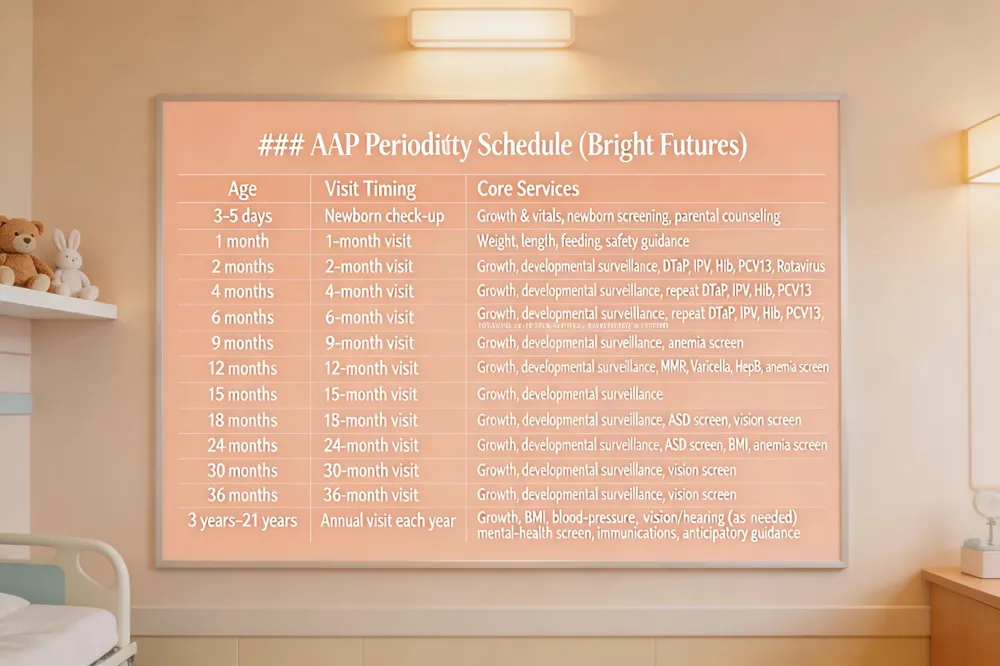 The American Academy of Pediatrics (AAP) Bright Futures periodicity schedule outlines a precise timeline for well‑child visits, beginning with a newborn check‑up at 3–5 days and continuing at 1 month, 2 months, 4 months, 6 months, 9 months, 12 months, 15 months, 18 months, 24 months, 30 months, and 36 months. After age 3, visits are scheduled annually through age 21. Each appointment includes growth measurements, developmental screenings, and age‑appropriate immunizations.
Bright Futures provides the evidence‑based framework that drives this schedule. It integrates CDC‑recommended vaccination timelines, vision and hearing screening standards, and preventive counseling on nutrition, safety, sleep, and mental health. By aligning every visit with CDC immunization and screening guidelines, the schedule maximizes protection against vaccine‑preventable diseases and ensures early detection of developmental or health concerns.
AAP Periodicity Schedule PDF – The official chart is available on the AAP website (https://downloads.aap.org/AAP/PDF/periodicity_schedule.pdf) and details recommended timings for screenings, vaccinations, and preventive services from birth through adolescence.
AAP well‑child visit schedule – Visits occur at the ages listed above, with annual follow‑ups after age 3, each incorporating age‑specific assessments and immunizations per Bright Futures.
Bright Futures Guidelines – This national initiative sets standards for growth monitoring, developmental surveillance, immunizations, and anticipatory guidance, ensuring comprehensive, family‑centered preventive care.
Screening and Preventive Services at Every Visit
Screening & Preventive Services Overview
| Visit Age | Screening | Key Points |
|---|---|---|
| Birth | Newborn screen (PKU, hypothyroidism, etc.) | Baseline metabolic & hearing eval |
| 6 months | Hearing screen | Repeat after newborn screen |
| 12 months | Anemia (Hb) | Detect iron‑deficiency |
| 18 months | Autism Spectrum Disorder (ASD) screen | Early identification |
| 24 months | ASD screen (repeat) | Follow‑up if positive |
| 3 years | Vision screen (acuity) | First formal visual assessment |
| 3 years onward | Blood‑pressure measurement | Annual screening |
| Every visit | Developmental surveillance | Age‑appropriate milestones |
| Every visit (≥2 years) | BMI calculation & obesity counseling | Lifestyle guidance |
| Every visit (all ages) | Mental‑health screening | Anxiety, depression, social‑emotional health |
| Annual (school entry) | Vision & hearing (repeat) | Ensure sensory health for learning |
| As needed | Pediatric cardiology screen | Heart murmur, exercise tolerance, referral if abnormal |
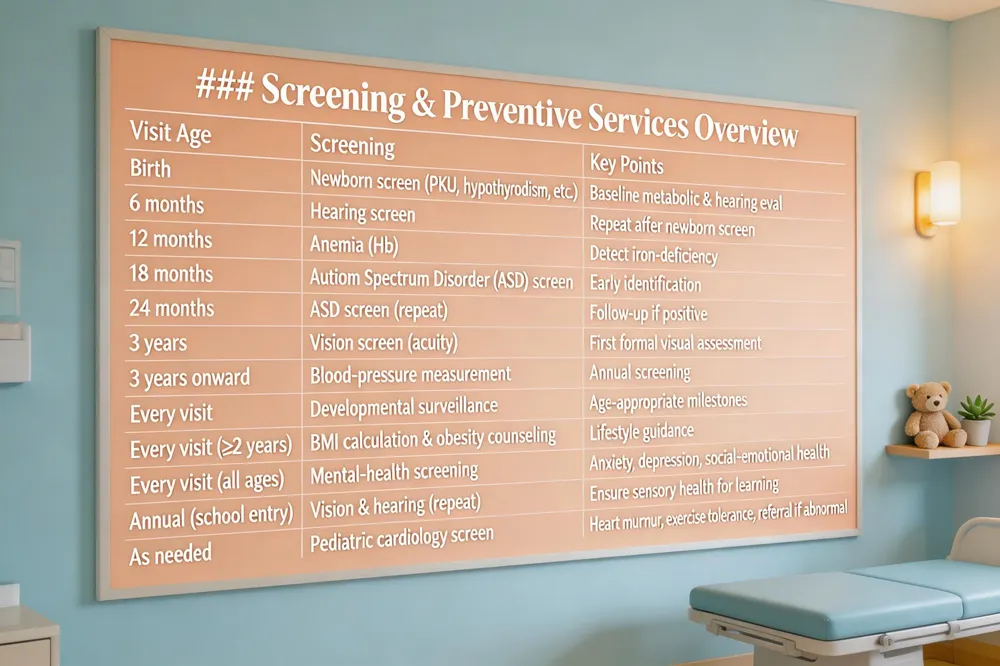 Well‑child visits follow the AAP Bright Futures Periodicity Schedule, which calls for universal developmental surveillance and formal screening at each appointment. Autism spectrum disorder screening is specifically recommended at 18 and 24 months, while vision checks begin at age 3 years and repeat at school entry; hearing screening is performed at birth, the 6‑month visit and again before school. Blood‑pressure measurement starts at 3 years and is repeated annually, and anemia screening is advised at 12 months. The schedule also mandates regular BMI calculation and obesity counseling beginning at 2 years, as well as mental‑health screening for anxiety, depression, and social‑emotional health throughout childhood and adolescence. Pediatric cardiology screening—heart murmurs, blood pressure, and exercise tolerance are incorporated into routine exams, especially in practices such as Federal Way Pediatrics. These evidence‑based screenings, aligned with CDC, USPSTF, and AAP guidelines, ensure early detection of developmental delays, sensory deficits, chronic conditions, and psychosocial risks, supporting a coordinated, family‑centered medical home.
Vaccinations: Protecting Your Child at Each Milestone
Vaccination Milestones
| Age | Vaccines Administered |
|---|---|
| 2 months | DTaP, IPV, Hib, PCV13, Rotavirus, HepB (dose 1) |
| 4 months | DTaP, IPV, Hib, PCV13, Rotavirus (dose 2) |
| 6 months | DTaP, IPV, Hib, PCV13, Rotavirus (dose 3) |
| 12‑15 months | MMR, Varicella, HepB (dose 2), PCV13 (dose 4) |
| 18 months | DTaP, IPV (booster), Hib (booster) |
| 4‑5 years | DTaP (booster), IPV (booster), MMR (booster), Varicella (booster) |
| Annually (≥6 months) | Influenza (inactivated) |
| Age‑appropriate (≥5 years) | COVID‑19 vaccine series (per CDC‑AAP guidance) |
| As indicated | Hepatitis A, additional boosters (e.g., Tdap, HPV) |
All vaccines are scheduled per CDC recommendations and administered during well‑child visits.
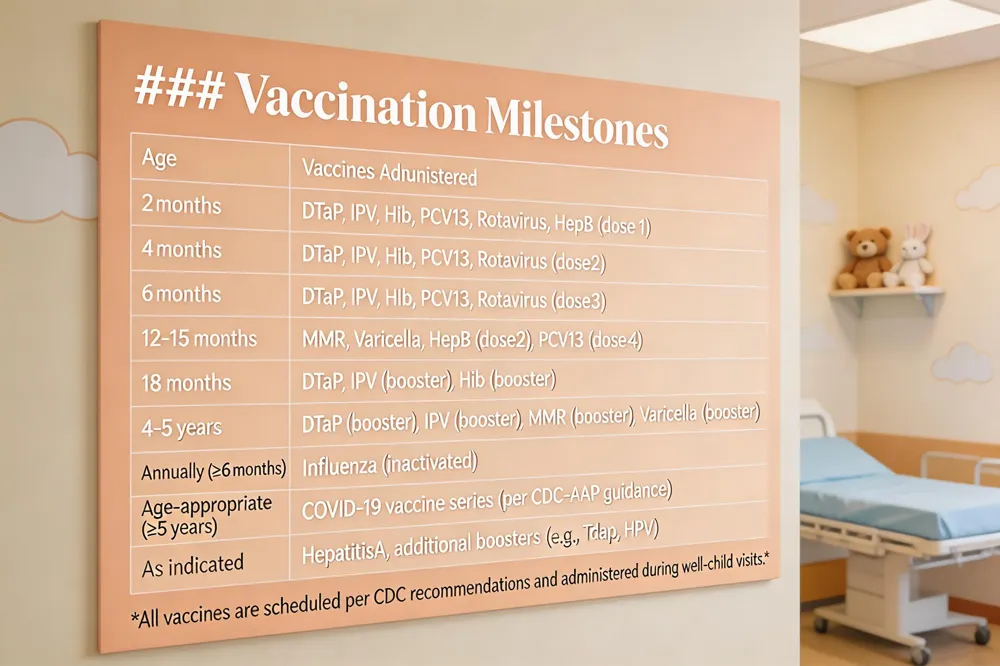 The American Academy of Pediatrics (AAP) Bright Futures schedule makes immunizations a cornerstone of well‑child care. Core vaccine series for infants and toddlers begins at 2 months with DTaP, IPV, Hib, PCV13, and rotavirus, then adds MMR, varicella, and hepatitis B at 12‑15 months. By the 18‑month visit the series is complete, giving protection against measles, mumps, rubella, diphtheria‑tetanus‑pertussis, polio, and pneumococcal disease.
Booster doses at preschool age are given at the 4‑year and 5‑year well‑child checks. The 5‑year visit includes a DTaP booster, IPV booster, second MMR and varicella doses (if not already administered), and a routine annual influenza vaccine each fall/winter. Hepatitis A and COVID‑19 vaccines are offered when age‑appropriate.
Annual flu and COVID‑19 considerations: The CDC recommends a flu shot for every child aged 6 months and older each season, regardless of prior vaccination history. COVID‑19 vaccination follows the CDC‑AAP joint guidance, with age‑specific formulations offered during well‑child visits.
Answers to common questions:
- 5‑year well‑child check vaccines: DTaP and IPV boosters, second MMR and varicella, plus flu (and COVID‑19 if eligible).
- American Academy of Pediatrics guidelines PDF: Available free on the AAP website under “Clinical Practice Guidelines”; the Bright Futures schedule is included.
- CDC well‑child visit schedule: Mirrors the AAP periodicity schedule, starting at 3‑5 days and continuing with visits at 1, 2, 4, 6, 9, 12, 15, 18 months, then at 2, 2½, 3, 4, 5 years and annually through adolescence, each incorporating age‑appropriate immunizations and developmental screening.
Practical Considerations for Families in Federal Way
Practical Tips for Federal Way Families
| Topic | Details |
|---|---|
| Insurance | Medicaid & most private plans cover the full Bright Futures schedule at no cost (EPSDT benefit). |
| School/Daycare | Up‑to‑date immunizations & health screenings required for enrollment; documentation often requested from well‑child visits. |
| Visit Preparation | Bring immunization record, insurance card, list of 3‑5 questions, and any school/daycare forms. |
| Pediatric Cardiology | Routine heart‑sound exam, BP check, and referral for echocardiography if murmur detected. |
| Scheduling | First 3 years: frequent visits (newborn, 2 mo, 4 mo, 6 mo, 9 mo, 12 mo, 15 mo, 18 mo, 24 mo, 30 mo, 36 mo); then annual exams through age 21. |
| Financial | No out‑of‑pocket cost for covered services; non‑covered items (e.g., certain labs) may require co‑pay. |
| COVID support | Federal Way clinics often provide interpreter services and culturally‑sensitive education materials. |
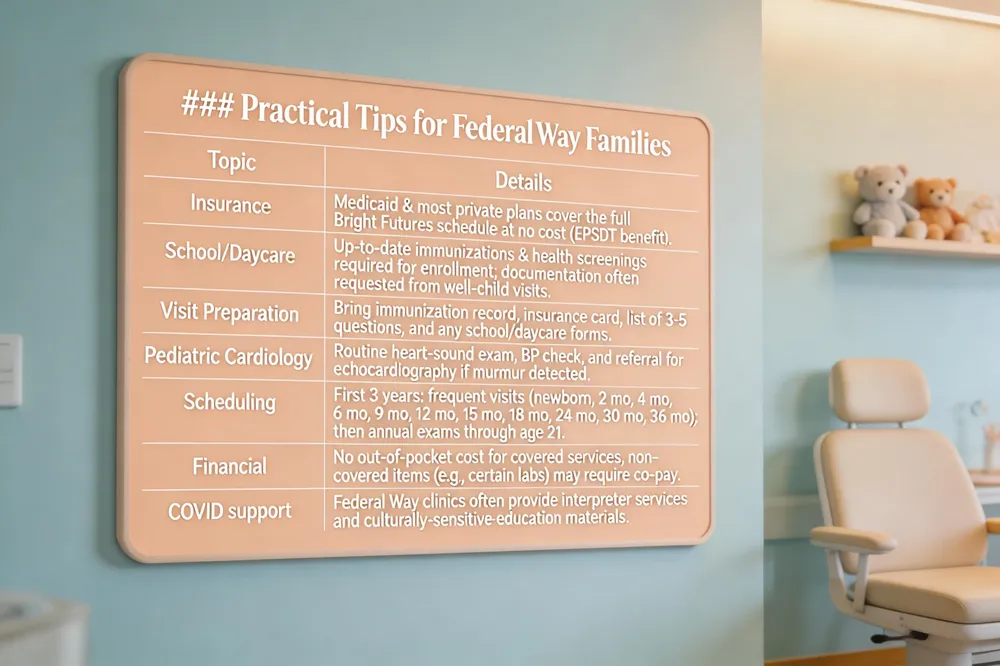 Families in Federal Way benefit from the AAP Bright Futures periodicity schedule, which Medicaid and most private insurers cover at no cost when tied to the EPSDT (Early and Periodic Screening, Diagnostic, and Treatment) benefit. The schedule includes frequent visits during the first three years—newborn (3‑5 days), 2 months, 4 months, 6 months, 9 months, 12 months, 15 months, 18 months, 24 months, 30 months, and 36 months—followed by annual exams through age 21. These visits provide comprehensive exams, growth and developmental screening, vision/hearing checks, nutrition counseling, and any needed immunizations.
Washington law does not mandate a specific visit schedule, but children must be up‑to‑date on immunizations and certain health screenings for public school or daycare enrollment. Schools and child‑care programs typically request documentation from well‑child visits, making them effectively required for entry.
Preparation tips: keep a list of 3‑5 questions, bring the child’s immunization record, insurance card, and any school or daycare forms. For families needing cardiac care, Federal Way pediatric practices integrate pediatric cardiology screening—listening to heart sounds, blood‑pressure checks, and referral for echocardiography—into the well‑child visit, ensuring seamless coordination of care.
FAQs
- Medicaid well‑child visit schedule: Medicaid follows the AAP schedule at covering all recommended visits from birth through age 21 at no cost, including follow‑up services identified during exams.
- Are well‑child visits required by law?: No federal law mandates them, but school and Medicaid requirements effectively make them necessary for enrollment and coverage.
- What is considered preventive care for children?: Routine exams, growth measurements, immunizations, vision/hearing screens, developmental/behavioral assessments, nutrition and safety counseling, and age‑specific laboratory tests.
- How often should a 2‑year‑old go to the doctor?: At 24 months, then again at 30 months, and thereafter annually.
Beyond the Exam: Building a Health Home
Health‑Home Benefits (Beyond the Exam)
| Benefit | Description |
|---|---|
| Continuity of Care | Same pediatrician/team sees child at each visit → stronger therapeutic relationship. |
| Early Detection | Routine growth, developmental, sensory, and mental‑health screens catch issues before they become severe. |
| Preventive Guidance | Age‑specific counseling on nutrition, safety, sleep, and behavior reinforces healthy habits. |
| Comprehensive Record | Centralized health record guides future preventive care and specialty referrals. |
| Family Engagement | Anticipatory guidance and open communication empower parents to address concerns promptly. |
| Reduced Emergency Visits | Early interventions lower need for acute care and improve long‑term outcomes. |
| Integrated Services | On‑site cardiology screening, dental referrals, and community resources create a true medical‑home model. |
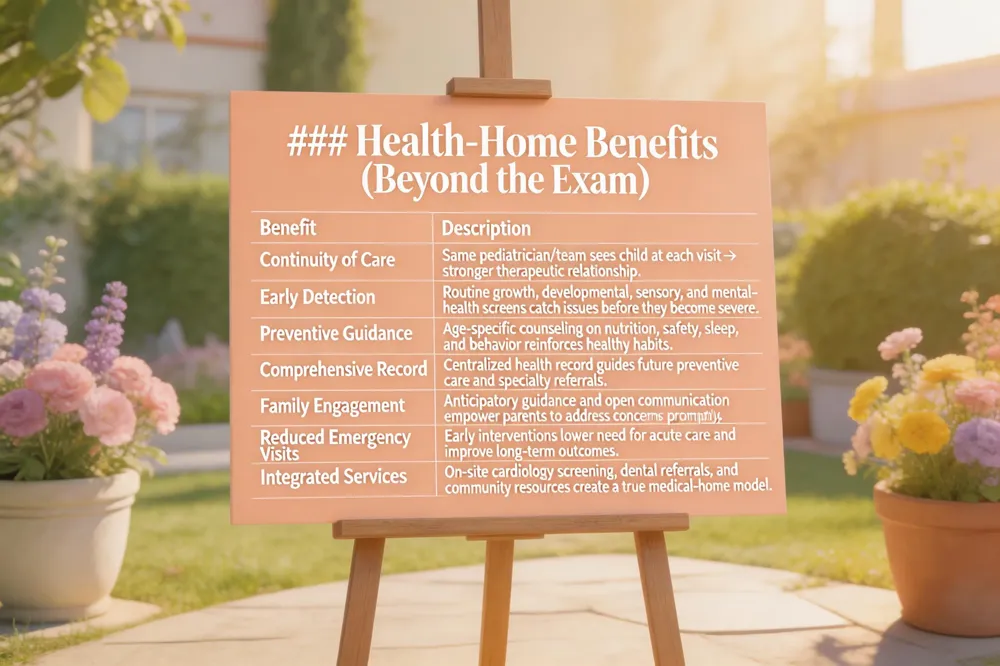 In Federal Way, pediatric practices use the AAP Bright Futures medical‑home model to create a trusted, team‑based partnership among child, parents, and providers. By seeing the same pediatrician at each scheduled well‑child exam, families build continuity of care, open communication, and confidence that concerns will be heard promptly.
Why are well‑child exams important? They give pediatricians a regular chance to monitor growth, developmental milestones, and overall health, catching issues such as vision loss, hearing problems, or early signs of chronic conditions—especially cardiac concerns—before they become serious. The visits also ensure timely immunizations and deliver age‑specific counseling on nutrition, safety, sleep, and behavior, fostering long‑term well‑being.
What are the benefits of a wellness exam? Early detection enables early intervention, reducing the need for emergency care and improving outcomes for asthma, obesity, anemia, or developmental delays. Consistent exams keep vaccinations current, reinforce healthy habits, and produce a comprehensive health record that guides future preventive care.
Well‑child visit Checklist for providers Record weight, height/length, head circumference, and BMI; plot on CDC growth charts. Perform a head‑to‑toe exam, visual acuity (by age 3‑5), hearing screen, and blood pressure (≥3 years). Conduct developmental surveillance and formal screenings at 9, 18, and 30 months. Review immunization status, screen for anemia, lead, autism, and oral health, and provide anticipatory guidance on nutrition, safety, car‑seat use, and parental mental health. Address parental concerns, update family/social history, and arrange referrals or follow‑up as needed.
Key Takeaways for Parents and Providers
Follow the AAP schedule—newborn check‑up at 3‑5 days, then 1 month, 2 months, 4 months, 6 months, 9 months, 12 months, 15 months, 18 months, 2 years, 2½ years and annually through age 21. Use each visit to measure height, weight and head circumference; screen vision, hearing, developmental milestones and heart; and discuss nutrition, safety, sleep and behavior. Verify that your insurance or Medicaid covers the preventive service at no cost. Consistent appointments build a lasting partnership, enabling early detection, coordinated referrals and personalized care for your child's health.