Why Well‑Child Visits Matter
Preventive pediatric care is the foundation of a child’s long‑term health, and well‑child visits are the central mechanism for delivering that care. At each appointment the pediatrician measures height, weight and head circumference, reviews developmental milestones, updates immunizations, and provides age‑appropriate counseling on nutrition, safety, sleep and behavior. Regularly scheduled visits—at 3‑5 days, 1 month, 2 months, 4, 6, 9, 12, 15, 18 months, 2 years, 2½ years and then annually through age 21—ensure timely vaccine protection, early detection of growth problems, developmental delays, asthma, obesity, mental‑health concerns. In Federal Way, pediatric practices weave cardiac screening into the routine well‑child schedule: routine heart exams, pulse‑oximetry for critical congenital heart disease, and prompt referral to pediatric cardiology when murmurs or risk factors are identified. This team‑based approach creates a seamless medical home, allowing families to receive comprehensive preventive care and specialized cardiac monitoring without extra appointments.
Foundations of Preventive Pediatric Care
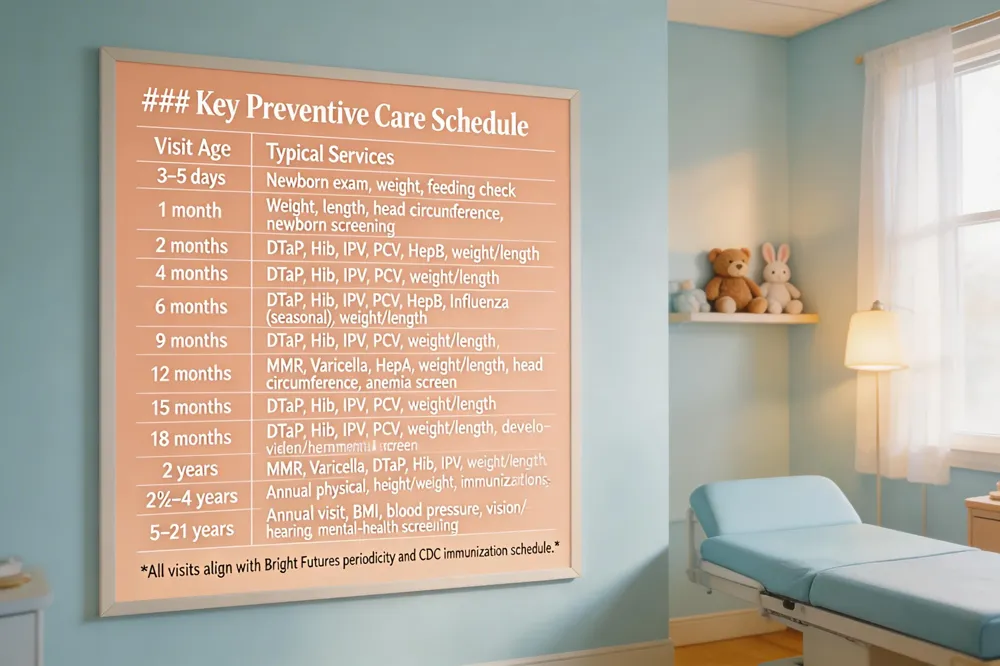
Key Preventive Care Schedule
| Visit Age | Typical Services |
|---|---|
| 3–5 days | Newborn exam, weight, feeding check |
| 1 month | Weight, length, head circumference, newborn screening |
| 2 months | DTaP, Hib, IPV, PCV, HepB, weight/length |
| 4 months | DTaP, Hib, IPV, PCV, weight/length |
| 6 months | DTaP, Hib, IPV, PCV, HepB, Influenza (seasonal), weight/length |
| 9 months | DTaP, Hib, IPV, PCV, weight/length, developmental screen |
| 12 months | MMR, Varicella, HepA, weight/length, head circumference, anemia screen |
| 15 months | DTaP, Hib, IPV, PCV, weight/length |
| 18 months | DTaP, Hib, IPV, PCV, weight/length, developmental screen |
| 2 years | MMR, Varicella, DTaP, Hib, IPV, weight/length, vision/hearing screen |
| 2½–4 years | Annual physical, height/weight, immunizations, safety counseling |
| 5–21 years | Annual visit, BMI, blood pressure, vision/hearing, mental‑health screening |
All visits align with Bright Futures periodicity and CDC immunization schedule.
 Preventive care for children is a systematic approach that keeps kids healthy and catches problems early. It consists of regularly scheduled well‑child visits, age‑appropriate immunizations, growth and development monitoring, and health‑education counseling. During each appointment the pediatrician measures height, weight, and head circumference; screens vision, hearing, and developmental milestones; updates vaccinations; and discusses nutrition, sleep, safety (car‑seat use, injury prevention), and behavior.
The CDC’s well‑child visit schedule begins with a newborn check at 3–5 days of life and continues at 1 month, 2 months, 4 months, 6 months, 9 months, 12 months, 15 months, 18 months, and 24 months, then shifts to annual visits through age 21 years. Each visit aligns with the American Academy of Pediatrics’ Bright Futures periodicity schedule and the CDC immunization timeline, ensuring timely vaccine protection.
U.S. preventive‑care guidelines are guided by Bright Futures, the CDC immunization schedule, and USPSTF recommendations, which grade services such as anxiety screening (ages 8‑18), vision checks, and counseling on healthy behaviors as high‑benefit (A or B).
While no federal law forces families to attend well‑child visits, many state requirements—school entry, childcare licensing, and Medicaid’s EPSDT benefit—depend on up‑to‑date records. The Affordable Care Act, reinforced by Healthcare.gov, mandates that private plans, Medicaid, and Marketplace coverage provide these preventive services at no cost‑share, guaranteeing access for all children.
By following this schedule, parents in Federal Way, Washington, and across the nation can build a strong, team‑based partnership with their pediatrician, fostering optimal physical, mental, and social health for their child.
The AAP Bright Futures Schedule in Detail
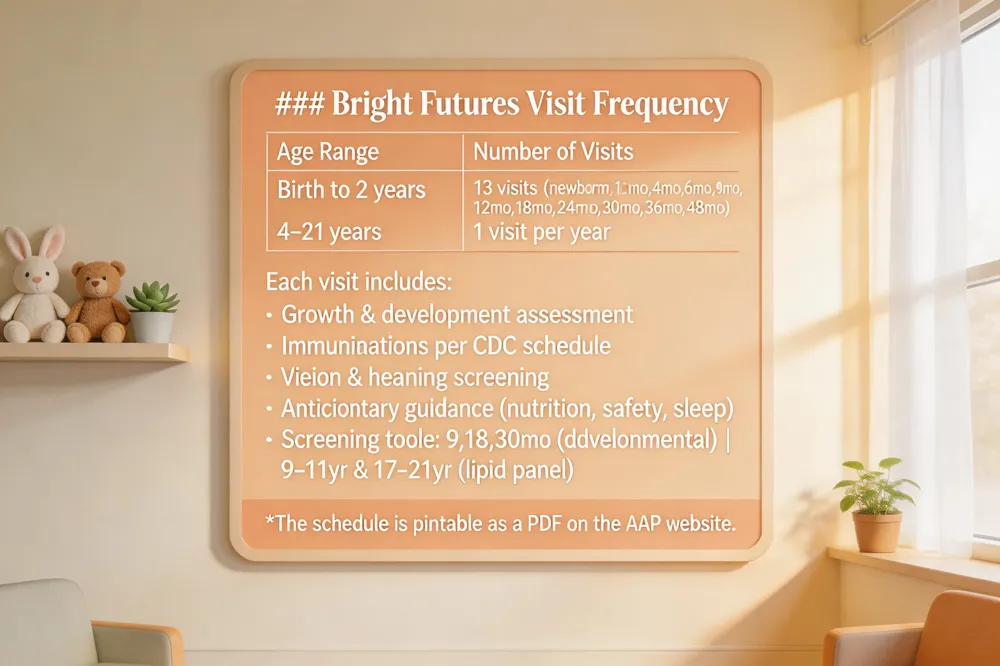
Bright Futures Visit Frequency
| Age Range | Number of Visits |
|---|---|
| Birth to 2 years | 13 visits (including newborn, 1 mo, 2 mo, 4 mo, 6 mo, 9 mo, 12 mo, 15 mo, 18 mo, 24 mo, 30 mo, 36 mo, 48 mo) |
| 4–21 years | 1 visit per year |
Each visit includes:
- Growth & development assessment
- Immunizations per CDC schedule
- Vision & hearing screening
- Anticipatory guidance (nutrition, safety, sleep)
- Screening tools at 9, 18, and 30 months (developmental) and at 9–11 yr & 17–21 yr (lipid panel)
The schedule is printable as a PDF on the AAP website.
 The American Academy of Pediatrics’ Bright Futures periodicity schedule is the backbone of preventive pediatric care. It outlines 39 well‑child visits from the first 3–5 days of life through age 21, with more frequent appointments in infancy (1 month, 2 months, 4 months, 6 months, 9 months, 12 months, 15 months, 18 months, 24 months, 30 months) and annual visits thereafter.
A printable PDF of the full schedule is available free of charge on the AAP website (https://downloads.aap.org/AAP/PDF/periodicity_schedule.pdf) and is often provided by Federal Way pediatric practices for easy reference.
Age‑specific timing matters: each visit includes height, weight, head‑circumference (when appropriate), developmental and behavioral screening, vision/hearing checks, immunizations, and anticipatory guidance on nutrition, safety, sleep, and activity.
A 4‑year‑old check‑up is essential. The pediatrician will assess growth, blood pressure, developmental milestones, vision and hearing, and administer any due vaccines (e.g., DTaP, IPV, MMR, varicella). This visit is a prime opportunity for counseling on healthy habits and, if needed, early cardiac screening.
Well‑child visits are fundamentally preventive. They deliver scheduled immunizations, developmental monitoring, lead and anemia testing, oral‑health advice, and safety counseling. Research shows that adherence to the Bright Futures schedule leads to higher vaccination rates, earlier detection of developmental concerns, and reduced emergency‑department visits, providing a strong foundation for lifelong health.
Clinical Components of Each Visit
Core Clinical Components
| Component | Typical Activities |
|---|---|
| Growth & Development | Plot height/weight/head on CDC charts; motor, language, social‑emotional milestone check |
| Immunizations | Administer age‑appropriate vaccines (e.g., DTaP, IPV, MMR, Varicella, HPV, Influenza) |
| Screenings & Labs | Vision (3‑5 yr), hearing, anemia (CBC at 12 mo), lead, lipid panel (9‑11 yr, 17‑21 yr), TSH if indicated |
| Safety & Anticipatory Guidance | Nutrition, sleep safety, car‑seat/helmet use, injury prevention, psychosocial health |
| Parent‑Question Checklist | 3–5 parent questions; provider asks about feeding, sleep, elimination, immunizations, maternal postpartum depression |
| Provider Checklist | Focused history → head‑to‑toe exam → screenings → immunizations → guidance → summary → schedule next visit |
These components ensure comprehensive preventive care.
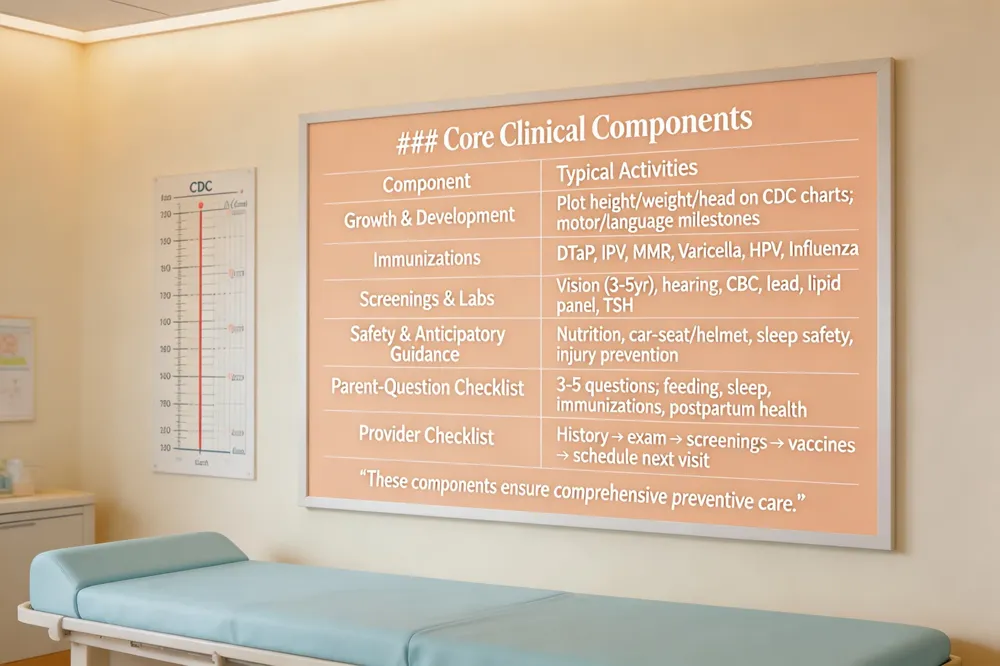 The Bright Futures/AAP periodicity schedule structures well‑child visits to cover five core components.
Growth and Developmental Monitoring – Height, weight, and head circumference (when appropriate) are plotted on CDC growth charts; clinicians assess motor, language, social‑emotional milestones and use formal screening tools at 9, 18, and 30 months.
Immunization Administration – Vaccine status is reviewed and age‑appropriate immunizations are given according to the CDC schedule, protecting against measles, polio, HPV, influenza, and other preventable diseases.
Screenings and Laboratory Tests – Age‑specific screens include vision (ages 3‑5), hearing, anemia (CBC at 12 months), lead exposure, lipid panels (ages 9‑11 and 17‑21), and, when indicated, thyroid‑stimulating hormone. These labs are covered as preventive services when ordered during a well‑child exam.
Safety and Anticipatory Guidance – Pediatricians counsel on nutrition, sleep safety, injury prevention (car‑seat use, helmets), and psychosocial health, addressing concerns such as abuse or neglect.
Parent‑Question Checklist – Families are encouraged to bring 3–5 questions; providers ask about feeding, sleep, elimination, immunizations, and maternal postpartum depression.
Well‑Child Visit Checklist for Providers – Begin with a focused history, perform a head‑to‑toe physical exam, conduct age‑appropriate screenings, update immunizations, deliver anticipatory guidance, summarize the plan, and schedule the next visit per the AAP schedule.
These components together ensure comprehensive preventive care, early detection of problems, and a collaborative partnership between pediatrician, parent, and child.
Specialized Care: Cardiology and Beyond
Cardiology Integration in Well‑Child Visits
| Screening Tool | Age Started | Purpose |
|---|---|---|
| Blood Pressure | 3 years | Detect hypertension early |
| Pulse‑oximetry | 3 years (or as indicated) | Identify hypoxia, cyanosis |
| Cardiac Auscultation | Every visit | Detect murmurs, arrhythmias |
| Lipid Panel | 9‑11 years and 17‑21 years (risk‑based) | Assess cardiovascular risk |
| Referral to Cardiology | When abnormal findings ↑ | Echocardiography, further evaluation |
Washington state programs (CHIP, Medicaid) cover these services at no cost, ensuring access for Federal Way families.*
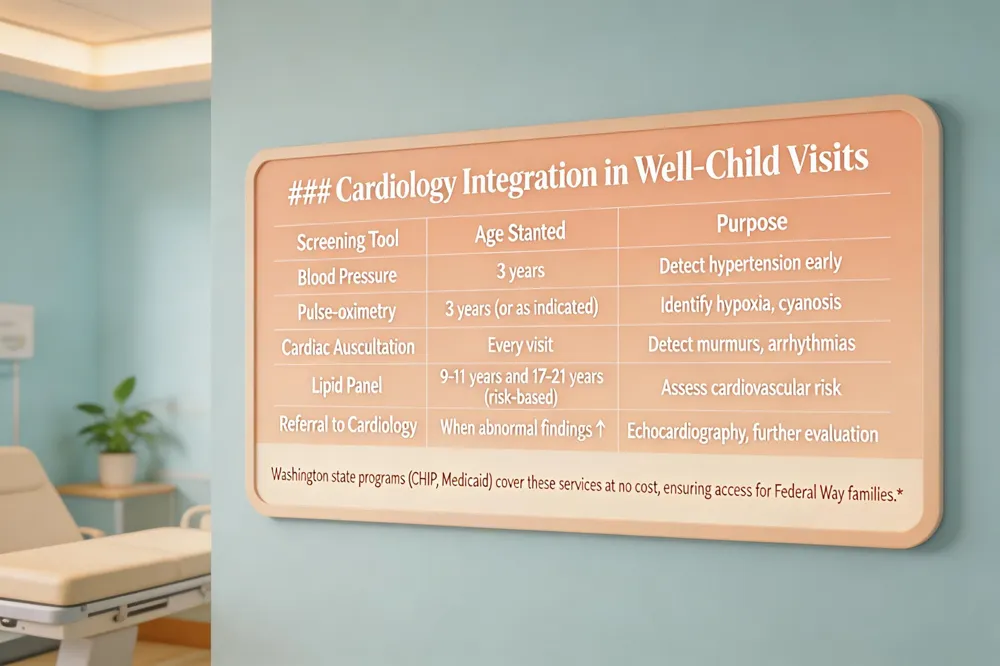 The American Academy of Pediatrics’ Bright Futures 4th Edition Periodicity Schedule defines the well‑child visit template from birth through adolescence. At each visit clinicians record vitals, growth (weight, height, head circumference), developmental milestones, immunization status, vision, hearing, oral health, and behavioral screening. State‑specific programs such as Washington’s CHIP and Medicaid provide these services at no cost, ensuring families in Federal Way receive comprehensive preventive care.
Pediatric cardiology integration – Federal Way pediatric practices routinely incorporate cardiac screening into the well‑child visit. A brief cardiac exam, pulse‑oximetry, and blood‑pressure measurement identify murmurs or arrhythmias early, prompting timely referral to a pediatric cardiologist for echocardiography or further evaluation.
Cardiac screening during well‑child visits – The AAP recommends blood‑pressure checks starting at age 3 and risk‑based lipid panels at 9‑11 years. Early detection of hypertension, obesity, or congenital heart disease enables interventions that prevent long‑term cardiovascular complications.
Washington state resources – Local health departments, the Washington State Immunization Information System, and school‑based health programs coordinate to keep immunizations current and provide education on car‑seat safety, helmet use, and heart‑health nutrition.
Benefits of early heart‑related detection – Identifying cardiac abnormalities before symptoms arise reduces emergency visits, supports normal growth and activity, and improves long‑term outcomes for children with congenital or acquired heart conditions. Regular well‑child visits thus serve as a cornerstone of both general preventive health and specialized cardiac care.
Practical Guidance for Parents and Providers
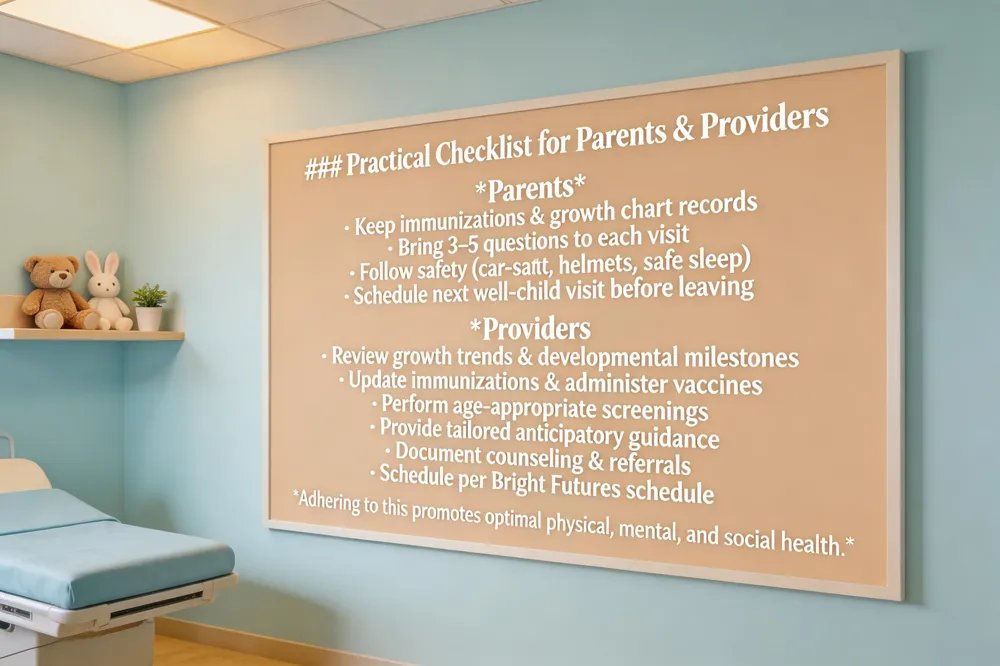
Practical Checklist for Parents & Providers
Parents
- Keep a record of immunizations and growth charts
- Bring 3–5 questions to each visit (e.g., sleep, nutrition, behavior)
- Follow safety recommendations (car‑seat, helmets, safe sleep)
- Schedule next well‑child visit before leaving
Providers
- Review growth trends and developmental milestones
- Update immunization status and administer due vaccines
- Perform age‑appropriate screenings (vision, hearing, anemia, lead, lipid panel)
- Provide anticipatory guidance tailored to age and family context
- Document counseling and any referrals (e.g., cardiology, mental health)
- Schedule next appointment per Bright Futures schedule
Adhering to this schedule promotes optimal physical, mental, and social health.
 Child check‑up schedule The AAP schedule begins with a newborn visit at 3‑5 days, then 1 month, 2 months, 4 months, 6 months, 9 months, and 12 months. After the first year, visits occur at 15 months, 18 months, 2 years, 2½ years, 3 years, 4 years, 5 years, and annually through age 21. Each appointment includes growth measurements, developmental screening, age‑appropriate vaccines, and anticipatory guidance.
Well‑child visits by age Early visits are frequent to monitor rapid growth and deliver vaccines such as DTaP, Hib, IPV and MMR. From school age onward, annual visits focus on physical exams, vision/hearing screens, BMI and blood‑pressure checks, mental‑health screening, and counseling on nutrition, physical activity and safety.
What is pediatric preventive care? It is a proactive, team‑based approach that uses scheduled well‑child visits, immunizations, and routine screenings to keep children healthy, detect problems early, and promote lifelong healthy habits.
Preventive aspects of child health Key components include immunizations, developmental and behavioral screening, nutrition and physical‑activity counseling, injury‑prevention education, oral‑health care, mental‑health screening, and parental education. Federal Way families can access these services through local pediatric practices, school‑health programs, and community health departments.
Ensuring a Healthy Future
Well‑child visits are the cornerstone of preventive pediatric care. Each appointment lets the pediatrician track growth (height, weight, head circumference), administer age‑appropriate immunizations, and screen for developmental, behavioral, and cardiac concerns—early detection that can prevent serious illness and support optimal physical, mental, and social health. By following the AAP Bright Futures periodicity schedule, families reduce the risk of missed vaccinations, undiagnosed developmental delays, obesity, and hypertension, while receiving tailored counseling on nutrition, safety, sleep, and activity.
Parents in Federal Way are encouraged to schedule their child’s next well‑child visit at Federal Way Pediatrics, where a team‑based approach integrates general wellness with specialized pediatric cardiology when needed.
Helpful resources include the AAP’s “Your Child’s Checkups” video, the “Milestones Matter” guide, the HealthyChildren.org schedule, and local support services such as the King County Public Health Department and school‑based health programs. Bring a short list of 3‑5 questions to make the most of each visit.