Setting the Stage: The Value of Certified Pediatric Expertise
Board certification is a rigorous process that confirms a physician has completed an accredited pediatric residency and passed the American Board of Pediatrics (ABP) exam; pediatric cardiologists add a three‑year fellowship and a subspecialty board exam. This credential guarantees that clinicians meet nationally recognized standards and must engage in Maintenance of Certification, which includes continuing medical education and quality‑improvement activities. As a result, board‑certified providers deliver care that reflects the latest evidence‑based guidelines, from preventive immunizations to advanced cardiac imaging. Children are not small adults—their developmental milestones, disease presentations, and medication dosing differ fundamentally, requiring physicians trained specifically in pediatric physiology. In Federal Way, Washington, families benefit from a network of board‑certified pediatricians and cardiologists at facilities such as Federal Way Pediatrics, Swedish Medical Center’s Federal Way campus, and EvergreenHealth Medical Center. These centers offer comprehensive well‑child visits, developmental screenings, and specialized pediatric cardiology services—including echocardiograms, Holter monitoring, and coordinated care with Seattle Children’s Hospital—ensuring timely, child‑focused care close to home. Parents can easily schedule appointments online or by phone, and many clinics provide telehealth options for follow‑up visits.
Board Certification Explained and Why It Matters
Board Certification Overview
| Requirement | Details |
|---|---|
| Residency | 3‑year accredited pediatrics residency (or relevant specialty) |
| Examinations | Pass ABP (or ABIM for subspecialties) certification exam |
| Maintenance of Certification (MOC) | Ongoing CME, quality‑improvement projects, periodic re‑examination |
| National Standards | Uniform benchmark for competence, safety, and quality of care |
| Insurance & Hospital Privileges | Many insurers, Medicaid, and hospitals require board‑certified status for reimbursement and privileges |
| Affiliation | Not required for a pediatrician to deliver care at the birth hospital, but can streamline record transfer |
| Specialty Differences | Pediatric cardiologists treat heart disease from birth‑age 18; adult cardiologists treat post‑adolescent conditions |
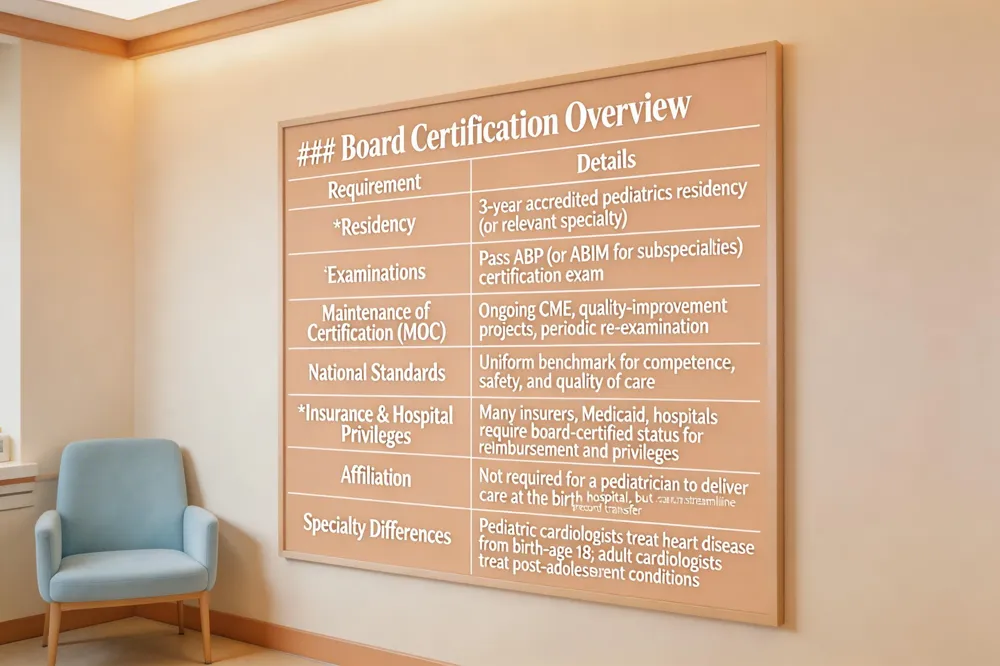 Board certification is a formal acknowledgment that a physician has completed an accredited residency (three years for pediatrics) and passed the rigorous examinations administered by the American Board of Pediatrics (ABP) or the American Board of Internal Medicine (ABIM) for subspecialties such as pediatric cardiology. After certification, doctors must participate in Maintenance of Certification (MOC), which includes continuing medical education, quality‑improvement projects, and periodic re‑examination. This process guarantees that pediatricians and pediatric cardiologists stay current with evolving guidelines, new technologies, and evidence‑based practices.
National standards set by the ABP and ABIM create a uniform benchmark for competence, safety, and quality of care. Insurers and Medicaid often require board‑certified providers for reimbursement, and many hospitals grant privileges only to those who meet these standards, which translates into smoother referrals and reduced out‑of‑pocket costs for families.
Does your pediatrician have to be affiliated with the hospital where you deliver? No. While affiliation can streamline record transfer and newborn care, it is not a requirement. Your chosen pediatrician can see your baby after discharge as long as the hospital has their contact information.
Pediatrician specialty practices include pediatric cardiology, endocrinology, gastroenterology, pulmonology, neurology, and many others, each offering focused expertise that complements primary care.
Pediatric cardiologist vs. cardiologist – Pediatric cardiologists are trained to treat heart disease in patients from birth through age 18, using child‑size equipment and age‑appropriate therapies. Adult cardiologists focus on heart conditions that develop after adolescence. For congenital defects, murmurs, arrhythmias, or family history of early heart disease, a pediatric cardiologist is the appropriate specialist, especially in Federal Way, Washington, where board‑certified pediatric cardiology services are readily available.
Local Pediatric Resources and How to Find the Right Provider
Federal Way Pediatric Resources
| Resource | Contact / Access | Services |
|---|---|---|
| Federal Way Pediatric Associates | 710 S 348th St STE B, Federal Way; Phone (206) 395‑6049 / (425) 243‑2293; MyChart portal | Well‑child visits, immunizations, chronic disease management, acute‑illness care, walk‑in/same‑day sick‑visit, telehealth, 24/7 on‑call coverage |
| Board‑Certification Verification | ABP Certification Verification tool; ABMS “Is My Doctor Certified?” | Confirm current board status and subspecialty credentials |
| AAP Find a Pediatrician | HealthyChildren.org (search by ZIP) | Locate AAP‑member doctors, filter by specialty (e.g., pediatric cardiology) |
| Telehealth & Same‑Day Visits | Virtual visits for routine follow‑up & urgent concerns; walk‑in sick‑visit slots | Reduces travel, provides timely care for febrile illnesses, ear infections, asthma, etc. |
| Specialist Referral | Board‑certified pediatric cardiologists at Federal Way Children’s Heart Center | Cardiac evaluation, advanced imaging, catheter‑based procedures |
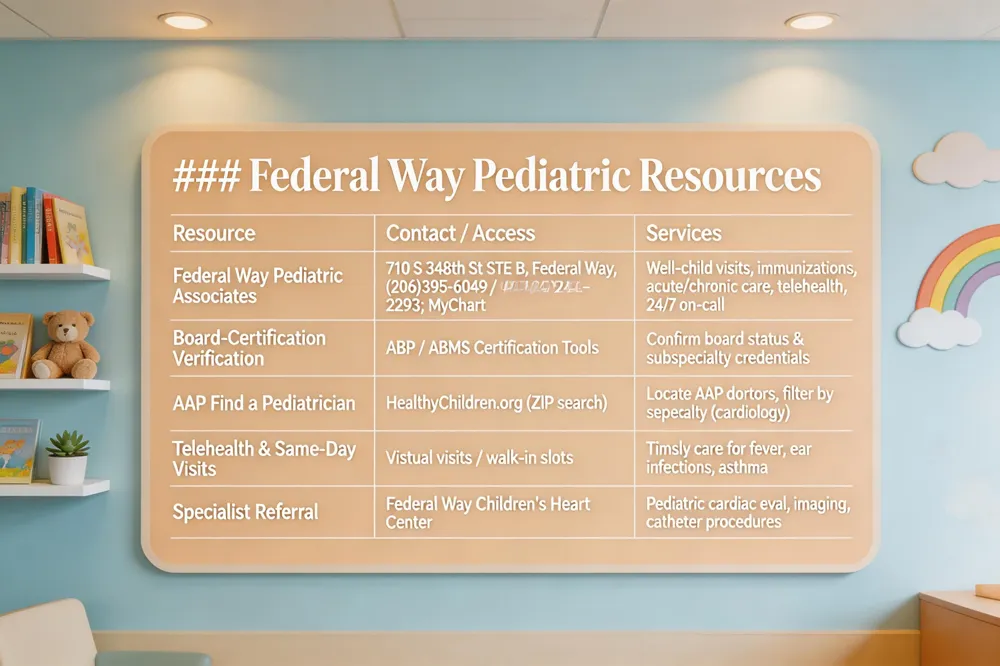 Federal Way families a robust network of pediatric care, anchored by Federal Way Pediatric Associates (also known as Federal Way Pediatrics or C & C Medical Associates). Located at 710 S 348th St STE B, the practice offers well‑child visits, immunizations, chronic disease management, and acute‑illness care, with walk‑in, same‑day sick‑visit, and telehealth options. A board‑certified pediatricians team of pediatricians and mid‑level providers provides 24/7 on‑call coverage and specialty tele‑consultations in cardiology, endocrinology, neurology, and more. Appointments can be booked by calling (206) 395‑6049 or (425) 243‑2293 or through the MyChart portal.
How to locate board‑certified pediatricians and specialists – Start with the American Board of Pediatrics Certification Verification tool or the ABMS “Is My Doctor Certified?” service to confirm current board status and subspecialty credentials (e.g., pediatric cardiology). Review practice websites for bios that list board certification, years of experience, and Maintenance of Certification (MOC) compliance. Ask the office for a copy of the physician’s ABP certificate or a certification lapel pin for additional assurance.
Using the AAP Find a Pediatrician tool – Visit HealthyChildren.org, select “Find a Pediatrician,” and enter the Federal Way ZIP code. The results highlight AAP‑member doctors (FAAP) and allow filtering by specialty, such as pediatric cardiology, helping families identify providers who adhere to the latest evidence‑based guidelines.
Telehealth and same‑day sick‑visit options – Federal Way Pediatrics offers virtual visits for routine follow‑up and urgent concerns, reducing travel burdens. Same‑day sick‑visit slots are available without an appointment, ensuring timely care for febrile illnesses, ear infections, or worsening asthma. These flexible services support a family‑centered medical home and seamless coordination with board‑certified pediatric cardiologists when cardiac evaluation is needed.
Specialized Pediatric Cardiology: Training, Roles, and Conditions Treated
Pediatric Cardiology Training & Practice
| Aspect | Information |
|---|---|
| Total Training Time | ~14‑15 years after high school (4 yr undergrad + 4 yr med school + 3 yr pediatrics residency + 2‑3 yr fellowship) |
| Education Requirements | MD/DO → pediatric residency → board certification in pediatrics → 3‑yr ACGME‑accredited pediatric cardiology fellowship → ABP subspecialty exam |
| MOC | Ongoing certification maintenance ensures current knowledge |
| Core Roles | Diagnose/treat congenital & acquired heart disease; perform echocardiograms, cardiac MRI, fetal echo, EKG, Holter; develop individualized care plans |
| Procedures | Catheter‑based interventions (device closures, balloon angioplasty); coordinate surgery but do not perform open‑heart surgery |
| Conditions Treated | Septal defects, hypoplastic left‑heart syndrome, myocarditis, cardiomyopathy, SVT, long‑QT, pulmonary hypertension, Kawasaki disease, prenatal anomalies |
| Salary & Compensation | Median $327‑$335 k/yr; range $200‑$420 k+; signing bonus avg $28 k; relocation allowance avg $11 k |
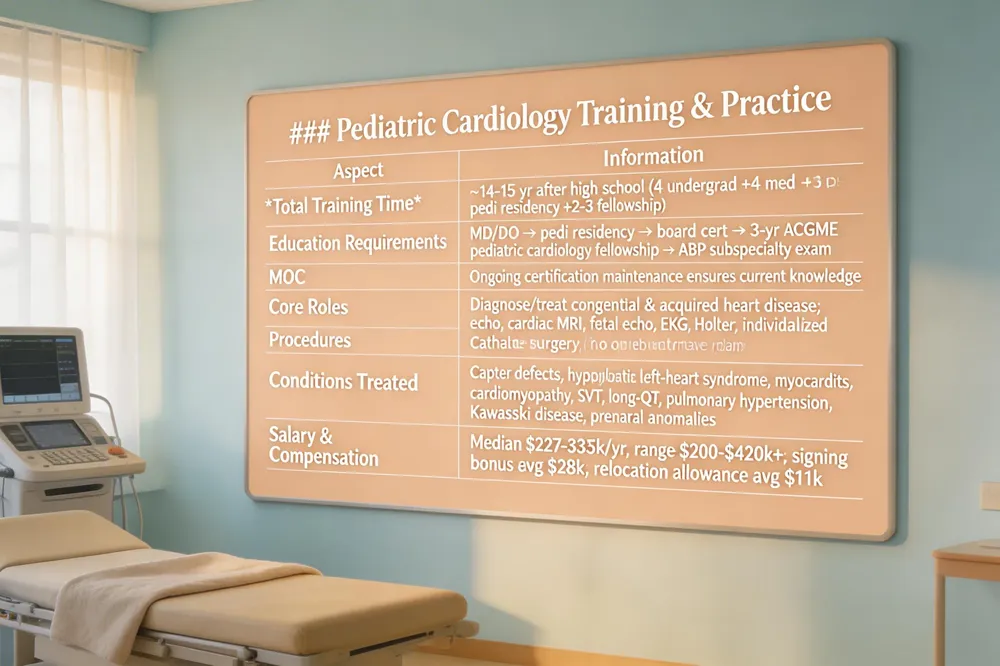 Choosing a board‑certified pediatric cardiologist means entrusting your child’s heart care to a physician who has completed extensive education and ongoing quality‑improvement activities. How many years to become a pediatric cardiologist? The pathway is roughly 14‑15 years after high school: a 4‑year undergraduate degree, 4 years of medical school, a 3‑year pediatric residency, and a 2‑3‑year pediatric cardiology fellowship (most programs are three years). What are the education requirements? After earning an M.D. or D.O., the physician must finish a three‑year pediatrics residency, obtain board certification in pediatrics, then complete an ACGME‑accredited three‑year pediatric cardiology fellowship and pass the ABP subspecialty exam. Ongoing maintenance of certification (MOC) ensures up‑to‑date knowledge. What does a pediatric cardiologist do? They diagnose and treat heart conditions in infants, children, and adolescents using echocardiograms, cardiac MRI, fetal echo, EKGs, and Holter monitoring. They develop individualized plans that may include medication, lifestyle counseling, catheter‑based therapies, or referral for surgery, while coordinating care with surgeons, geneticists, and primary pediatricians. What conditions are treated? Congenital defects (e.g., septal defects, hypoplastic left‑heart syndrome), acquired diseases (myocarditis, cardiomyopathy), rhythm disorders (supraventricular tachycardia, long‑QT syndrome), pulmonary hypertension, Kawasaki disease, and prenatal heart anomalies. Do they perform surgery? They do not perform open‑heart surgery; that is the role of pediatric cardiac surgeons. However, many conduct minimally invasive catheter procedures such as device closures and balloon angioplasty. Salary and compensation trends: Median total compensation in the United States is $327,000‑$335,000 annually, with a range of $200,000 to $420,000+ depending on experience and location. Signing bonuses average $28,000 and relocation allowances about $11,000, reflecting the specialty’s competitive remuneration and high demand for expert pediatric cardiac care.
Practical Guidance for Parents: From Pregnancy to Ongoing Care
Parenting Timeline & Key Actions
| Timeline | Action | Details |
|---|---|---|
| Second Trimester | Begin pediatrician search | Compare offices, insurance compatibility, hours; aim to select board‑certified pediatrician |
| Before Hospital Discharge | Schedule newborn’s first visit | Ideally within 24‑72 hrs after discharge; confirm appointment and paperwork |
| Calling Pediatrician (pre‑birth) | Introduce, due date, request newborn visit | Ask about prenatal/new‑patient meetings, insurance, after‑hours coverage, and hospital affiliation |
| Heart‑Screening | Routine cardiac screening | Starts ~age 5, pre‑participation ECG at age 12, lipid screening ages 9‑11, earlier if family history |
| Specialist Referral Triggers | Shortness of breath, abnormal murmur, fatigue | Pediatric cardiologist evaluates via history, exam, ECG, echo, MRI |
| Neurological Check | Muscle tone assessment | Performed at well‑child visits; abnormal tone → PT, neurology, or cardiology referral |
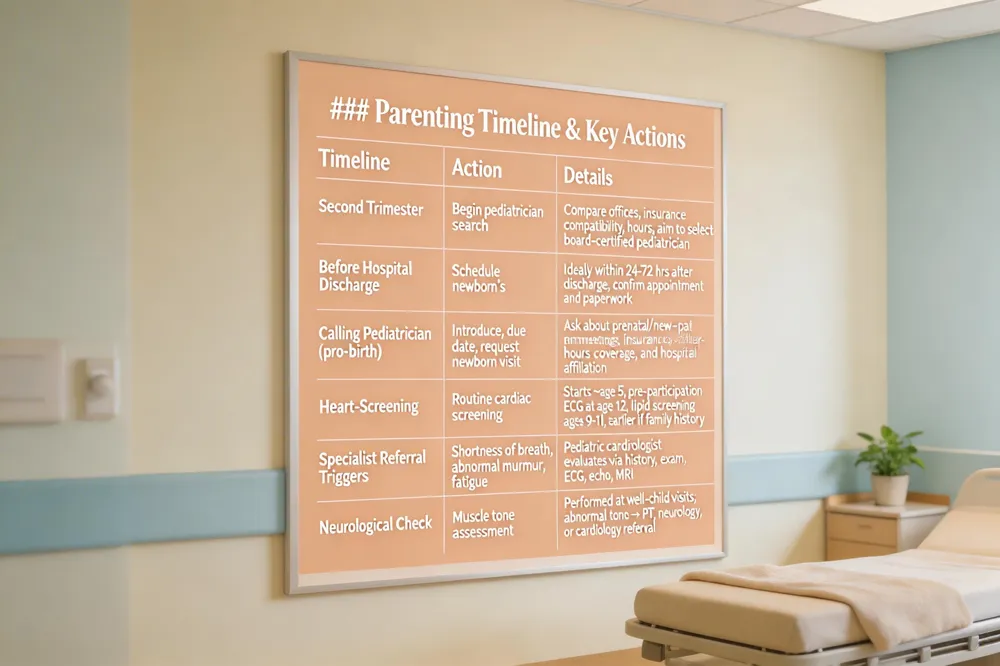 When to start looking for a pediatrician – Begin your search in the second trimester so you have time to compare offices, insurance compatibility, and hours. Aim to have a board‑certified pediatrician selected and your newborn’s first visit scheduled before you leave the hospital, ideally within 24–72 hours after discharge. In Federal Way, practices such as Federal Way Pediatrics and the Center for Pediatric Medicine already coordinate with local hospitals, making the early hand‑off smoother.
What to say when calling the pediatrician before the baby is born – Introduce yourself, state your due date, and ask to schedule the newborn’s first visit. Request information on any prenatal or new‑patient meetings, required paperwork, insurance details, and after‑hours coverage. Inquire whether the pediatrician has a relationship with your birthing facility (e.g., Swedish Medical Center – Federal Way) to streamline the transition. Ask for any handouts on feeding, safe sleep, and vaccination timelines.
Heart‑screening timelines – Routine cardiac screening often begins around age 5 and continues through adolescence. For children entering organized sports, a pre‑participation exam—including an ECG—is recommended starting at age 12. Universal lipid screening is advised at ages 9‑11, with a repeat in the late teens. If there is a family history of early heart disease or hypercholesterolemia, screening may start as early as age 2. Your board‑certified pediatrician can tailor the schedule to your child’s needs and refer to a pediatric cardiologist at Federal Way Children’s Heart Center when appropriate.
When to seek specialist care for shortness of breath or abnormal findings – A pediatric cardiologist can evaluate dyspnea that stems from heart failure, valve disease, arrhythmias, or congenital defects. They will conduct a focused history, physical exam, and order tests such as an ECG, echocardiogram, or cardiac MRI. Early referral, especially for children with murmurs or unexplained fatigue, can prevent complications and restore normal activity levels.
Do pediatricians check muscle tone? – Yes. During well‑child visits, board‑certified pediatricians perform a neurological exam that includes assessment of muscle tone, reflexes, and balance. Detecting abnormal tone early allows timely referral to physical therapy, neurology, or a pediatric cardiologist if cardiac causes are suspected.
Putting It All Together: The Assurance of Certified Care
Board certification is more than a badge—it guarantees that a pediatrician or pediatric cardiologist has completed a rigorous residency, passed a national examination, and commits to ongoing education through Maintenance of Certification. For general pediatric care, this means the physician is skilled at tracking growth, developmental milestones, immunizations, and early signs of disease, while for cardiology it ensures expertise in congenital heart defects, arrhythmias, and advanced imaging such as echocardiography and cardiac MRI. Because board‑certified pediatricians serve as a child’s medical home, they develop a longitudinal record of health, allowing them to recognize subtle changes that may signal a cardiac issue. When a concern arises, a certified pediatrician can promptly refer the child to a board‑certified pediatric cardiologist, creating a seamless, multidisciplinary team that shares records, coordinates treatment plans, and follows the child through surgery, catheter interventions, and long‑term follow‑up. Families in Federal Way benefit from a robust network of certified providers—including Federal Way Pediatrics, Swedish Medical Center’s Federal Way campus, and nearby Seattle Children’s Hospital—offering convenient, high‑quality, child‑focused cardiac and primary care. Leveraging these local experts reduces travel, speeds diagnosis, and improves long‑term health outcomes for every child.