Why Understanding Pediatric Coverage Matters
Health insurance is a cornerstone of positive child health outcomes because it guarantees timely access to preventive services, immunizations and developmental‑ and specialist care—services that Medicaid and CHIP cover at no cost when provided in‑network. Before selecting a plan, families should compare premiums, deductibles, copays, out‑of‑pocket maximums, and confirm that their pediatrician and any cardiology specialists are listed as in‑network providers; they also need to understand referral and prior‑authorization requirements for specialty visits. Federal Way offers a robust network of pediatric specialists, including cardiologists at Federal Way Pediatrics, Seattle Children’s affiliates, and Radiance Pediatrics, many of which accept major private insurers, Medicaid, Apple Health, and CHIP. These practices also provide transparent self‑pay options and sliding‑scale fees for families without insurance. By verifying network status, reviewing cost‑sharing details, and leveraging available public programs, parents can ensure continuous, affordable care for routine well‑child visits and complex cardiac evaluations.
Insurance Basics Simplified for Families
Quick Reference: Core Insurance Terms
| Term | What It Means | Typical Family Impact |
|---|---|---|
| Premium | Fixed monthly payment to keep the plan active. | Predictable monthly cost; does not affect per‑visit charges. |
| Deductible | Amount you must pay out‑of‑pocket before the insurer starts sharing costs. | Families pay the first $X‑$Y each year; higher deductibles usually mean lower premiums. |
| Copay | Fixed fee (e.g., $20) for a specific service such as a doctor visit. | Easy to budget; applies even after deductible is met for many services. |
| Coinsurance | Percentage of the bill you pay after the deductible (e.g., 20%). | Can lead to larger bills for expensive procedures; varies by plan. |
| Out‑of‑Pocket Maximum | Cap on total spending (deductible + copays + coinsurance). After reaching it, the insurer pays 100 % for the rest of the year. | Provides financial protection against catastrophic costs. |
| Preventive Services | Well‑child visits, vaccinations, screenings—covered at 100 % when in‑network. | No copay, deductible, or coinsurance; no extra cost for essential child health care. |
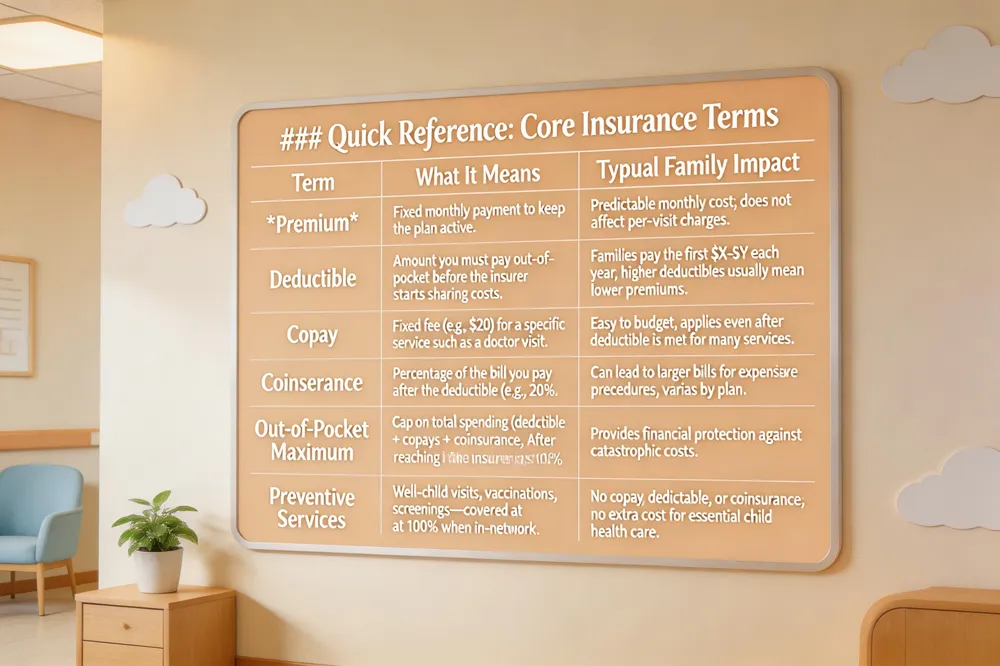 Parents often wonder how health insurance works and what it actually covers for their children. In simple terms, you pay a regular premium to keep your plan active. When you visit a doctor or fill a prescription, you may pay a small fee called a copay. Before the insurer starts sharing costs, you must meet a deductible—a set amount you pay out‑of‑pocket for covered services. Once the deductible is satisfied, the plan pays a percentage of the bill (coinsurance) while you cover the remainder, often with a fixed copay for office visits. All of these expenses count toward an out‑of‑pocket maximum; after you reach that limit, the insurer pays 100 % of additional covered care for the year. Preventive services—well‑child visits, vaccinations, developmental screenings, and other ACA‑mandated checks—are typically covered at 100 % when you use in‑network providers, meaning no copay, coinsurance, or deductible applies.
Having both a primary and a secondary insurance plan can be a smart financial move for families with children who need frequent care, especially specialty services like pediatric cardiology. The primary insurer pays first, and the secondary plan can pick up any remaining costs, often covering deductibles, copays, or services the first plan didn’t fully reimburse. This coordination of benefits can substantially lower out‑of‑pocket expenses. The trade‑off is extra paperwork and the need to verify that both plans share the same network of providers.
Under the Affordable Care Act, all Marketplace plans, Medicaid, and the Children’s Health Insurance Program (CHIP) must cover a core set of preventive pediatric services at no cost when delivered by in‑network providers. This includes well‑child visits, immunizations, screenings, and developmental assessments. Medically necessary doctor visits, emergency care, and specialist referrals—such as pediatric cardiology—are also covered, though cost‑sharing may apply after preventive services are exhausted or when services are out‑of‑network. Families should confirm that their child’s pediatrician and any specialists are in‑network to avoid surprise bills.
In Washington State, Medicaid (Apple Health) and CHIP provide comprehensive coverage for most families, with minimal or no cost‑sharing for preventive care. Private plans vary in premiums, deductibles, copays, and out‑of‑pocket maximums, so comparing these elements helps families choose the most cost‑effective option for their child’s health needs. For those without insurance, self‑pay discounts, sliding‑scale fees, and health‑savings accounts (HSAs/FSA) can reduce out‑of‑pocket costs.
Overall, understanding premiums, deductibles, copays, and out‑of‑pocket maximums, knowing that preventive services are fully covered in‑network, and weighing the benefits of dual coverage can empower families in Federal Way to make informed, financially sound decisions for their children’s pediatric and cardiology care.
Finding Affordable Coverage for Kids
Coverage Options & Typical Costs for Children in Washington State
| Coverage Type | Eligibility / Notes | Typical Cost (per month) | Key Benefits |
|---|---|---|---|
| Medicaid (Apple Health) | Low‑income families; income eligibility varies by household size. | $0 (free) | No premiums, very low or no cost‑sharing for preventive and most services. |
| CHIP | Families slightly above Medicaid income limits. | $0‑$15 (often subsidized) | Low premiums, modest copays; covers comprehensive pediatric care. |
| Marketplace Plans (with subsidies) | Families earning 100‑400 % of the federal poverty level; subsidy based on income. | $0‑$200 after tax credits | Varying deductibles/copays; must meet ACA preventive coverage. |
| TriCare | Military families; accepted at Seattle Children’s Hospital with pre‑authorization. | Varies by sponsor | Coverage similar to private plans; requires prior authorization for specialty referrals. |
| Self‑Pay Discounts | No insurance; cash‑price discounts at local clinics. | $70‑$120 per visit after 10‑30 % discount | Immediate payment, no paperwork; useful for uninsured or high‑deductible plan members. |
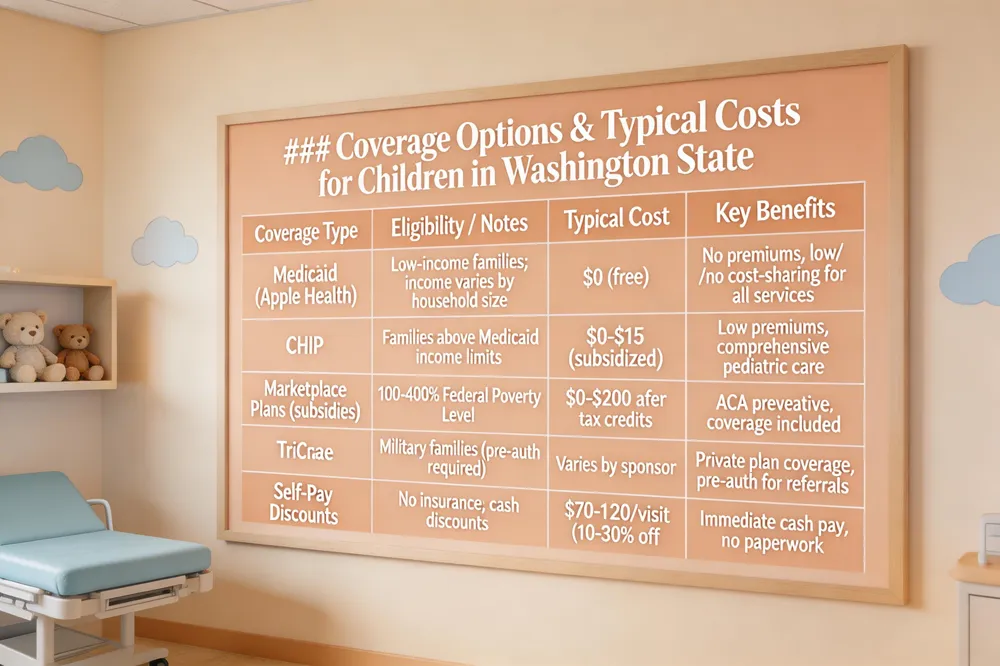 What is the cheapest insurance for kids? The lowest‑cost option is typically Medicaid or CHIP, which is free or very low‑cost coverage for eligible families. If you do not qualify, marketplace plans with subsidies may become inexpensive after tax credits are applied.
Does Seattle Children accept TriCare? Yes. TriCare coverage is accepted, but a pre‑authorization is required before scheduling any specialty appointment.
What if I can’t afford insurance for my child? First, check eligibility for Medicaid or CHIP, which many families qualify for even when they think income is too high. Apply online via the state’s portal or call the enrollment hotline. If ineligible, explore subsidized marketplace plans. Community health centers also offer low‑cost preventive and urgent care regardless of insurance status.
Navigating Well‑Child Visits and Preventive Care
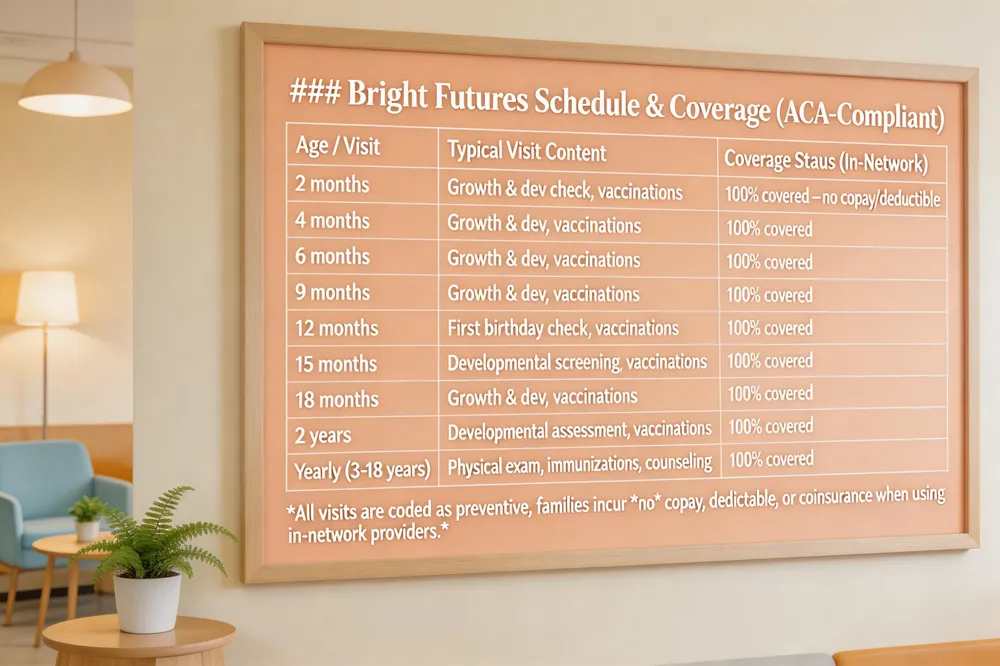
Bright Futures Schedule & Coverage (ACA‑Compliant)
| Age / Visit | Typical Visit Content | Coverage Status (In‑Network) |
|---|---|---|
| 2 months | Growth & development check, vaccinations | 100 % covered – no copay/deductible |
| 4 months | Growth & development, vaccinations | 100 % covered |
| 6 months | Growth & development, vaccinations | 100 % covered |
| 9 months | Growth & development, vaccinations | 100 % covered |
| 12 months | First birthday check, vaccinations | 100 % covered |
| 15 months | Developmental screening, vaccinations | 100 % covered |
| 18 months | Growth & development, vaccinations | 100 % covered |
| 2 years | Developmental assessment, vaccinations | 100 % covered |
| Yearly (3‑18 years) | Physical exam, immunizations, counseling | 100 % covered |
All visits are coded as preventive; families incur no copay, deductible, or coinsurance when using in‑network providers.
 How often are well‑child visits covered by insurance?
Under the Affordable Care Act, private plans, Medicaid, and CHIP must cover the Bright Futures schedule of preventive visits with zero cost‑share. Recommended visits occur at 2, 4, 6, 9, 12, 15, and 18 months, again at 2 years, then yearly through adolescence. Because they are coded as preventive, families incur no copay, deductible, or coinsurance for the visit itself; only vaccines or optional labs may have separate coverage rules.
How often are well‑child visits covered by insurance?
Under the Affordable Care Act, private plans, Medicaid, and CHIP must cover the Bright Futures schedule of preventive visits with zero cost‑share. Recommended visits occur at 2, 4, 6, 9, 12, 15, and 18 months, again at 2 years, then yearly through adolescence. Because they are coded as preventive, families incur no copay, deductible, or coinsurance for the visit itself; only vaccines or optional labs may have separate coverage rules.
Are well‑child visits free with insurance? Yes. All ACA‑compliant plans are required to pay the full fee for the preventive check‑up. The core visit is billed to the insurer at no out‑of‑pocket cost. Some payers still need prior authorization for certain vaccines or screenings, so confirming details before the appointment is advisable. Non‑preventive services performed during the visit (e.g., specialty referrals) may trigger cost‑sharing.
How much does a pediatric visit cost without insurance? In Washington, self‑pay cash prices for a routine visit range from $99 to $139. Clinics often offer a discount—10 % to 30 %—for families who pay the full amount at the time of service, lowering the bill to roughly $70‑$120. The base fee covers the clinician’s evaluation; vaccines, labs, or imaging are billed separately. Federal Way practices such as Federal Way Pediatrics and Country Kids Pediatrics list self‑pay rates for well‑child exams between $145 and $155, with additional discounts for cash pay.
Self‑Pay, Direct Primary Care, and Financial Tools
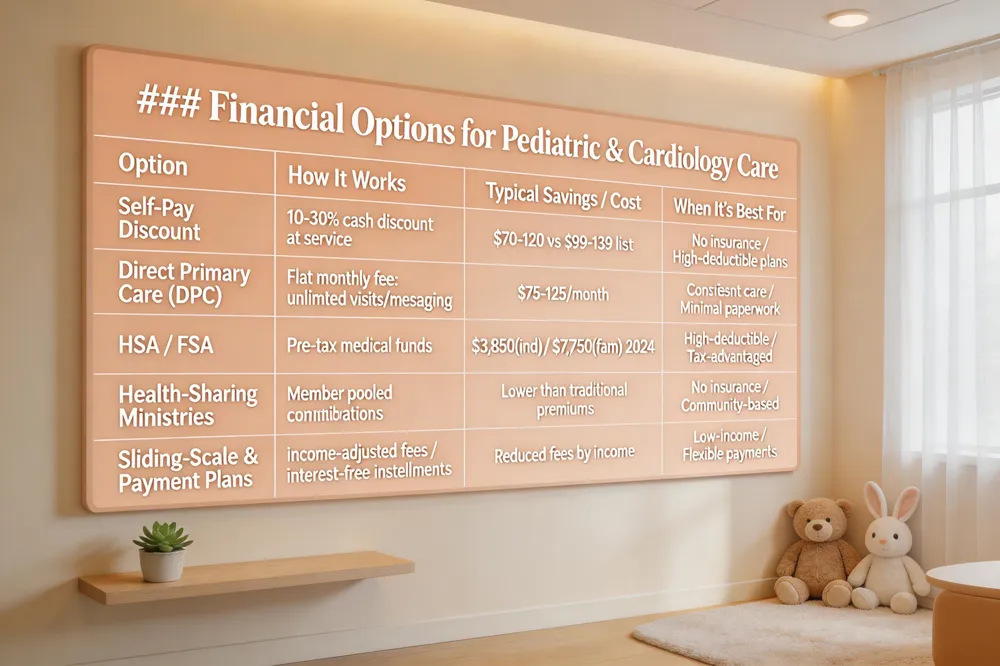
Financial Options for Pediatric & Cardiology Care
| Option | How It Works | Typical Savings / Cost | When It’s Best For |
|---|---|---|---|
| Self‑Pay Discounts | Clinics offer a flat cash‑price discount (10‑30 %) when payment is made at service. | $70‑$120 for a well‑child visit vs. $99‑$139 list | Families without insurance or with high‑deductible plans. |
| Direct Primary Care (DPC) Membership | Flat monthly/annual fee covers unlimited primary‑care visits, messaging, and same‑day appointments. | $75‑$125 per month (predictable budgeting) | Families seeking consistent primary‑care access and minimal paperwork. |
| Health Savings Account (HSA) / Flexible Spending Account (FSA) | Pre‑tax dollars set aside for qualified medical expenses (e.g., labs, meds, specialist visits). | Up to $3,850 (individual) or $7,750 (family) tax‑free per year (2024 limits) | Families with high‑deductible plans or those wanting tax‑advantaged spending. |
| Health‑Sharing Ministries | Member contributions pooled to cover out‑of‑pocket costs; not insurance but can offset expenses. | Varies; often lower than traditional premiums | Families with high‑deductible plans, no insurance, or seeking community‑based cost sharing. |
| Sliding‑Scale & Payment Plans | Clinics adjust fees based on income; offer interest‑free installments. | Reduced fees based on household income | Low‑income families or those needing flexible payment timelines. |
 How self‑pay discounts work at local pediatric clinics
Federal Way pediatric offices—including Federal Way Pediatrics, KidsStreet Urgent Care, and Country Kids Pediatrics—offer cash‑price discounts of 10‑30 % when families pay the full amount at the time of service. A simple self‑pay option means the practice bills the family directly, eliminating insurance paperwork, referrals and prior‑authorizations. New‑patient deposits range from $150‑$200, and many clinics provide detailed cost estimates before an appointment, allowing families to budget for routine well‑child visits, urgent care, or cardiology follow‑ups without surprise bills.
How self‑pay discounts work at local pediatric clinics
Federal Way pediatric offices—including Federal Way Pediatrics, KidsStreet Urgent Care, and Country Kids Pediatrics—offer cash‑price discounts of 10‑30 % when families pay the full amount at the time of service. A simple self‑pay option means the practice bills the family directly, eliminating insurance paperwork, referrals and prior‑authorizations. New‑patient deposits range from $150‑$200, and many clinics provide detailed cost estimates before an appointment, allowing families to budget for routine well‑child visits, urgent care, or cardiology follow‑ups without surprise bills.
Radiance Pediatrics Direct Primary Care model and membership fees Radiance Pediatrics operates as a Direct Primary Care (DPC) practice. Families enroll by completing a Meet & Greet call, then choose a monthly or yearly membership fee—typically a flat rate that covers all primary‑care services, same‑day or next‑day appointments, and secure messaging via Spruce. The DPC model does not bill insurance for regular visits; insurance may still be used for vaccines or specialist referrals. Membership fees provide predictable budgeting and unlimited access to the pediatrician, reducing reliance on emergency or urgent‑care centers.
Using HSAs, FSAs, and health‑sharing ministries to offset costs Health Savings Accounts (HSAs) and Flexible Spending Accounts (FSAs) allow families to set aside pre‑tax dollars for eligible pediatric expenses, including cardiology consultations, labs, and medication. Health‑sharing ministries—non‑insurance programs that pool member contributions—can also cover out‑of‑pocket costs for families with high‑deductible plans or no insurance. Combining self‑pay discounts, DPC membership, and tax‑advantaged accounts can significantly lower the financial burden of pediatric and cardiology care.
What is a self‑pay option? A self‑pay option means you pay the pediatric practice directly for the visit or treatment instead of filing a claim through health insurance. The office typically offers a discounted, upfront price for self‑pay patients, and payment is usually required at the time of service or in advance. This approach eliminates the need for referrals, authorizations, or network restrictions, giving families the freedom to choose the provider and schedule that best fit their needs. It also provides transparent billing with no hidden costs and often faster access to care because there is no waiting for insurance approvals. For families with high‑deductible plans or no insurance at all, self‑pay can be a cost‑effective way to receive comprehensive pediatric and cardiology services.
How to explain insurance to a 7‑year‑old? Think of insurance like a safety net that catches you when something unexpected happens, just as a trampoline helps you land softly if you fall. When a storm comes and you get wet, an umbrella keeps you dry; insurance works the same way for things like a sudden illness or a broken toy, paying part of the cost so you don’t get soaked with big bills. You can picture it as a strong brick house that protects you from the “big bad wolf” of surprise expenses. Every month you pay a little “ticket” called a premium, and if a problem shows up, the insurance company shares the cost, much like friends sharing a big pizza so no one has to eat it alone. This way, you and your family can stay safe and focus on feeling better instead of worrying about money.
What is the difference between a pediatric cardiologist and an adult cardiologist? A pediatric cardiologist is a physician who specializes in diagnosing and treating heart conditions that affect infants, children, and adolescents, especially congenital heart defects, rhythm disorders, and other problems related to growth and development. An adult cardiologist focuses on acquired heart disease that typically emerges later in life, such as coronary artery disease, hypertension‑related issues, and age‑related valve problems. The two specialties differ in patient demographics, the underlying causes of disease, and the therapeutic approaches needed for a body that is still maturing versus one that is fully grown. Pediatric cardiologists undergo additional fellowship training that emphasizes fetal and childhood cardiac anatomy, imaging, and interventions tailored to smaller patients. In contrast, adult cardiologists complete training centered on adult physiology, risk‑factor management, and procedures common in the adult population.
Specialty Care: Pediatric Cardiology and Coverage
Pediatric cardiology visits are covered when the child’s health plan includes the specialty as an essential health benefit—required by the ACA and Washington state law. Most private insurers, Medicaid (Apple Health) and CHIP list pediatric cardiology in‑network, so a routine consult, echocardiogram, or cardiac MRI is reimbursed at no cost‑share for well‑child visits and preventive services. For non‑preventive care, families should verify any required copay, deductible, or coinsurance amounts before the appointment.
Network and referral rules vary by plan. HMO and EPO plans typically demand a referral from the primary‑care pediatrician, while PPO and POS plans may allow direct self but still benefit from in‑network pricing. Families should confirm that the cardiology practice—such as those affiliated with Federal Way Pediatrics or Seattle Children’s Hospital—appears in the insurer’s provider directory and that any prior‑authorizations are secured for advanced testing or procedures.
Financial assistance is widely available. Many Federal Way cardiology offices offer sliding‑scale fees, interest‑free payment plans, and 10‑30 % cash‑pay discounts for self‑pay families. Health Savings Accounts (HSAs) and Flexible Spending Accounts (FSAs) can be used tax‑free for co‑pays and medication costs. For low‑income households, Medicaid and the Washington Children’s Health Insurance Program (CHIP) provide comprehensive coverage with little or no out‑of‑pocket expense.
Can I cover my stepchildren on health insurance? Yes—stepchildren can be added as dependents if they are under 26, live with you, and you provide at least half of their support. Most employer‑sponsored and Marketplace plans treat them like biological children, allowing enrollment during Open Enrollment or after a qualifying life event.
Is pancreatitis covered in health insurance? Yes, most plans cover pancreatitis treatment, though pre‑existing condition waiting periods (12‑36 months) may apply. Some carriers offer add‑ons to shorten or eliminate the wait. Once satisfied, hospital stays, imaging, medications, and surgery are reimbursed.
What is the difference between a pediatric cardiologist and an adult cardiologist? A pediatric cardiologist treats heart conditions in infants, children, and adolescents—especially congenital defects and growth‑related rhythm disorders—requiring specialized training in fetal and childhood cardiac anatomy. An adult cardiologist focuses on acquired heart disease in fully grown patients, such as coronary artery disease and hypertension‑related issues.
Putting It All Together for Your Child’s Health
Securing affordable, high‑quality pediatric care in Federal Way starts with matching the right payment approach to your family’s needs. Use Medicaid or Washington’s Apple Health for children who earn up to 138 % of the federal poverty level; CHIP (Apple Health for Kids) covers families slightly above that threshold with no premium and minimal copays. If you qualify for a marketplace plan, compare metal‑tier premiums, deductibles, and out‑of‑pocket maximums, and verify that your pediatrician and any cardiology specialists are listed as in‑network. For families without coverage, self‑pay options such as flat‑fee Direct Primary Care (Radiance Pediatrics), discounted cash rates (KidsStreet Urgent Care, Country Kids Pediatrics), or bundled payment plans can reduce out‑of‑pocket costs. Key resources include the Washington Healthplanfinder portal for plan comparison, the Washington State Medicaid/CHIP enrollment site, and local clinics like Federal Way Pediatrics, Franciscan Medical Clinic, and Radiance Pediatrics. Next steps: 1) Check eligibility and enroll via the Medicaid/CHIP portal or Healthplanfinder; 2) Contact your chosen clinic to confirm network status and request a cost estimate for routine visits and any cardiology referrals; 3) Set up an HSA/FSA or a direct‑primary‑care membership to lock in predictable fees; and 4) Schedule a telehealth or in‑person well‑child visit to establish a medical home for your child’s ongoing health.