Understanding Behavioral Therapy for ADHD
Behavioral therapy for children with ADHD is a structured, skill‑building approach that does not alter neurobiological deficits but teaches practical strategies to manage inattention, hyperactivity and impulsivity. Its primary goals are to set clear, achievable behavior targets; provide consistent positive reinforcement for desired actions; and apply predictable consequences for inappropriate behavior, thereby shaping lasting coping skills. A robust body of research—including CDC, AAP, and Child Mind Institute studies—shows that parent‑training programs (e.g., PCIT, Triple P), classroom report cards, and executive‑function coaching improve functional outcomes such as school performance, peer relationships, and family stress, even though they do not directly change core symptom severity. In a multimodal treatment plan, behavioral therapy is the first‑line option for preschool‑aged children and a critical component for school‑aged children and adolescents, often combined with stimulant medication to maximize symptom control while fostering enduring self‑management skills.
Local Behavioral Therapy Services
 Federal Way Pediatrics is located at 32124 1st Ave S #100, Federal Way, WA 98003. Call (253) 661‑5939 or visit federalwaypediatrics.com to schedule appointments; most insurance plans are accepted and flexible hours are offered to fit school and family schedules.
Our clinic provides both individual and group behavioral therapy for children with ADHD. Sessions focus on skill‑building—such as planning, time‑blocking, and use of checklists—while integrating classroom strategies like Daily Report Cards. Licensed pediatric behavioral specialists work closely with families to monitor progress and adjust plans as needed.
Parent‑training programs (e.g., PCIT, Triple P, Parent Management Training) are offered in‑person and via telehealth. Workshops teach positive reinforcement, consistent routines, clear expectations, and calm discipline, empowering caregivers to manage ADHD‑related challenges at home and school.
Research consistently shows that evidence‑based behavioral interventions improve functional outcomes—better classroom conduct, academic task completion, and peer interactions—especially for children with oppositional or defiant behaviors. When combined with medication, these therapies yield the greatest overall improvement, but they also provide lasting skills that persist after medication is stopped.
Behavioral therapy for ADHD near me – Federal Way Pediatrics delivers tailored behavioral therapy integrating parent training, school coordination, and executive‑function coaching.
Behavioral parent training ADHD near me – Interactive workshops teach consistent reinforcement and structured routines; enrollment is available by calling (206) 395‑6049 or through MyChart.
Therapy for ADHD child near me – Comprehensive behavioral, occupational, and speech‑language services are provided on‑site.
ADHD behavioral therapy for kids – Our program combines individualized skill‑building, parent workshops, and school consultation to boost attention, impulse control, and social success.
Does behavioral therapy help kids with ADHD? – Yes. It improves behavior, self‑control, and self‑esteem; the AAP recommends parent‑training as first‑line for children under 6, and combined therapy‑medication approaches for older children.
Evidence‑Based Resources and Downloadable Guides
 Our clinic offers a suite of free, evidence‑based PDFs to empower families and educators in supporting children with ADHD.
Evidence‑Based Interventions for ADHD PDF – This guide outlines the most effective strategies, including parent‑training programs (e.g., PCIT, Triple P) that teach positive reinforcement, structured routines, and consistent consequences, as well as classroom behavior plans such as Daily Report Cards and executive‑function tools (checklists, planners).
Play‑Therapy Techniques for ADHD PDF – Although play therapy alone does not change core symptoms, the PDF provides structured games and movement‑based activities that reinforce turn‑taking, impulse control, and self‑regulation, with simple behavior‑chart tracking.
ADHD Therapy Activities PDF – A collection of hands‑on activities for ages 5‑12, featuring mindfulness exercises, organization games, visual‑schedule templates, and printable worksheets to build attention and executive‑function skills.
Behavioral Therapy for ADHD Child PDF – Step‑by‑step instructions for creating age‑appropriate reward charts, setting clear expectations, and monitoring progress across home and school settings.
What is the 1/3/5 rule for ADHD? – Choose one “big” task, three medium tasks, and five small tasks each day to prioritize and reduce overwhelm.
What therapy is best for an ADHD child? – A multimodal plan that combines behavioral therapy, parent‑training, and medication (when needed) yields the strongest functional outcomes.
What type of therapy is best for kids with ADHD? – Behavioral therapy, supplemented by CBT for comorbid conditions and parent‑training, is the primary evidence‑based approach.
To download any guide, click the appropriate button on our website or email fedwaypediatrics@gmail.com.
Core Behavioral Interventions for Children
 Behavioral interventions for ADHD focus on teaching children to monitor their actions and reinforcing desired behaviors with consistent rewards such as praise, privileges, or token systems. Positive reinforcement and token economies, used in parent‑training programs like Triple P and PCIT, provide immediate, tangible feedback that reduces impulsive and disruptive actions. In schools, Daily Report Cards set individualized behavior goals, give daily feedback, and reward achievement, improving classroom conduct and academic task completion. Executive‑function skill building teaches organization, planning, and time‑management through checklists, planners, and reward charts, helping children stay on task and complete assignments. Structured routines and visual schedules create predictable environments, limit distractions, and break tasks into manageable steps, supporting self‑control. Self‑monitoring and goal‑setting encourage children to track progress, set specific, achievable objectives, and celebrate successes, fostering lasting motivation. At home, families benefit from clear rules, calm discipline, and regular check‑ins with clinicians to adjust plans. The “10‑3 rule”—10 minutes of focused work followed by 3 minutes of movement—helps sustain attention, while the Four F’s (Forgetfulness, Fidgeting, Frustration, Failure to Finish) remind caregivers of common ADHD challenges.
Parent‑Training Programs and Skill Development
 Behavioral therapy for children with ADHD equips families with practical tools that persist beyond medication. Parent‑Child Interaction Therapy (PCIT) uses live coaching to teach parents how to increase positive exchanges, set clear "when‑then" expectations, and reduce coercive cycles. The Positive Parenting Program (Triple P) offers tiered group workshops that focus on consistent praise, structured routines, and calm discipline, while Parent Management Training (PMT) emphasizes contingency‑based reinforcement and clear communication. Effective ADHD parenting follows the 5 C’s: Consistency in rules and rewards, Self‑Control as a modeling strategy, Compassion to separate behavior from identity, Collaboration to co‑create solutions, and Celebration of small successes to build confidence. When core symptoms require additional support, Cognitive‑Behavioral Therapy (CBT) teaches children to break tasks into manageable steps, use visual reminders, and practice self‑monitoring; parents and teachers are coached to reinforce these skills across settings. Together, these evidence‑based programs improve self‑control, academic performance, and family relationships, providing a lasting foundation for children to thrive.
School‑Based and Executive‑Function Supports
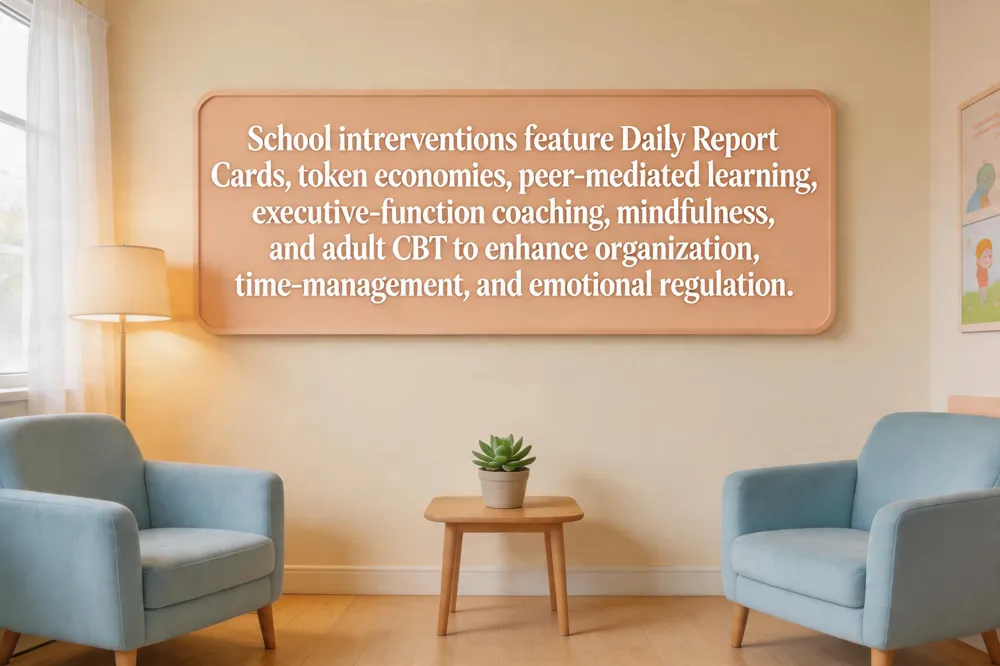 Effective school‑based interventions start with Daily Report Card that give teachers a clear way to set individualized behavior goals, provide immediate feedback, and reward children for meeting targets. Complementary classroom token economies reinforce on‑task behavior by assigning points or tokens that can be exchanged for preferred activities, helping children see a tangible link between effort and reward.
Executive‑function coaching teaches students how to break assignments into manageable steps, use checklists, planners, and visual timers, and develop time‑management routines that transfer to home and community settings. Peer‑mediated interventions, such as cooperative learning groups and peer‑tutoring, provide structured social interaction that builds communication skills and reduces feelings of isolation.
Adults with ADHD benefit from structured cognitive‑behavioral therapy that teaches practical coping skills, such as breaking tasks into manageable steps and challenging negative thought patterns. Skill‑building workshops and group programs provide opportunities to practice time‑management, organization, and prioritization techniques in a supportive setting. Coaching—whether in‑person or virtual—offers personalized accountability, goal‑setting, and real‑time problem solving for daily challenges. Mindfulness‑based interventions and stress‑reduction strategies help improve emotional regulation and reduce impulsivity. Combining these behavioral approaches with medication, when appropriate, yields the most consistent improvements in work performance, relationships, and overall quality of life.
Behavioral interventions for ADHD adults
Adults with ADHD benefit from structured cognitive‑behavioral therapy that teaches practical coping skills, such as breaking tasks into manageable steps and challenging negative thought patterns. Skill‑building workshops and group programs provide opportunities to practice time‑management, organization, and prioritization techniques in a supportive setting. Coaching—whether in‑person or virtual—offers personalized accountability, goal‑setting, and real‑time problem solving for daily challenges. Mindfulness‑based interventions and stress‑reduction strategies help improve emotional regulation and reduce impulsivity. Combining these behavioral approaches with medication, when appropriate, yields the most consistent improvements in work performance, relationships, and overall quality of life.
ADHD behavior therapy for teens
Teen‑focused ADHD behavior therapy combines executive‑function coaching, cognitive‑behavioral therapy techniques, and peer‑group skills training to help adolescents develop organization, self‑regulation, and social skills. The program often includes structured family sessions that teach parents how to reinforce positive routines and reduce conflict at home. Our clinic offers both in‑person and telehealth appointments, allowing teens to receive consistent support even when schedules are busy. Services are coordinated with a pediatrician to monitor any medication needs and ensure a comprehensive approach to care. Regular progress reviews help adjust strategies, keeping therapy aligned with each teen’s evolving goals and challenges.
Practical Daily Planning and Lifestyle Strategies
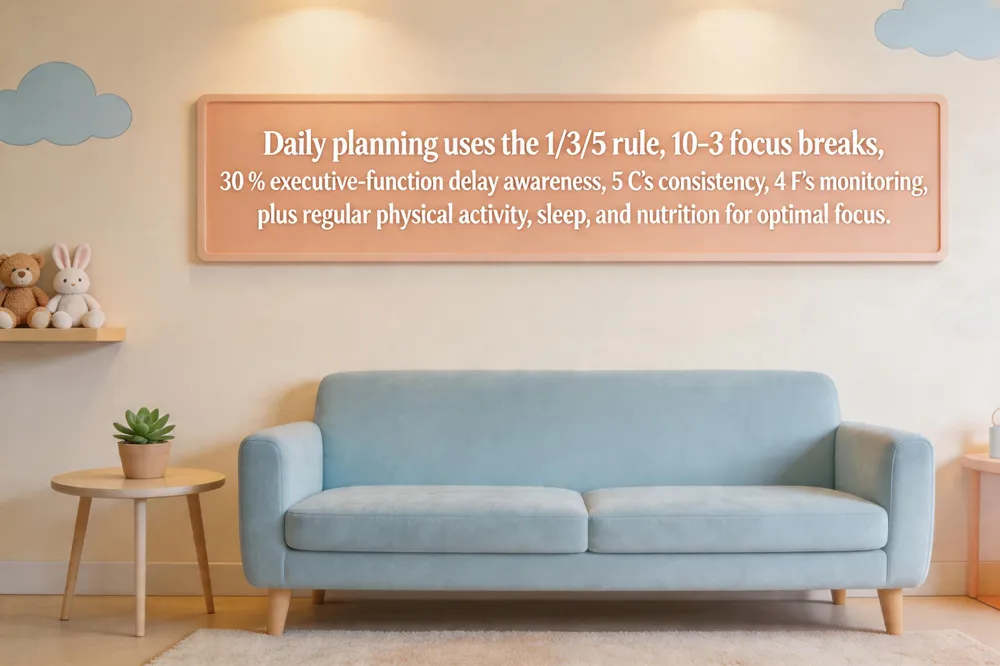 Effective daily planning for children with ADHD blends simple structures with healthy lifestyle habits. The 1/3/5 rule limits a day’s to one major task, three medium‑sized tasks, and five quick‑completion tasks, turning vague to into concrete steps (e.g., “call the pediatric cardiology office”). The 10‑3 rule pairs a ten‑minute focus period with a three‑minute movement break—jumping jacks, stretching, or a short walk—to re‑energize the brain and sustain attention. Research notes the 30 % rule, meaning children with ADHD develop executive‑function skills roughly 30 % more slowly than peers; therefore, extra scaffolding such as visual schedules, checklists, and frequent coaching is essential. Parenting guided be guided by the 5 C’s: Consistency, Self‑Control, Compassion, Collaboration, and Celebration—each reinforcing predictable routines and positive self‑esteem. Recognizing the 4 F’s—Forgetfulness, Fidgeting, Frustration, and Failure to Finish—helps families anticipate challenges and intervene early. Finally, regular physical activity, adequate sleep, and balanced nutrition (protein‑rich meals, complex carbs, omega‑3s) provide the neurochemical foundation for improved focus and mood. Together, these strategies create a compassionate, evidence‑based framework that supports children’s success at home, school, and in health‑care settings.
Putting It All Together for Your Child’s Success
Behavioral therapy for ADHD offers several evidence‑based options that complement medication or can stand alone. Parent‑training programs such as Parent‑Child Interaction Therapy, Parent Management Training, and Triple P teach caregivers consistent praise, clear expectations, and predictable consequences. In school, Daily Report Cards and token‑economy systems set individualized goals, give daily feedback, and reward on‑task behavior. Executive‑function coaching adds checklists, planners, and time‑blocking to improve organization and task completion. Early, age‑appropriate intervention—ideally before age 6 for preschoolers and continuously through school years—prevents secondary problems, reduces parental stress, and builds lasting self‑management skills. To begin at Federal Way Pediatrics, schedule a comprehensive evaluation with your pediatrician. The team will screen for ADHD, discuss behavioral‑therapy referrals, and connect you with certified parent‑training providers and school‑based specialists. Ongoing monitoring, collaborative care plans, and regular follow‑up ensure the strategies remain effective as your child grows.