Why Understanding Overlap Matters
Approximately 10 % of U.S. children—especially those with special health care needs—are dual‑enrolled in private insurance and Medicaid or CHIP, according to CMS and PolicyLab. Coordinating benefits lets the private plan pay first while Medicaid (or CHIP) covers remaining eligible costs, reducing out‑of‑pocket expenses, filling gaps for services such as home nursing, transportation, and adaptive equipment, and ensuring continuity of care for complex conditions like pediatric cardiology. However, claim denials can arise if families fail to update private‑insurance information with Medicaid, neglect to provide the Coordination ofof‑Benefits (COB) form, or attempt to bill services that are already covered. To avoid denials, keep insurance cards current, submit claims to the primary payer first, verify network participation, and work with the practice’s billing staff to confirm that Medicaid is listed as secondary when appropriate.
Choosing the Right Insurance for Your Child
Quick Comparison of Child Health Coverage Options
| Plan | Income Eligibility | Monthly Premium* | Cost‑Sharing (Deductible / Copay) | Primary Benefits | Typical Network |
|---|---|---|---|---|---|
| Medicaid | ≤ 138 % FPL | $0 (free) | Minimal or none | Well‑child visits, immunizations, EPSDT screenings, pediatric specialty care | State‑run provider network (often broad) |
| CHIP | 138‑300 % FPL (varies by state) | Low (often $0‑$10) | Low copays, modest deductibles | Same core services as Medicaid, plus some extra benefits | State‑run or managed‑care network |
| Private Marketplace | Any income (premium tax credits if ≤ 400 % FPL) | Varies (average $150‑$300) | Deductibles & copays per plan | Broad coverage, optional add‑ons (dental, vision) | Private insurer’s provider network (may be larger or smaller) |
*Premiums shown are typical estimates; actual amounts depend on plan, location, and subsidies.
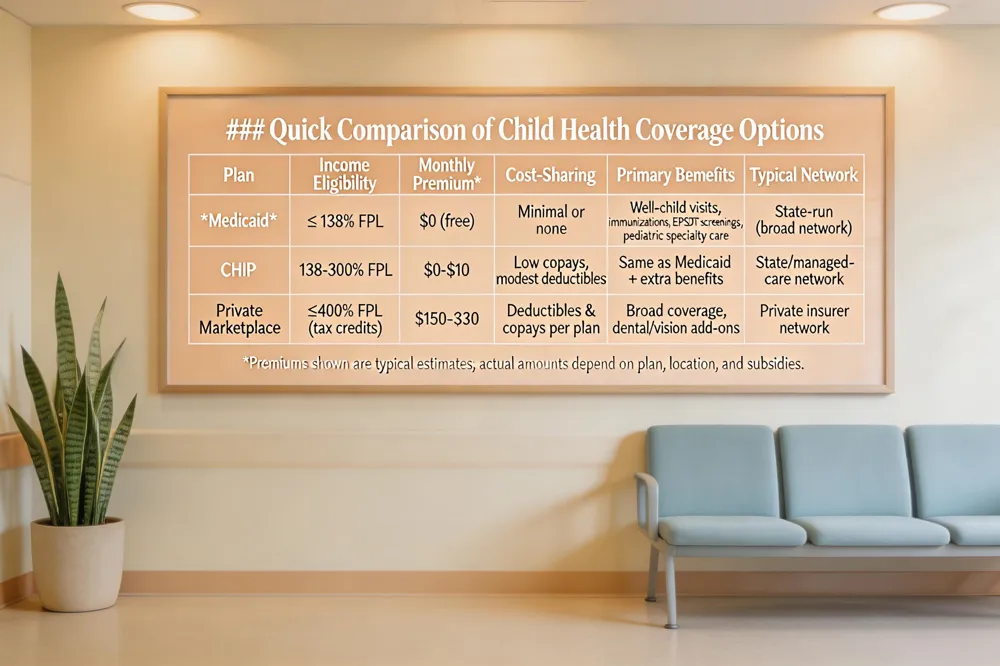 When deciding which health plan best meets a child’s needs, parents should compare Medicaid, CHIP, and private marketplace options. Medicaid, free or low‑cost, is available to families whose income is at or below 138 % of the Federal Poverty Level (FPL) and includes comprehensive benefits such as well‑child visits, immunizations, EPSDT‑required screenings, and pediatric specialty care. CHIP fills the gap for families earning above Medicaid limits—typically up to 200‑300 % of the FPL—offering low premiums and minimal copayments while covering the same essential services. Private plans purchased through the Health Insurance Marketplace may provide a broader provider network and quicker specialist appointments, but they require monthly premiums, deductibles, and cost‑sharing. Eligibility hinges on household income, family size, and state‑specific thresholds, so families should verify limits in Washington State (Apple Health for Medicaid, Apple Health for Kids for CHIP). Provider networks matter: a plan that includes your child’s pediatric cardiology clinic can reduce out‑of‑pocket costs and wait times.
Which health insurance is best for children? For most families, the optimal choice depends on income and coverage needs: Medicaid (≤ 138 % FPL) offers the most affordable, comprehensive coverage; CHIP serves families slightly above that range; and private marketplace plans may be preferred when a larger specialist network is essential.
Best children health insurance options Government programs—Medicaid and CHIP—provide the lowest cost and guarantee core pediatric services. If employer coverage is available, it often adds flexibility, while Marketplace “child‑only” plans can be subsidized based on income. Compare total cost, network reach, and benefit scope to select the plan that best supports your child’s health and developmental needs.
Transitioning from Medicaid to Private Coverage
Steps to Move from Medicaid/CHIP to a Marketplace Plan
| Step | Action | Key Details | Deadline |
|---|---|---|---|
| 1 | Create a Marketplace account | Use HealthCare.gov or your state exchange before Medicaid ends | As soon as you receive notice of termination |
| 2 | Enter household info | Income, size, citizenship; system calculates eligibility for premium tax credits & cost‑sharing reductions | By the end of the Special Enrollment Period (SEP) |
| 3 | Compare plans | Look at premiums, deductibles, copays, and whether your child’s specialists are in‑network | Within the SEP (typically 60‑90 days after loss of coverage) |
| 4 | Submit application & documents | Proof of income, SSN, citizenship/residency | Before the SEP closes |
| 5 | Enroll & receive card | Coverage starts first day of the month after enrollment; you’ll get an insurance card | Immediately after approval; avoid gaps in coverage |
Note: The SEP usually lasts 60 days (up to 90 days in many states) after Medicaid/CHIP ends.
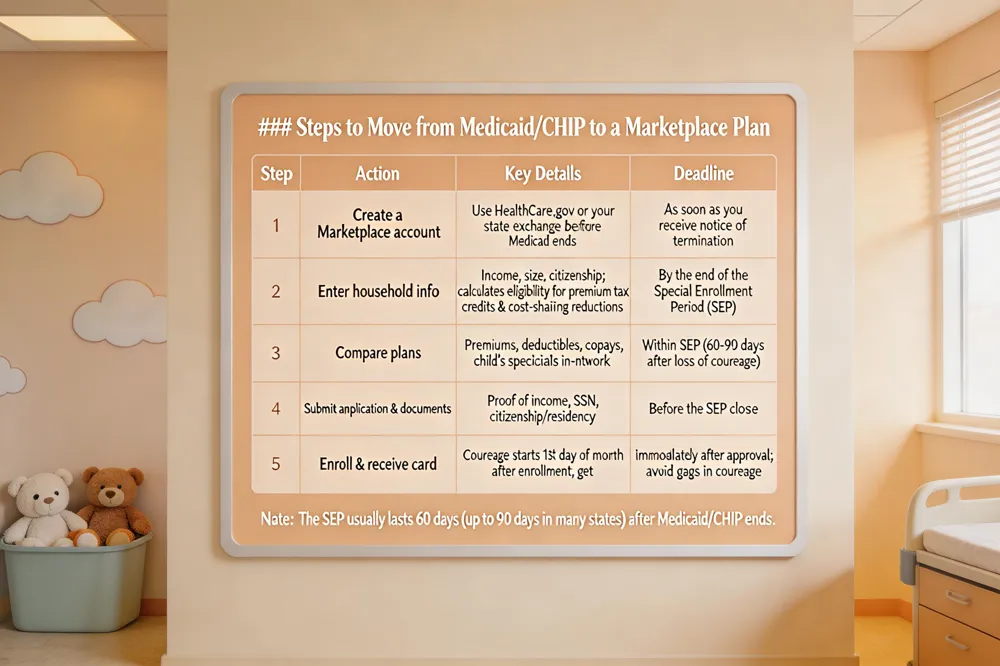 When a child’s Medicaid or CHIP benefits end, families automatically enter a special enrollment period (SEP) in the Health Insurance Marketplace. This window—typically 60 days (up to 90 days in many states) after loss of coverage—allows you to apply for a private plan without waiting for the annual open‑enrollment cycle.
How to transition: 1. Create a Marketplace account at HealthCare.gov or your state’s exchange before your Medicaid ends. 2. Enter household income, size, and citizenship information; the system will tell you if you qualify for premium tax credits or cost‑sharing reductions. 3. Compare plans, focusing on premiums, deductibles, copays, and whether your child’s pediatric cardiology specialists are in‑network. 4. Submit the application with required documents (proof of income, SSN, citizenship). 5. Once approved, the new policy starts on the first day of the month after enrollment, and you’ll receive an insurance card.
How to get health insurance for your child: First, check eligibility for Medicaid or CHIP via your state’s portal. If ineligible, use the Marketplace during SEP or open enrollment, or add the child to an employer‑sponsored plan. Gather proof of income, SSN, and residency before applying to avoid gaps and ensure continuous coverage for essential pediatric and cardiology services.
Medicaid as Secondary Payer and Coordination of Benefits
Coordination of Benefits (COB) Overview
| Role | Payer | What It Covers | How It Works |
|---|---|---|---|
| Primary | Private Marketplace or employer‑sponsored plan | Pays its allowed amount first; patient pays any remaining deductible/copoly | Provider submits claim to primary insurer; insurer processes according to plan terms |
| Secondary | Medicaid (or CHIP) | Covers remaining eligible costs (e.g., prescription drugs, durable medical equipment, uncovered specialist visits) | After primary payment, claim is sent to Medicaid; Medicaid reimburses the balance up to its limits |
| COB Process | Both insurers | Reduces out‑of‑pocket expenses and expands overall coverage | Must notify both payers of dual coverage; they follow federal COB rules (birthday rule, etc.) |
*Eligibility for Medicaid secondary continues as long as the child meets state income, residency, citizenship, and age criteria (usually up to 19‑21 years).
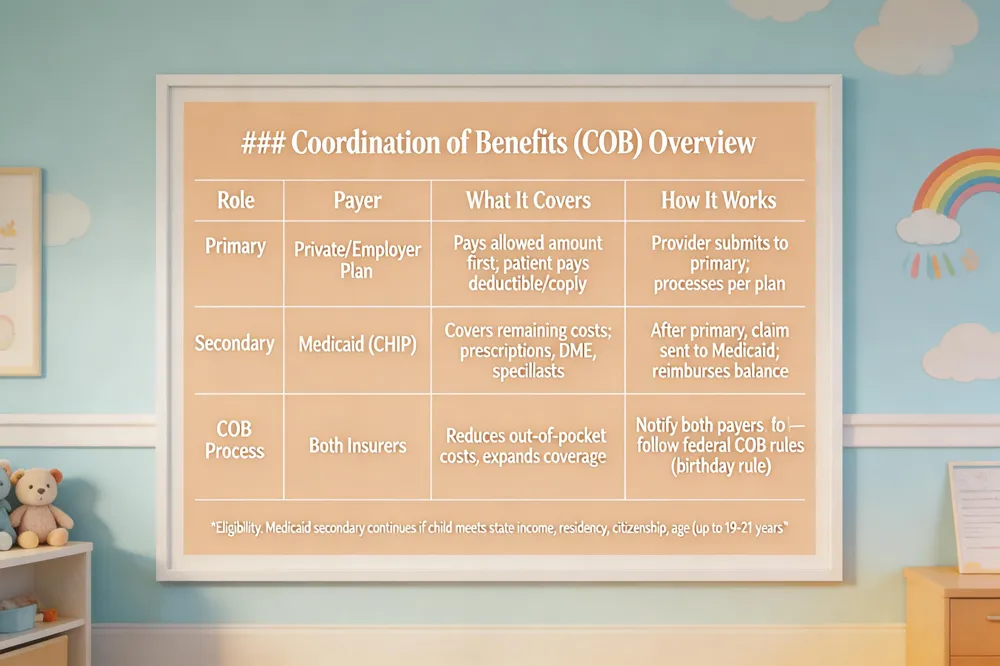 In a dual‑coverage situation the private health plan is the primary payer and Medicaid (or CHIP) acts as the secondary payer. The provider first submits the claim to the private insurer, which pays its allowed amount, anyibles, copayments, or services it does not cover. The remaining eligible costs are then billed to Medicaid, which fills the gaps—often covering prescription drugs, durable medical equipment, home‑based therapies, or specialist visits that the private plan excludes. This coordination of benefits (COB) process is required by federal law and helps keep families’ out‑of‑pocket expenses low while ensuring the child receives comprehensive care.
Private insurance and Medicaid secondary – When a child has both cover, the private insurer pays first; Medicaid reimburses the balance, reducing deductibles, copays, and uncovered services.
Can a child be on two health insurance policies? – Yes. One plan is designated primary (often determined by the “birthday rule” for parental policies) and the other secondary. Both insurers must be notified to apply COB correctly, which can lower overall costs and expand coverage.
How long can my child stay on Medicaid if I have insurance? – As long as the child meets Medicaid eligibility (income, residency, citizenship, and age—usually up to 19 or 21), enrollment can continue alongside private coverage. Annual renewal is required, but there is no fixed time limit unless eligibility changes.
Special Cases: Disability, Chronic Illness, and Specific Services
Medicaid Coverage for Special Health Needs
| Condition / Service | Medicaid Coverage? | Key Notes |
|---|---|---|
| Lupus (chronic illness) | Yes | Covers rheumatology visits, labs, imaging, hospital stays, and prescription drugs when income/disability criteria are met |
| Disabled child – higher income limit | Yes (Washington’s Family Opportunity Act) | Income up to ~300 % FPL; no asset test; eligibility for children with disabilities regardless of income |
| Free/low‑cost insurance for kids | Yes (Washington Apple Health & Apple Health for Kids) | Covers doctor and specialist visits, vaccinations, emergency care, mental health, prescriptions, dental with little or no copay for children ≤ 19 years |
| Gallbladder stone (cholecystectomy) | Generally covered | Hospital stay, surgeon, anesthesia, diagnostics, follow‑up are covered; may require pre‑authorization and subject to deductibles/copays |
*Coverage details can vary by state; always verify with your specific Medicaid plan.
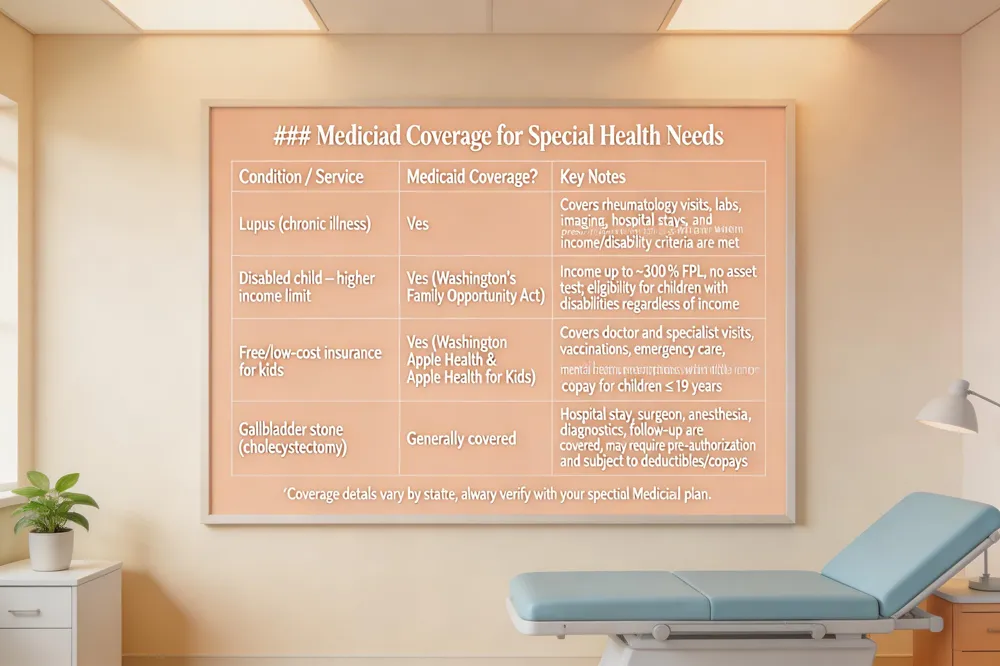 Parents of children with special health needs often wonder how Medicaid and related programs can help.
Is lupus covered by Medicaid? Yes. Medicaid pays for medically necessary lupus care—including rheumatology visits, labs, imaging, hospital stays, and prescription drugs—when the child meets state income and disability criteria. In many states children can also qualify through CHIP, and dual‑eligible children may receive supplemental Medicare coverage.
Medicaid for disabled child income limits Washington follows the Family Opportunity Act, a buy‑in option that lets families with a disabled child enroll even if income exceeds standard limits—up to about 300 % of the Federal Poverty Level. No asset test applies, so a child with a disability can be covered while the household earns roughly three times the FPL.
Free health insurance for kids Washington’s Medicaid (Apple Health) and CHIP (Apple Health for Kids) offer free or low‑cost coverage for children up to age 19. Benefits include doctor and specialist visits, vaccinations, emergency care, mental‑health services, prescriptions, and dental care with little or no copay. Families can apply online at wa.gov, call the Medicaid office, or visit a local enrollment center.
Is a gallbladder stone covered in health insurance? Most plans consider cholecystectomy medically necessary. Coverage typically includes the hospital stay, surgeon’s fees, anesthesia, diagnostic tests, and follow‑up care, subject to deductibles, copays, and network requirements. Pre‑authorization may be needed, and policy details should be verified with the insurer.
State‑Specific Resources and How to Verify Coverage
Florida Medicaid Verification & Support Resources
| Resource | How to Access | What It Provides |
|---|---|---|
| MyACCESS portal | Online at MyFlorida.com/AccessFlorida (login with username/password) | View enrollment status, eligibility dates, required documents, and send uploads |
| Phone status check | Call 1‑866‑762‑2237 (24‑hour) or automated line 1‑888‑356‑3281 | Quick verification of Medicaid status and eligibility |
| Documentation checklist | Required: ID (driver’s license/state ID/passport), SSNs, citizenship/immigration proof, recent income verification, Florida residency proof (utility bill/lease) | Needed for new applications or renewals |
| Help & navigation | State Medicaid office staff, Certified Medicaid Planners, local Marketplace navigators, non‑profits (e.g., HealthWell Foundation), pediatric clinic social‑workers | Free assistance with eligibility, enrollment, and care coordination |
| Eligibility basics for children | Must be U.S. citizen/qualified immigrant, reside in Florida, under 19 (or up to 21 in some states) | Medicaid ≤ 138 % FPL; CHIP up to ~400 % FPL; applications accepted year‑round online, by phone, mail, or in‑person |
Tip: Keep a copy of all submitted documents and note the reference number from MyACCESS for future follow‑up.
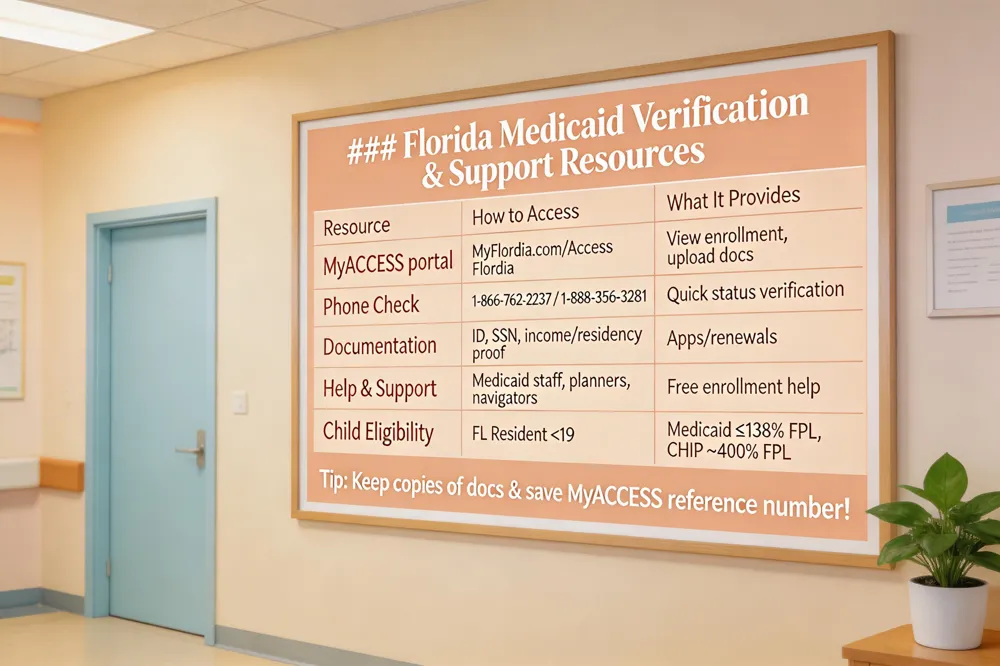 How do I check my Medicaid status in Florida?
Log in to the MyACCESS portal (MyFlorida.com/AccessFlorida) with your username and password to view enrollment status, eligibility dates, and required documents. If you lack an account, you can create one online or call the 24‑hour Medicaid Customer Service line at 1‑866‑762‑2237 for a status update. A quick automated check is also available by dialing 1‑888‑356‑3281. For personalized help, visit a local Department of Children and Families office or use the online “Contact Us” form.
How do I check my Medicaid status in Florida?
Log in to the MyACCESS portal (MyFlorida.com/AccessFlorida) with your username and password to view enrollment status, eligibility dates, and required documents. If you lack an account, you can create one online or call the 24‑hour Medicaid Customer Service line at 1‑866‑762‑2237 for a status update. A quick automated check is also available by dialing 1‑888‑356‑3281. For personalized help, visit a local Department of Children and Families office or use the online “Contact Us” form.
Florida Medicaid website The official site is MyFlorida.com/AccessFlorida, which leads to MyACCESS for applications, status checks, document uploads, eligibility tools, FAQs, and a provider directory. Call the Department of Children & Families at (850) 300‑4323 for assistance and language‑access services.
Documentation required for Medicaid in Florida Provide proof of identity (driver’s license, state ID, or passport), Social Security numbers (or proof of in) for all household members, citizenship or eligible immigration status (birth certificate, green card, etc.), recent income verification (pay stubs, tax return, or employer statement), and Florida residency proof (utility bill, lease, or mortgage statement).
Who can help navigate Medicaid? Washington State Medicaid office staff, Certified Medicaid Planners, local Marketplace navigators, non‑profits like the HealthWell Foundation, and social‑work teams at pediatric clinics can all offer free guidance on eligibility, enrollment, and care coordination.
Children's health insurance program eligibility Children must be U.S. citizens or qualified immigrants, reside in the applying, and be under 19 (or up to 21 in some states). Medicaid eligibility generally requires family income ≤138 % of the Federal Poverty Level; CHIP covers families up to roughly 400 % of FPL. Applications are accepted year‑round online, by phone, mail, or in person, with help available via state hotlines or InsureKidsNow.gov.
Staying Covered and Reducing Out‑of‑Pocket Costs
Parents should check their child’s Medicaid or CHIP eligibility and renewal dates at least once a year—many states send a 45‑day notice, but families can also set personal reminders. Keep every insurance card, the enrollment confirmation, and the provider’s Coordination‑of‑Benefits (COB) forms in a dedicated folder; update the information immediately when a private plan changes its network or premium. When a child has both private coverage and Medicaid (or secondary Medicaid), Medicaid acts as the payer of last resort and can cover services that the private plan does not fully pay for, such as home‑based nursing, adaptive equipment, or specialist visits like pediatric cardiology. Notify both insurers of the overlap, provide the latest documentation, and ask the practice’s billing staff to submit the claim to the private insurer first and then to Medicaid to minimize out‑of‑pocket expenses.